"Ordinary Time" is back...and I like it.
Don't get me wrong, Advent and Christmas were great; but there are some nice things about "Ordinary" time.
First, let me explain what "ordinary" time means: it has to do with things being "ordered" -- hence the proper bishop of a diocese is the "ordinary," the "rulebook" that tells how to do things is called an "ordo," and numbers that indicate order are called "ordinal": first, second, etc. From this comes the idea of "routine," which can be dull; but it is also helpful.
So this is why I've been putting quotes around "ordinary" above: to invite you to consider that it may not mean quite what you think it does. Part of the idea is that it means "counted time": note that we designate each week by a number -- as well as each year: we are counting both from and to certain key events: the birth of Christ* and the coming of the Lord at the end of . . . wait for it . . . time. Hence what is inbetween? "Counted time": ordinary time. (This is why my green vestment has an alpha and an omega on it: in a sense, all time between the actual Nativity and the end is "ordinary time," and Christ is supreme over all.)
I like to point out the color green is useful because it reminds us of growth and life: Ordinary Time is "growing" time; while we await the Lord's return, we grow in grace and holiness, allowing him to transform us to be fit to meet him.
Ordinary time has certain charms to me, as a priest.
One is the mostly continuous readings at daily Mass, and to a lesser extent, Sunday. Last year, I was able to do a series of homilies on the Letter to the Hebrews. Both my parishioners and I learned something about that incredible section of Scripture. Insofar as daily Mass is attended by regulars, it is possible to pick up somewhat where one left off, and thus build on what was discussed previously. Insofar as at daily Mass, both the first reading and the Gospel are continuous, I can shift back and forth, both in my own study and reflection, and in what I share in homilies, if trying to focus simply on one or the other might become tedious.
Another thing I like is there are many options for the choice of prayers for Mass. Sometimes priests will say, to other priests, they get tired of the "same old" thing. Perhaps in decades to come, I will feel that. But as it is, I find more than enough options in how I offer Mass. I can offer Mass for various needs -- yesterday, "for the sick" seemed apt -- and I can offer a votive Mass at various times -- if the Gospel mentions the Apostles, a votive Mass to the Apostles may be called for.
Also, in Ordinary Time, I can use the Fourth Eucharistic Prayer, which I like very much; but because it has a proper preface, it should not be used except in Ordinary Time. There are other Eucharistic prayers that can be used, although there is a good argument to be made that too much variation is unhelpful. Again, I think daily Mass is a more suitable place for such variety, whereas at Sunday Mass, I prefer to stick to three Eucharistic Prayers: the Roman Canon, EP III, and (during Ordinary Time), EP IV.
Finally, I like praying the breviary in Ordinary Time -- it is simpler to do, less flipping around! -- and the practice of the routine is helpful, spiritually.
If you're tuned into what's really going on, there's nothing "blah" about "Ordinary" Time.
* Hence Anno Domini denotes each year since the moment of his birth, alas inexactly calculated -- and therefore, "A.D." properly is always put before the year, not after. If we were saying it in a more modern-English fashion, I guess we'd say this is the 2,006th year of our Lord; but since we don't say that, we should say, in the year of our Lord 2006: A.D. 2006.
Wednesday, January 11, 2006


Monday, January 09, 2006
Gas too high? Thank Uncle Sugar...

As usual, James Glassman has excellent stuff at TechCentralStation, such as this on how our oppressors--er, I mean, our government--makes gas cost too much.
New Laptop works fine...once I tame it (or it tames me!)
My new laptop arrived from Dell today. It took me all of five minutes to get it out of the box and plug everything in; it took me hours of aggravation to get my internet connection up again (a fine fellow at Roadrunner did a good job solving the problem -- Roadrunner support is 24/7, fyi), then to get my wireless router working.
Now, if only it would fetch me a beer!
Now, if only it would fetch me a beer!
Sunday, January 08, 2006
Where have I been?
I haven't posted any comments this week, both because it's been a busy week, but even more, because my laptop, which I keep at home, died. Requiescat in pace.
What treasure will you lay at His feet? (Epiphany Homily)
The feast of Epiphany is about Light;
we recall the star:
and the Wise Men, following it from afar.
Notice the Gospel calls them,
not “kings,” but “Magi.”
These Magi were considered “wise”
because they looked for
the deeper meaning of things.
That’s why they looked at the stars.
“Magi” is where the word “Magic” comes from!
“Say the magic word”—and a door opens,
a rabbit comes out of a hat,
and you make someone do what you want.
In a word: power.
So notice where the star led these Magi,
these powerful Wise Men:
to Bethlehem—no place powerful!;
to an ordinary home—not a glittering palace;
to a child and his mother!
What was the “secret”?
Not some spell, or magic wand,
but that the Creator of all things,
came to earth, as a child needing his mother,
a human being facing
the troubles common to all!
The power of heaven surrendered
to the powerlessness of ordinary human life!
How strange! How surprising!
But what do these wise and powerful Magi do?
They were not impressed
by Herod’s pomp and pride;
but, meeting the Child, it is there
they “opened their gifts,”
and laid their gifts at his feet,
and then, they laid themselves before Him!
How many King Herods there are,
that seem so impressive.
The Herod who pushes us around
at school, or on the job;
the pressure to fit in,
to meet a standard set by others,
rather than Christ.
Maybe the King Herod is us:
reacting with fear or anger
when we don’t get our way.
When we are impressed by the King Herods,
we miss the Light—or, worse,
fearing what others might say,
we don’t respond;
we don’t want to look ridiculous!
That image of the Magi,
prostrating before Jesus—
Reminds me of when I was ordained,
first a deacon, then a priest.
As the bishop led the “Litany of the Saints,”
My classmates and I
prostrated ourselves on the floor.
It was an awesome moment.
This is a powerful image
of what it means to be a priest.
To many, a priest can be a “magus”—
someone people see as a wise man,
with “secret knowledge” and sacramental “power.”
I have no “magic word”—other than Him.
Jesus: He is the “secret”;
it’s not meant to be “secret”—
except that many miss it. They miss Him.
What is a priest?
A priest is a man who does as the Magi did:
he surrenders all worldly power,
he brings whatever the world thinks valuable,
He “opens his treasures,”
and lays them at the feet of Jesus Christ.
Above all, it is his life—his very self—
that he lays at the feet of Jesus Christ.
A man doesn’t simply make some promises,
and take on responsibility for life.
A priest surrenders himself to Christ;
His very self is transformed.
It’s something like
what happens to the bread and wine at Mass.
It is wonderful but also frightening.
We know how a priest can misuse that Gift.
It fills us with sorrow and horror to think of it.
Still—it is an awesome Gift!
But doing this, becoming a priest,
to many seems a very strange,
even foolish, thing to do.
I had more money before I entered the seminary.
I’ll never make as much as I did then.
I worked in politics, as you’ve heard.
I’m proud of the work I did;
but that can be a heady experience:
you try to “make things happen,”
to see people defeated, or elected:
In a word…power!
It’s like the wizard of Oz—
behind the curtain,
pulling levers and pushing buttons;
it’s impressive;
maybe it works, or maybe it doesn’t.
And if we are not careful, at the end of our lives,
we may be wondering the same thing:
were we just pushing buttons and pulling levers,
making a good show—
but what value does it have, in the end?
A priest is a man who says, I want more!
And a priest gets more.
Like the Magi, a priest will travel however far;
he will bring his best gifts,
he will lay them at the Lord’s feet;
and last the priest lays himself down,
on his face: and he waits…
“Here I am, Lord. I am yours!”
Not everyone understands that.
It’s shocking, but true,
that sometimes parents, grandparents,
siblings and friends will discourage
a man from the priesthood.
“You won’t make much money”
“Isn’t that a hard life?”
“You won’t get married!”
“What about grandchildren?”
Sometimes, the discouragement is subtle:
when showing up for sports,
or school activities,
matters more than Mass,
or learning their faith.
You might wonder why
I’m speaking so much about the priesthood.
I hope we all know how much
we need more priests?
Very soon, St. Mary and St. Boniface will—
for the first time—share a pastor.
Yours truly.
I’ve given you full time the past six months.
That will change.
Yes, we have Father Ang, and Father Boeke.
I hope Father Tom will stay in the area.
But Father Boeke and Father Ang are 87!
Father Tom faces critical health problems.
We need more priests!
So here’s the question:
What are you and prepared to do about that?
Are there sacrifices in being a priest?
Yep—as many as you want!
Perhaps too much for some.
But I won’t promote the priesthood
as soft and comfortable:
we don’t need priests who want that!
This is “Vocations Awareness Week”—
but I’m here to tell you that from now on,
every week in Piqua is “Vocations Week.”
If you and I want priests in our parish,
what will you and I do to make that happen?
You’ve seen in the bulletin the prayer
I ask everyone to pray, very simple.
Five words: “Please send us more priests!”
I ask you to add them, at the end,
when you say grace over a meal.
In the vestibule, in the back and on the side,
you’ll find some booklets that look like this.
These booklets are from the
“St. John Vianney Vocation Society.”
Here are prayers you can use;
and it invites you
to commit to daily prayer for vocations,
and to a weekly holy hour.
I asked Craig Peltier
to serve on a Vocation Committee.
He agreed. He said,
“what do you want me to do first?”
First, I said, pray.
Pray that others will step forward.
Now I’m asking: will you step forward?
There are lots of ideas out there;
I need someone to make them happen!
If you want to help, call Craig, or call me.
If you are thinking about being a priest,
or you know someone who is, or should be!
If you have questions: Call me!
Epiphany is about Light—
not an obvious light that everyone saw,
but the Light that Christ
gives to those who seek him:
not in power and worldly glory,
but in hiddenness and humility.
Will you follow that Star?
And when you have seen Him,
what will you lay at his feet?
Sunday, January 01, 2006
Worst angel images
I was going to find a jpeg of angels for the post below, about Christmas carols, but I didn't find any good ones, only Pweshus Moments images that make me reach quickly for the trash can so I can (urp!) -- um, excuse me...
Ok, feeling better now (wiping my chin)...
I thought of a funny webpage I linked last month -- and sure enough, it has a "cavalcade" of bad angel images. Be sure to check out the archives at the bottom of the page . . .
(Bonus: check this out, courtesy of Going Jesus.)
Ok, feeling better now (wiping my chin)...
I thought of a funny webpage I linked last month -- and sure enough, it has a "cavalcade" of bad angel images. Be sure to check out the archives at the bottom of the page . . .
(Bonus: check this out, courtesy of Going Jesus.)
'Best' Christmas Hymns
Now as Christmas settles down, I invite your comments on what you rate as the "best" Christmas hymn, or carol.
By "best," I mean more than just "favorite," although feel free to offer your favorite -- but tell us why: tell us why it's "better."
Here are my "best" Christmas hymns:
Hark, the Herald Angels Sing. It is well written, both for style and for theology. And it is rousing to sing, with lots of exclamation marks.
It moves from Biblical imagery and language to our world and our concerns -- a good "homiletic" method.
It does a good job making both Our Lord's humanity and divinity real: "offspring of the Virgin's womb," "pleased as man with men to dwell"* . . . yet also: "veil'd in flesh the Godhead see: hail th'Incarnate Deity."
(By comparison, Angels we have heard on high, which uses the same Biblical material, is -- in my opinion, weaker in substance, although certainly rousing to sing--but that, mainly, the "Gloria" refrain. I suppose the angels sang "sweetly"--but we know they were disturbing ("and they were struck with great fear," Luke 2:9). The "mountains in reply echo[ing] back their joyous strains" is a nice flourish, from Isaiah, I think.)
Another nominee I'd offer: Of the Father's Love Begotten -- right there, the title (and first line) contains implicit Trinitarian theology, as well as containing both ideas of "begotten"--eternally, before time, as well as in time, via Mary's fiat. This hymn goes on to smash heresies right and left to smithereens, like a joyful child armed with a toy mallet: "begotten, ere the world's began to be, he is Alpha and Omega, he the source, the ending he, of the things that are, that have been, and that future years shall see, evermore and evermore." Take that, Arius! Whack! Whack! Slam!
And that's just the first verse . . .
"When the Virgin, full of grace, [take that, deniers of the Immaculate Conception! Hah!]** by the Spirit blest conceiving, bore the Savior of our race." [Manages to be inclusive without vitiating second-Adam theology.]
"...First revealed his sacred face"--what a nice turn of phrase: does it mean the human face, or the divine? Or both?
Aesthetically, the hymn has the haunting, otherworldly beauty of all chant; and because it is chanted, it is easy to do without any musical accompaniment (and often better without). The tune is relatively simple, and thus easy for most to enter into.
The pity is that Gather has but four verses of this outstanding hymn -- the mostly Protestant "Cyber Hymnal" has nine verses, in both English and Latin! (This hymn, in full, would be very suitable for the offertory on Christmas, as you have both a long collection, then the procession with gifts, then, one hopes, the full treatment of incense.)
Well, I could go on and comment on other fine Christmas carols, but I offer these as two "best."
Please add your own nominees, but please do offer reasons why, if you can.
*Here's my diatribe against PC bowlderization of hymns...changing this to "us" is not only pusillanimous and pandering, it ruins both the poetry and the theology of Wesley's verse. Bleagghhh! Likewise, the following verse is ruined by this stupidity: "born to raise the sons of earth" becomes, "born to raise us from the earth" -- notice the change? It actually shifts from a creation-positive, Catholic idea, to a faintly Gnostic idea! Oh, but we mustn't allow "exclusive" language! Somebody show me the petition signatures asking for these changes, because the original verses were so "offensive"?)
** Of course, the Immaculate Conception was not formally defined in the 4th century, when this hymn originates; and the Latin original doesn't actually use "gratia plena"...comments from a better Latinist welcome...
God at his mother's breast (homily for 'e Theotokos)

As Catholics,
we celebrate Mary in many ways.
Today, the emphasis is on “Mother of God”—
So this is about Mary,
but even more about her Child.
This Feast teaches us Jesus is both God and man.
Not half-and-half; not 60-40 or 80-20!
Jesus is all-God, and all-man, all the time!
He’s really human—so he has a real mother.
Mary guarantees Jesus is truly human.
Maybe you wonder, “who says otherwise?”
The thing is, Jesus being really human
is controversial.
There are those who say
Jesus was only “sort of” human:
He pretended to be human,
to show us how to escape being human.
If you’ve ever heard of “Gnosticism”—
This is part of that movement.
And if you say, who cares about Gnosticism,
The answer is—
it’s still around,
still trying to undermine
the truth of Jesus and why he came.
Gnosticism says being human
is something to escape;
And you do it through hidden knowledge.
You know that popular novel
that caused such a stir:
The DaVinci Code?
That’s what it was about:
Gnosticism!
The blockbuster “secrets” that it “revealed”--
what didn’t come
from the author’s imagination,
came from Gnostic writings.
Remember how we heard
that this novel lifted women up,
in contrast to the mean,
old Catholic Church?
Funny thing is,
Gnosticism can be
pretty hostile to women!
One of the things
Gnosticism said you escape is…
get this—being a woman!
Here’s a quote from one
of these Gnostic writings—
and please note—
this is not Christian, but Gnostic:
“Peter said to them:
‘Let Mary go forth from among us,
for women are not worthy of the life.’
Jesus said: ‘Behold, I shall lead her,
that I may make her male,
in order that she also
may become a living spirit
like you males.
For every woman
who makes herself male
shall enter into the kingdom of heaven.’”
Now, I say again, that was not from our Christian Bible!
That’s Gnosticism.
There have always been movements that said,
Being human is at odds with approaching God.
Our Christian Faith says, balderdash!
Instead,
Christ shows us that union with God
is to become more human—
truly human—not less human!
Compare that Gnostic stuff I just read,
with what we heard today:
“When the fullness of time had come,
God sent his Son, born of a woman…”
God never demeans being human!
God chose to enter
our world the same way we do!
St. Irenaeus put it well:
“the glory of God is man fully alive”!
Now, let’s acknowledge:
Jesus really being human
can be a little shocking.
Think about our images of Jesus:
I don’t know about you,
but images of him
looking malnourished—pale, thin—
don’t have credibility with me.
Jesus had a beard—
he had hair on his chest;
He had muscles—
had to be pretty tough, as a carpenter.
Jesus grew up in a house with Joseph,
who worked hard and made tough choices.
Jesus was—and is!—a real man!
Not this “wimpy, wimpy” Jesus!
Can we picture the Lord laughing,
getting angry, feeling tired or discouraged?
Can we imagine him not knowing something?
What a tough question!
As God, he knew everything;
yet as a newborn baby, in his mother’s arms,
do you think he started
explaining Quantum Physics to her,
in five languages?
The humanity of Jesus is real—
not pretend, not for show.
When Jesus was a teenager,
what was happening in his body,
his feelings?
The same thing as all of us—
Except he was not darkened,
as we are, by sin.
He had the clarity to see
and choose what was right.
And that gives us hope.
If you’re trapped in a dark place
with others in darkness,
you need someone with Light
to come show you the way out.
God became human,
and lit up our humanity
as it is meant to be—
as it can be for each of us.
That’s hope!
I’ve been stressing Jesus
is a real, flesh-and-blood man.
But today we also recall
he’s not merely human, he is God!
Not a “kind of” God, not hybrid:
true God, eternal, from forever and ever.
This, too, is controversial.
Everybody approves of
a “nice,” merely human Jesus.
But if Jesus is not God,
then he is no one’s Savior.
If he is not God,
we should take all this down—
the cross, the images;
we should take away this altar,
the tabernacle—all of it.
Because we’re committing idolatry!
If Jesus is not God,
then God remains distant.
Look at Islam.
Islam says Jesus was a prophet, but that’s all.
In Islam, God is distant.
Do you know what “Islam” means?
It means “submission.”
Yes, we Christians submit to God;
But we also call God our brother!
God came down and put himself
under the authority of a human couple—
who submitted to whom?
This is not a distant God,
But a God who comes so close he shocks us!
God became a tiny embryo in Mary’s womb!
God needed to be fed and clothed!
God knelt and washed the feet of sinners!
When God is distant,
he remains unknown, frightening;
the God of thunderbolts and retribution.
Yes, our God is the God of thunderbolts,
but our awesome God did not stay distant.
God was born of a woman.
God comes as close,
and intimate, as a mother’s womb,
a mother's breast, and a mother’s heart.
Why? Why did God do this?
Our holy father said it well, last week:
God does this
so that we might not be afraid
to love him!
Saturday, December 31, 2005

Friday, December 30, 2005
A non-theological basis for Catholic sexual morality
More on Catholic teaching about matters sexual . . .
Many wonder, where does the Church's teaching on these matters come from? They challenge the Church's credibility on the matter. Sometimes (here comes more silly thinking) the argument comes down to the calendar: "How can the Church make her teachings understood in this contemporary age" (or similar language) -- as if 21st century Man is a radically different creature, sexually, from all that went before! All we can take credit for is finding new ways to do what human beings have always wanted to do: have their cake and eat it, too.
Now, let me propose thinking about the matter this way--just for kicks, let's take out all supernatural references, all theology, all Sacred Scripture, all "churchy" stuff. And just think about this by looking at the matter itself. What can we discover about sex simply by looking at it?
We might ask--is there any purpose or meaning to it? If so, what?
Well, we find that answer quickly enough, don't we? We know what sex does and is "for": it's about reproducing the species; and we discover it is also about bonding two people together.
We also discover, fairly quickly, that not all people who have sex, produce children -- or, for that matter, get very bonded. (This is where the question of homosexuality often comes into the discussion: why, look! Some people are oriented toward their same sex! Therefore, all conclusions are suspect!) We also discover that some people have eyes that do not see; that hardly discredits the conclusion about what the eye is for.
So--we know what sex is for. We quibble about it, when the conclusion is unhelpful to what we want.
Now, as to monogomy and fidelity. It seems clear that men especially like to have lots of sex. I'm not an expert in matters Darwinistic, but I think one argument is that this makes sense from the point of view of evolutionary theory. However, the female doesn't care all that much about theory -- she cares about the child the man fathered, and expects the man to stick around. It doesn't take too long for humanity to figure out the benefits of this, and so the customs and laws that demand it are pretty common-sensical. (And even if the new mother doesn't care, the larger community does, and will help her to care.)
My point is, you don't need to thump a Bible to justify heterosexuality as the norm, and for fidelity and exclusivity in sexual unions (marriage), and for society to care about such things.
Indeed, if you really did take the Bible, and religion out of it, I think those who argue specifically for social and moral indifference to homosexual behavior, and for autonomy in sexual matters generally, would find the climate far more hostile than they think it is because of a Biblical/Christian milieu.
Why?
Well, for one, if I assert, "I have a right to ____," the reasonable question is, "who says?" A Christian, or a theist, would say, "God says." Without God, who says? Well, then, I say. Fine--who are you?
The inevitable result, it seems to me, is that rights have to arise either from the exercise of power, and social agreement. Because while I can assert whatever rights I like, vindicating them all on my own isn't a very promising approach. Trying to vindicate a right the rest of society doesn't think much of is even less promising. Hence, I need to get society to agree with me about what rights I claim. (And even if I say, "God says so," I still have to do this, unless we all agree on some mechanism of determining that God said it--such as consulting a text, or teaching authority, etc.)
So when we hear assertions of "rights" in relation to sexual "freedom," who can marry, marriage/divorce/remarriage, sex "behind closed doors," etc. -- the question remains: "who says"?
Furthermore, there is no question that society reasonably is concerned with all these matters. Through most human history, societies have been very concerned about reproducing more children. We've experienced a period, very brief in human history, in which society has emphasized having fewer -- and already, governments and others are saying, "uh oh..." So it's not terribly hard to figure out why a society might care whether men get together with other men, vs. with women. And without a higher authority, such as God, to appeal to for some fundamental rights, it isn't terribly hard to imagine a society that doesn't give a hoot about sexual minorities saying, "but I have rights!"
Ah, well, there is more I might say, but let this be food for thought, as I go meet a friend for dinner.
Sex and the Catholic Faith
The Church's teaching on matters sexual is a subject of much concern; ironically, far more outside the Church, than in the Church herself. No, I'm not saying it's not important to the Church, because it is; but this fact itself is often mocked: "why does the Church care so much about sex?" One answer would be, because human beings care so much about it! And, unfortunately, we handle it in ways that occasions a great deal of human suffering.
But the Church's teaching on matters sexual gets even more attention outside the Church, which is really a compliment: if the Church were as "irrelevant" as we're supposed to be, why spend so much energy analyzing, insulting, dismissing and mocking Catholic teaching?
It is funny to me how people end up saying rather silly things in discussing this, such as, "What's the big deal?" -- as if society is toodling along, paying very little attention to sex, and here comes lecherous Mother Church saying, "you wanna talk about sex?"
Put it another way--you don't need to have ever heard of the Church to know that sex is a big deal. Nor that it can occasion great human suffering. So why the surprise that the Church thinks its fraught with weighty moral considerations?
Nor do you need the Church to tell you that sexuality goes right to the core of human identity. So why should it surprise anyone to learn the Church believes that choices and habits in matters sexual are fundamental to our final destiny, either for good or ill? No, how I groom my hair isn't terribly significant for eternity; but then, perhaps that's because my hair is rather peripheral to my human identity.
Not so sexuality. Here's a thought experiment: think of a human being. Any human being, either someone who has lived, or is living, or a fictional human being, such as a character in a story. Picture that person, fill in the portrait, the image of that person.
Now, were we in a room, I'd ask: if your person was male, raise your hands. OK, if your person was female, raise your hands. And I feel very confident no one would remain who did not raise his or her hand.
Put it another way -- what would a truly "sexless" human being be? Not a man, not a woman. Even children have sexual identity. (Yes, sometimes this is messed up, either physically or psychologically. And its both very disturbing for the subject, as well as for others. Eventually does not that person have to opt for one or the other? Even someone pretending to be a man or woman, assumes a sexual identity for the sake of interacting with others, and perhaps even oneself.)
So, yeah, "sex is a big deal." And therefore, it is big deal morally.
It doesn't take much thought to realize that the one thing that would decisively discredit the Church would be if she did as her critics insist she ought, and simply shrug her shoulders about sex and said, "oh well, not a big deal."
Monday, December 26, 2005
Hannukah for Christians?

By a happy "coincidence," Hannukah coincides this year with the Octave of Christmas. We Christians don't celebrate Hannukah, which I think a shame. We believe in the miracle our elder brothers and sisters in the Covenant celebrate in this feast -- it is a very pleasing feast, a commemoration of the miracle of oil lasting eight days, rather than one, in the lampstands of the temple, from the time of the Macabbees.
Of course, we who are Christians cannot help thinking of the One who went to that very same temple and said, "I am the Light of the world." Such statements in the Gospel are what prevent us from saluting Jesus as "a good man" or a mere prophet -- because if he wasn't someone altogether extraordinary -- indeed, if he was not the Most High, the Holy One -- then he was a a very strange man, a very sad man; a lunatic, if not an evil man. Either Jesus is the Lord God come in human form, the Son of the Most High -- or he is someone embarrassing to forget.
Most of our Jewish brothers and sisters don't believe Jesus is the Light, and that is a shame; but we continue to bear witness to the Light, and we hope for the day that they will recognize Jesus as the Messiah.
But I am very happy I live in a country where Jews do not fear to celebrate their feasts, where Christians do not regard their Jewish neighbors with suspicion. Sadly, such has not been the case in so many Christian nations. That is our shame as followers of Christ. But at least in this land, Jews worship in peace, and that is how it ought to be.
Happy Hannukah!
You can't be a priest without the bishop

"All I want to do is be a pastor in this beautiful church . . . and to imitate Jesus," he said a few minutes later in his homily. "I'm coming here to serve you every day and every night. I'm coming to be one of you and if one day you love me in return, my vocation and my life will be fulfilled."
So Father Marek Bozek was quoted as saying at Mass on Christmas Eve at St. Stanislaus Kostka church, in St. Louis. This is the Polish parish you've heard about, that is in a bitter fight with the bishop of St. Louis, Archbishop Raymond Burke.
Would that Father Bozek -- who has been suspended as a priest by his bishop in another diocese, whom he defied in going to St. Louis -- and, I presume excommunicated for his formal cooperation with schism in St. Louis -- might reflect on the teaching of St. Ignatius of Antioch, who wrote this to the Christian faithful in Smyrna:
You must all follow the lead of the bishop, as Jesus Christ followed that of the Father; follow the presbytery as you would the Apostles; reverence the deacons as you would God's commandment. Let no one do anything touching the Church, apart from the bishop. Let that celebration of the Eucharist be considered valid which is held under the bishop or anyone to whom he has committed it. Where the bishop appears, there let the people be, just as where Jesus Christ is, there is the Catholic Church. It is not permitted without authorization from the bishop either to baptize or to hold an agape; but whatever he approves is also pleasing to God. Thus everything you do will be proof against danger and valid.
It is a theological truth of our Catholic faith, that a priest's priesthood finds completeness in the bishop.
When a priest forgets this, bad things happen.
There are those Catholics -- who assert they are "traditional" and "orthodox" and "faithful" -- who cannot keep unexpressed their dislike -- well, let's be honest, their contempt of their own, and other bishops. (I recall being at a meeting of such self-styled "faithful" who were warm and affirming toward priests, until the priests at their meeting declined to obey their demand that they publicly attack the Archbishop. At that point, they turned on the priests, calling them "cowards.")
They, too, I would refer to St. Ignatius of Antioch.
a coveted day of rest
I have to admit: I was tired this morning! Not just from all the activity of the past few days, and even the past couple of weeks, but also because the past few days, I haven't slept as well as I usually do. This morning was no exception -- although I awoke at 7, rather than 5, as was the case the prior two mornings.
Ah well; it'll all come out even in time. As it was, I got a call at 8:15; I thought, "uh oh -- that means two things: the retired priest didn't show for daily Mass, or it's a funeral home." It was the latter.
Funeral, turns out, will be Thursday -- a service, not a Mass. Don't know why, yet.
Rest of the day? Oh, heavenly do-nothingness! I had coffee and sweet rolls, prayed the office, surfed the 'net. A parishioner showed up around 10 -- what's that about? -- so he gets to see me in my bathrobe! Turns out he had served 10 AM Mass yesterday, someone handed him some envelopes, he forgot to give them to the priest. Since office was closed...no problem!
I was going to see a movie, "King Kong"; only I couldn't find out online what time it was at the local theater (I could have called -- duh!) so I drove over @ 2 PM. Nope: 3 and 3:30 (so I thought I read); so I drove over to the office, to check my email, headed back for 3:30 start time -- only it was 3:20--d'oh! So I'll see it later this week...
So...I came home to blog and read and look at my Christmas Tree.
Someone gave me a great gift: a ready-to-cook prime rib -- which is cooking as I type. Then I thought: I should have one of my "Christmas beers"! (During the two octaves, I always buy the best beer I can find. I really like Anchor Steam and Liberty Ale, but alas, not available at my local Krogers. So I got my third favorite: Sierra Nevada Pale Ale.
"Oh, Christmas Beer, O Christmas Beer, . . ." (feel free to write the rest of this song).
Sunday, December 25, 2005
How he changes things (Midnight Mass)
Two thousand years ago,
in the black of night,
When Mary gave birth to the World’s Savior,
it’s Lord and God,
The Light came into the world.
Christ was born, yes, God was born!
The Son came from heaven,
Took our human nature,
soul and mind and emotions,
Flesh and bone and blood,
and made it forever his own.
This is what we celebrate today.
This, by the way,
is why we genuflect
during the Creed on Christmas.
You’d think the world would notice.
But it did not!
All the world lay in darkness that night,
The darkness of being far from God.
Man sought salvation in a thousand false gods,
Ensnared in the gloom of sin.
Such was the world’s darkness 2,000 years ago.
And the world is not far different today.
The challenge of Christmas, is wondering why—
Why hasn’t the Light made more of a difference?
False gods are as popular as ever;
We know their names:
Money and Success, Pleasure and Sex,
Entertainment and Sports;
Political Power, Military Might,
Science and Technology;
And above all, the great idol of Choice:
There is no truth—we are told—
but what we make for ourselves.
Sometimes movies and books
will have apocalyptic themes
of destruction and darkness to come:
Think of Terminator,
Think of dark portrayals of global warming,
Think of the “Left Behind” series.
Or just check out the day’s headlines!
We see the gloom of a world turning from God
Toward darkness and sin and chaos.
Well we might ask: Where is the Light?
Where it has always been:
Humble as an animal stable in a small town,
As small as newborn child,
And just as easy to ignore if we choose.
The Light is there; he is real and powerful;
But he invites rather than coerces.
That is the way of love.
That night in Bethlehem,
the world went on with business
as if nothing special happened;
It’s not far different today.
But if we stop; really stop;
And we meet his gaze and hold it;
If we let his Light really touch us and enter us…
What difference can that Child
and his Light make?
It can change us.
He can conquer our heart, if we let him;
He can fill us with hope,
With a vision of what mankind really can be—
Beginning with the vision
of the new person you and I can be.
But the hope begins by meeting that Child,
Kneeling before him, and letting in his Light.
We wonder when that Light
will finally change things,
Will finally make things right.
The answer lies
in the Child’s challenge to us:
When will you let my Light change you?
Saturday, December 24, 2005
Be part of the story (Vigil of Christmas homily)
“For Zion’s sake I will not be silent,
for Jerusalem’s sake I will not be quiet,
until her vindication
shines forth like the dawn
and her victory like a burning torch.”
The Prophet Isaiah has Good News!
He’s bursting with it!
I’m sure it’s happened to you.
“I tied my shoes all by myself!”
“I got an ‘A’ on the exam”…
“I got the job we’ve been praying for!”
Sometimes we have news
inside us, ready to explode—
and we have to share it.
Love is that way, too;
It grows inside you,
like the Sun, burning and intense—
It has to get out.
Isn’t that why some
are here tonight, with your children?
That’s why I am a priest.
Another priest planted the idea in me;
And the more I reflected on our Lord,
and what he’d done in my life,
the more it grew inside me:
Love: for the Lord—
and love for his People.
Young men, it may happen to you, too;
and you will be like Isaiah, the Prophet,
or like Paul the Apostle
in the second reading:
“For Zion’s sake”—
you have to speak, you have to act.
Now, who is “Zion”?
Zion is God’s People.
In that long Gospel
Father Ang just proclaimed,
we heard a list
of just some of those people.
They are mostly unfamiliar to us,
but for the first folks
who heard this Gospel,
they would have recognized those names.
They would have said—
“those are our people!
Our relatives—that’s our family tree.”
Abraham—our father in faith:
He and his wife
were old and had no children;
One day God called them to follow him.
God said: “I will give you a son.
I will make
your descendants as numerous
as the stars in the sky!”
It was hard for Abraham to believe;
but it happened.
In time, one of Abraham’s descendants
became King: King David.
And God told David:
Your kingdom will last forever!
Also hard to believe—
especially when the kings
who came after him failed.
Eventually, they went into captivity!
It would have been easy
to forget the promise of God.
But God did not forget:
And so the story continued,
generation after generation.
Now, there were certain names
in that list that deserve special notice.
Who here goes on the Internet?
Do you know what a hyperlink is?
Some of these names are like “hyperlinks”:
when you “click” on them,
more of the story comes up,
and you think, “wow”!
So let’s “click” on some of the “hyperlinks”…
Way back, early in the story was Tamar.
Without details,
there was a terrible act—a crime.
And yet, God worked
through her and her children.
Another “hyperlink” is Rahab.
She was—
parents, you’ll get my meaning here—
a “lady of the evening.”
But she it was who gave shelter to Joshua,
way back, early in the story!
(By the way—
the name “Joshua” is Hebrew—
do you know what it is in Greek?
It is a very famous name,
the most famous Name: JESUS!)
Rahab’s past did not keep God
from making her
a key player in his wonderful Plan.
Yet another “hyperlink” is Ruth.
Ruth was a foreigner—an “outsider,”
as were several others in this story.
She is included
to show that God has no interest
in treating anyone as an “outsider.”
One more “hyperlink”: Uriah.
We heard that David
married the wife of Uriah.
The rest of the story
is that he had Uriah murdered—
so that he could have
Uriah’s wife for himself!
Sometimes our family stories
have ugly parts we’re not proud of.
But God can heal them;
and if we allow him,
he will transform our ugliness
into something beautiful and powerful.
We follow the story, step-by-step,
and it brings us to familiar names: J
oseph, and Mary;
and at last to Jesus,
“who will save his People
from their sins.”
Is this the end of the story?
No! It’s a climax—
and a new beginning.
Jesus is the promise kept to Abraham;
Jesus is the promise kept to David;
Jesus is the Good News
that Isaiah’s heart was bursting to share;
Jesus is the Salvation
that St. Paul traveled
far and wide to tell people about;
Jesus is the Light for us in dark places,
when all other lights go out.
Now, one more thing.
You did not come here
merely to behold that Light.
Jesus did not come simply to be marveled at:
“What a cute baby; what a nice story!”
The God who carefully wove this story,
link-by-link,
has just as carefully brought you here:
you are part of this story!
Jesus himself brought you here—
he is a Question:
How will you respond?
Will you be a link in the Story?
Will you be, not a beholder,
but a bearer of Christ?
Be careful!
It is dangerous;
it takes courage to say “Yes”!
Isaiah and Paul, Joseph and Mary:
it changed their lives.
To accept Christ,
to be his Light-bearer,
changes everything.
The King deserves no less!
That’s what makes it a good story!
His Light casts out
all our darkness—nothing else can!
His Light can never go out—
nothing else has that power!
Nothing else will last!
That’s the News that bursts in Isaiah’s heart—
and, O, I pray it bursts in yours:
“For Zion’s sake I will not be silent,
for Jerusalem’s sake I will not be quiet,
until her vindication shines forth like the dawn
and her victory like a burning torch.”
for Jerusalem’s sake I will not be quiet,
until her vindication
shines forth like the dawn
and her victory like a burning torch.”
The Prophet Isaiah has Good News!
He’s bursting with it!
I’m sure it’s happened to you.
“I tied my shoes all by myself!”
“I got an ‘A’ on the exam”…
“I got the job we’ve been praying for!”
Sometimes we have news
inside us, ready to explode—
and we have to share it.
Love is that way, too;
It grows inside you,
like the Sun, burning and intense—
It has to get out.
Isn’t that why some
are here tonight, with your children?
That’s why I am a priest.
Another priest planted the idea in me;
And the more I reflected on our Lord,
and what he’d done in my life,
the more it grew inside me:
Love: for the Lord—
and love for his People.
Young men, it may happen to you, too;
and you will be like Isaiah, the Prophet,
or like Paul the Apostle
in the second reading:
“For Zion’s sake”—
you have to speak, you have to act.
Now, who is “Zion”?
Zion is God’s People.
In that long Gospel
Father Ang just proclaimed,
we heard a list
of just some of those people.
They are mostly unfamiliar to us,
but for the first folks
who heard this Gospel,
they would have recognized those names.
They would have said—
“those are our people!
Our relatives—that’s our family tree.”
Abraham—our father in faith:
He and his wife
were old and had no children;
One day God called them to follow him.
God said: “I will give you a son.
I will make
your descendants as numerous
as the stars in the sky!”
It was hard for Abraham to believe;
but it happened.
In time, one of Abraham’s descendants
became King: King David.
And God told David:
Your kingdom will last forever!
Also hard to believe—
especially when the kings
who came after him failed.
Eventually, they went into captivity!
It would have been easy
to forget the promise of God.
But God did not forget:
And so the story continued,
generation after generation.
Now, there were certain names
in that list that deserve special notice.
Who here goes on the Internet?
Do you know what a hyperlink is?
Some of these names are like “hyperlinks”:
when you “click” on them,
more of the story comes up,
and you think, “wow”!
So let’s “click” on some of the “hyperlinks”…
Way back, early in the story was Tamar.
Without details,
there was a terrible act—a crime.
And yet, God worked
through her and her children.
Another “hyperlink” is Rahab.
She was—
parents, you’ll get my meaning here—
a “lady of the evening.”
But she it was who gave shelter to Joshua,
way back, early in the story!
(By the way—
the name “Joshua” is Hebrew—
do you know what it is in Greek?
It is a very famous name,
the most famous Name: JESUS!)
Rahab’s past did not keep God
from making her
a key player in his wonderful Plan.
Yet another “hyperlink” is Ruth.
Ruth was a foreigner—an “outsider,”
as were several others in this story.
She is included
to show that God has no interest
in treating anyone as an “outsider.”
One more “hyperlink”: Uriah.
We heard that David
married the wife of Uriah.
The rest of the story
is that he had Uriah murdered—
so that he could have
Uriah’s wife for himself!
Sometimes our family stories
have ugly parts we’re not proud of.
But God can heal them;
and if we allow him,
he will transform our ugliness
into something beautiful and powerful.
We follow the story, step-by-step,
and it brings us to familiar names: J
oseph, and Mary;
and at last to Jesus,
“who will save his People
from their sins.”
Is this the end of the story?
No! It’s a climax—
and a new beginning.
Jesus is the promise kept to Abraham;
Jesus is the promise kept to David;
Jesus is the Good News
that Isaiah’s heart was bursting to share;
Jesus is the Salvation
that St. Paul traveled
far and wide to tell people about;
Jesus is the Light for us in dark places,
when all other lights go out.
Now, one more thing.
You did not come here
merely to behold that Light.
Jesus did not come simply to be marveled at:
“What a cute baby; what a nice story!”
The God who carefully wove this story,
link-by-link,
has just as carefully brought you here:
you are part of this story!
Jesus himself brought you here—
he is a Question:
How will you respond?
Will you be a link in the Story?
Will you be, not a beholder,
but a bearer of Christ?
Be careful!
It is dangerous;
it takes courage to say “Yes”!
Isaiah and Paul, Joseph and Mary:
it changed their lives.
To accept Christ,
to be his Light-bearer,
changes everything.
The King deserves no less!
That’s what makes it a good story!
His Light casts out
all our darkness—nothing else can!
His Light can never go out—
nothing else has that power!
Nothing else will last!
That’s the News that bursts in Isaiah’s heart—
and, O, I pray it bursts in yours:
“For Zion’s sake I will not be silent,
for Jerusalem’s sake I will not be quiet,
until her vindication shines forth like the dawn
and her victory like a burning torch.”
Second Breakfast

Aragorn: Gentlemen, we do not stop till nightfall.
Pippin: But what about breakfast?
Aragorn: You've already had it.
Pippin: One, yes. What about second breakfast?
(Photo and text courtesy of About Second Breakfast.)
I've just concluded my Second Breakfast, which I picked up from McDonalds on the way home from confessions, to fortify myself to decorate the Tree.
O Tannenbaum, O Tannenbaum
 (Not my tree, but that of the People of North Dakota...)
O Tannenbaum, o Tannenbaum,
wie treu sind deine Blätter!
Du grünst nicht nur zur Sommerzeit,
Nein auch im Winter, wenn es schneit.
O Tannenbaum, o Tannenbaum,
wie treu sind deine Blätter!
O Tannenbaum, o Tannenbaum!
Du kannst mir sehr gefallen!
Wie oft hat nicht zur Weihnachtszeit
Ein Baum von dir mich hoch erfreut!
O Tannenbaum, o Tannenbaum!
Du kannst mir sehr gefallen!
O Tannenbaum, o Tannenbaum!
Dein Kleid will mich was lehren:
Die Hoffnung und Beständigkeit
Gibt Trost und Kraft zu jeder Zeit.
O Tannenbaum, o Tannenbaum!
Das soll dein Kleid mich lehren.
(I think one is supposed to sing this on the Eve, after the tree is completely dressed; but it's 7:20 am, and caffeine is coursing through my nervous system with greater voltage than the lights on mich tannenbaum...)
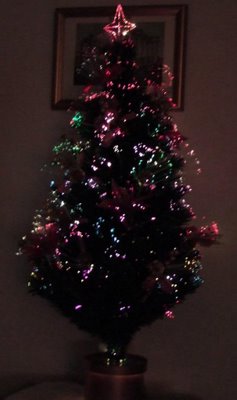 (Not my tree, but Fr. Jim Tucker's "Advent Shrub.")
Oh, and while I'm on the subject, I'm interested in any theological reflection on the Christmas Tree. Original is welcome, but I'd enjoy it if anyone could cite something significant, something really, well, traditional.
I'd point out that the Tree is a hugely important theological reality in the economy of salvation. Recall that the Lord God planted a Garden, and in the midst of it, he planted a Tree: the Tree of Life. Alas, humanity focused on another tree, that of Knowledge of Good and Bad -- so much so, that to Adam and Eve's mind, this other tree was the center of the Garden (and the one humanity still remembers -- isn't that fascinating?).
Christ, whose birth this is of course, came to embrace the tree of death, and transform it into the Tree of Life -- for us. Hence, when (in Scripture), we return at last to the Garden, there is but one Tree, bearing fruit 12 months a year, "for the healing of the nations" (Rev. 22:2).
Hence -- on top of the linkage between the Christmas tree and our patron here, St. Boniface -- I would say emphatically, it is a religious symbol. Whether the ornaments signify the fruit of the Tree (by the way: did you know what some early ornaments were? Paper roses and -- wait for it -- apples!), or if you place gifts on the tree (a nice pneumatological image, don't you think?), by all means, see in the tree, in the midst of your house and family, the Tree God planted in the midst of the Garden.
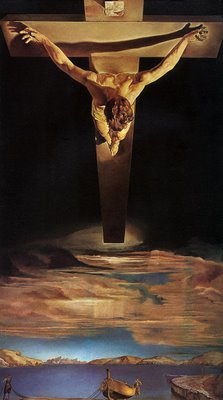 The Christmas Tree
What am I doing up so early?
It's 6:45 Saturday morning. I've been up since 5 am; I've had coffee, breakfast, prayed part of my office, browsed the 'net (nothing much happening--everyone is more sensible than I) and done some decorating for Christmas. I bought some garland with lights in it -- just fits the rail on the staircase. I bought two mega-strings of lights (3oo apiece!) for the tree. First I had to clip off all those annoying little lawyer-generated tags all over the light strings, which have tiny print, and say (in two languages at least!) things like, "this involves electricity -- so don't do anything really stupid with this, like plugging it in, then cutting it with a scissors, or taking the other end with you into a bathtub full of water, or trying to light the whole house off of one plug--but since this warning is for morons, and morons don't pay attention to warnings, this is really useless, except it makes our lawyers happy..."
I should really let someone else handle the lights, since this brings out my worst perfectionism; fortunately, laziness comes to the rescue -- one vice moderating another: what might the Angelic Doctor make of that?
Anyway, the lights are on, and they look nice, especially as it's still dark outside. I have twinkling lights on the porch, strung along the perimeter -- that took about 10 minutes. (All white for the porch; multi-color for the tree, for those who care.) I have my manger ready: Joseph and Mary just arrived about 30 minutes ago; the cow and donkey seem a little miffed.
Later today--two hours from now!--I'll head over to church to shrive anyone who comes (for confession), then I think I'll have second breakfast, and take a nap. The retired priest here is having a Mass for a couple this afternoon, at which he will witness the convalidation of their marriage. I'm invited to concelebrate; I will probably join them. At 6, we'll have our first Mass for Christmas, and I'll find out if my rehearsal with the servers made any sense to them.
I had to go over things with four of them Thursday evening, and then the remaining server -- the "smoker" (the one who'll handle incense) -- on Friday afternoon. Fortunately, he's a bright boy and seemed eager for the challenge. He'll have a lot of work, insofar as I intend to have smoke at every possible place (yes, including the elevations, for any who care about such details). Then we do almost the same thing at Midnight: my "smoker" for that Mass seemed a little dazed, but his mom said, "oh, he'll be fine."
In between, I'm going to dinner with some parishioners. I expect I won't get to bed until after 2 am, which is fine, if only I last that long. (I'm really a night person, which is why waking up at 5 am is such a trauma. And fair warning: anyone who assumes a posture of moral superiority because he rises early will be subjected to withering skepticism on my part.)
Friday, December 23, 2005
A funeral in the light of Christmas
It’s impossible not to notice the world-changing event we will mark starting Sunday. The church shows signs of the celebration only days away. “God became man that men might become God.” St. Thomas Aquinas made that startling statement, echoing both the Scriptures and our ancient Christian tradition.
This may seem an odd theme for a funeral—except that this fact: God became man—is necessary for us to have hope; and therefore, this celebration gives us hope.
And at time like this, hope is a very precious commodity.
It may seem curious to us, but at the time the first reading was written, it was not taken for granted that there was life after this life ends. That’s why it said, “they seemed, in the view of the foolish, to be dead”; but rather, they “are in the hands of God” and “they are in peace.”
If we take it for granted that there is life after death, then we can thank 2,000 years of the Gospel being proclaimed—we heard it today; and Paul received and believed in the Gospel.
And it all starts with what we celebrate Sunday: God became man—so that men might become God.
We heard St. Paul tell us this in the second reading: we “did not receive a spirit of slavery to fall back into fear, but [we] received a spirit of adoption, through which we cry, Abba! ‘Father!’”
The other night, Mary, you and I were together, with Paul, with much of your family around you. We prayed with Paul, and for Paul. Paul believed in Christ; he received the Spirit of adoption in baptism. And he was crying out, as you know. I think he was crying to Abba.
We recalled Paul’s baptism, just now, at the doors of church. Notice we did it at the doors; because baptism is our entry into Christ. Then we came here, to the altar. Mary, did not you and Paul come to this altar, so many times over the years, to receive Christ in the Eucharist?
Consider all we receive in baptism—what St. Paul was talking about: we are adopted, not as hirelings or servants, but as children—true children of God, “joint heirs with Christ”! The Eucharist—the Body and Blood of Christ, makes us not only friends of Christ—we are that, certainly—but we become part of Him. We share his Sonship! We share His divine life!
And that is hope!
That hope brings light to the darkness of sorrow—and it lights up certain features of life and gives them meaning to encourage us.
For 58 years and counting, Mary and Paul had a romance. It was sealed in the sacrament of marriage. Marriage being a sacrament means it, too, is a sharing in divine life. All those ordinary events, all those ups and downs, all the joy—and sorrow: Mary, at all those moments, you and Paul were sharing the very life of God, through Jesus Christ. When your children were born, you had a Christmas moment; today, you have a Good Friday moment. But it’s all part of Christ. His birth, his life, his death…
And his resurrection.
All this and infinitely more was wrapped up in the Gift humanity received that first Christmas, so long ago: God became man that men might become God!
Bishop Fulton Sheen used to point out that Jesus was the only man ever born to die. That was the meaning of his life: to embrace the Cross, to embrace human suffering, all the way to death. So that the path of salvation, for all of us, would cut straight through that which is most terrifying, most sorrowful for us.
Recalling that now likewise gives us hope! Jesus came to die; so that we might live. He rose from the dead, to come back and share his divine life with us.
I can only imagine how hard it might be for you to celebrate Christmas this year—or in years to come.
But I pray that this might be some help to you. Jesus was born to die; the result is that we, in dying, are born to eternal life. Therefore, may this be in your thoughts, at this time of year, in time to come: Jesus’ birth means Paul will live— not just for a few years on earth —but forever.
Thursday, December 22, 2005
Papa's got a brand new groove

There's a lot a of talk around the "blogosphere" about the holy father's hat. Not terribly important, but noteworthy.
(I have no patience for anyone who finds fault. His head is cold -- what do you want him to wear? A stocking cap?)
A sudden realization hit me about an hour ago: "this holy father has won my heart!" That wasn't easy, because the previous holy father, Pope John Paul, looms large in my imagination and affection, and it brings tears to my eyes, even now, as I think of his absence.
Yet, the Almighty, in his providence, has provided us a new shepherd, a new successor to Peter. And something -- je ne c'est qua (my French is horrible) makes me feel very confident, very reassured of our Father's care. (No, it's not the hat!)
Preparing for Christmas
As you might imagine, I've been busy as I suppose most priests are this time of year.
But things are cooling down a little. I thought I ought to post something.
Perhaps you would find it diverting to know what is keeping a parish priest, a pastor, busy these days...
Naturally, of course, Penance services, both here and at neighboring parishes.
Weather: we have had two snows already; one on the Vigil of Immaculate Conception, and then a week later, when we had our penance service. Far too much of the wretched stuff is still on the ground. When this hits, all kinds of "wheels are in motion" to quote that great philosopher, Jerry Seinfeld.
Decorations. The office "needs" to be decorated. (Of course, it really doesn't. Except that the staff enjoys doing it, so why be a Scrooge? And we are celebrating our Savior's birth--we want to look like we're celebrating.)
The church has to be decorated -- first for Advent, now, gradually this week, for Christmas. Fortunately, we have daily Mass (except for Mass with the schoolchildren) in a chapel; meaning the volunteers who decorate can do so without disrupting too much.
The crib is up, with all but il Bambino and, of course, the Magi.
I recall when I was in the seminary, one of my brother seminarians, now a priest, had the Wise Men, and their retinue, on a journey through the whole seminary for I-don't-know-how-many-days before Epiphany; but it was amusing to walk down the hall and see they'd advanced several doors during the night. How about if I did that?
Writing extra homilies: for a Penance Service (although I confess I redid a homily from a past penance service; sorry, but I think that's preferable to "winging it"), Immaculate Conception (two homilies), and now Christmas (two homilies). Today, I worked on a funeral homily for tomorrow, after which I wrote my homily for Midnight Mass. Sorry: again, I wasn't as original as I'd like.
I don't know how priests write several homilies, one right after another.
I find that, having investing myself into a particular homily, a particular set of readings, and the occasion, etc., it is hard to turn that off, and do it again, especially for a similar, but not the same, occasion: i.e., the Vigil Mass (and its readings) and the Midnight Mass. Hence, my Vigil Mass homily was brand new (I've never had that Mass; at my prior assignment, the pastor took it, and I took midnight). while my midnight homily reworks one from several years ago.
I have done no Christmas shopping, other than to get the necessary items to decorate my own home. I have a (real) tree, a leftover from a party here, and I have decorations I may put up tonight, otherwise, tomorrow. Christmas cards? Don't be funny! (Again: some people say, why bother? I think some priests do. But for me, I think my house should look like I'm a Christian.)
What else? A lot of the usual craziness, only turned up several notches. Phone calls can drive one crazy; it is a real skill to handle them well. "Six PM, Midnight, 7 and 10 AM. You're welcome." Requests for money, for gifts (we had a "giving tree" all through Advent; but all the gifts have been given away), people show up to drop things off and pick things up. Some of these things can be time-sponges.
Meanwhile, I have an staff to manage, various, boring-yet-essential business matters to attend to, other, genuine crises show up at the door (one a couple weeks ago took pretty much the whole day, between the crisis itself, then the followup, then just reacting to it afterward).
But I am looking forward to next week: the office is closed! I will have a chance to work without interruption! (That's a little-told secret about priests; yes, many of us are happy to have "time to relax" but what we would love is time to work in peace.)
Sunday, December 18, 2005
A chanted Penitential Rite for 4th Sunday of Advent
You heavens, open from above,
to rain down the Just One: Lord, have mercy.
Do not remember, O Lord, our sins,
for desolate is your holy city, Jerusalem: Christ, have mercy.
Console us, console us, your Israel,
and send the Redeemer
to free your captive people: Lord, have mercy.
to rain down the Just One: Lord, have mercy.
Do not remember, O Lord, our sins,
for desolate is your holy city, Jerusalem: Christ, have mercy.
Console us, console us, your Israel,
and send the Redeemer
to free your captive people: Lord, have mercy.
Saturday, December 17, 2005
God's in 'Our House' (Sunday homily)
We heard how King David
wanted to build a temple for the Lord.
At that time,
they worshiped the Lord in a tent.
Here’s why:
When God brought his People
out of slavery in Egypt,
at Mt. Sinai,
God made a covenant with his People;
and he showed Moses,
how they would worship him: in a tent!
After all, they were in the desert;
they were on the move.
So, years later,
perhaps David is thinking,
“we’re not on the move any more.”
Notice God’s response:
“Should you build a house for Me?”
I don’t need a house.
He tells David, I will establish your house—
meaning, his kingship—“forever”!
So notice, God doesn’t need us to build him a temple—
we are the ones who need it!
It’s as if David is singing
the song by the band Madness: “Our House”!
And if you’ve never heard of that band,
I bet you’ve heard of Maxwell House coffee?
It’s the song in their ads:
“Our house, in the middle of the street…”
That’s where King David,
and that’s where we,
want God to come—to “our house”!
And here is the amazing thing…
That’s exactly what God does!
I don’t mean the temple David built.
That is long gone.
Rather, look at the Gospel.
Gabriel comes from Heaven,
and God, through Gabriel, says, to Mary,
“Hail, Full of Grace!”
This is amazing!
Normally, in Scripture,
it’s the human being
who pays honor to the angel;
but not here.
Here, the angel—
speaking for God—honors Mary!
No wonder she’s “troubled”!
Remember that promise God made to David?
His throne would endure forever.
Yet, in Mary’s time,
that line of kings had failed.
So two things happen here, both marvelous:
First: God keeps that promise to David:
Mary’s Son will be king,
not for a time, but forever!
Second, God at last responds to David’s desire,
and ours, that he come and dwell in “our house.”
God chose to dwell,
not in a house made of cedar or stone,
but in a “house” made of our very humanity!
God became man:
and he not only made
our humanity his “house,” forever!
He also made every one of us his family!
Everyone—without exception!
This is why we’re prolife;
why we question the death penalty;
why we dare not forget the poor;
and why we must
never give in to hate and vengeance.
This gives me an opportunity to explain something
you may have seen Fr. Ang,
or me, or some lectors, do.
We bow our heads at certain points:
At the name of Jesus, Mary,
the Father, Son, and Holy Spirit,
named together;
and if it’s a Saint’s day,
at the name of the saint as well.
You’ve also seen me bow
with my body during the Creed,
at the words,
“by the power of the Holy Spirit…”
This is actually something
we are all supposed to do as part of Mass.
After all, it isn’t just the priest,
or the folks up front,
who “do” the Mass; we all “do” it together.
Now, are gestures and postures important?
Well, when I was kid, answering my parents,
I could say the right words…
But how I said them; my posture;
if I rolled my eyes…
what do you think happened?
So, yes, they do matter—
they speak volumes, don’t they?
So we genuflect when we enter His Presence.
We stand together for the Gospel, and other times;
we kneel together at various times.
Now: common-sense here: if you can’t, then don’t.
But I kid the servers about this.
They’ll be in a hurry,
and they do a “quickie”;
and I make them do it over:
“you can do this!”
Yes, there are more important things,
no question.
But we show how important something is to us,
by how much we care about doing it right—
Isn’t that true?
You go on a date…
Go to a job interview, meet the boss;
When the game’s on the line:
we care about doing it right.
If you go to a funeral for a veteran,
you will see an honor guard.
They have a ritual—they do it just right.
Occasionally, I’ve seen it done sloppily.
And it’s not good. Which makes the point:
it matters that they do it right.
So, do details at Mass matter?
After all, Who is it
that has come to our house?
So, I’ll end with a special invitation.
In your pews, you will see
cards that look like this.
Everyone knows we have a chapel, downstairs,
where Our Lord Jesus Christ, in the Eucharist,
is present in our house! All the time!
Let me here commend you…
So many are so faithful, day and night,
in all weather, year after year.
Your prayers, and the way Christ works in you,
is a great gift to our parish. Thank you!
Of course, you’ll say that what Jesus gives you,
is infinitely more valuable
than the time and sacrifice you give him.
My invitation is for anyone
who may want to try this.
I’m not trying to push anyone to do it.
Not everyone can.
But if He has given you an invitation in your heart,
why not try it?
You have an option on the card
to try it for three months!
If you feel called to this,
drop in the collection,
or in the box in the vestibule,
or hand it to me.
God is in our house.
“And you shall name him Jesus.”
How the rest of the world lives
We in the prosperous (prosperissimus!) West take so many things for granted.
We also hear the petulant whines of pampered people talk about "oppression."
The headline above links to a story about what women face in many parts of the world -- in this case, Nigeria.
Shocking; but still full of hope.
We also hear the petulant whines of pampered people talk about "oppression."
The headline above links to a story about what women face in many parts of the world -- in this case, Nigeria.
Shocking; but still full of hope.
Friday, December 16, 2005
Life in the Vine (Penance Service Homily)
“I am the Vine”—the true Vine, Jesus tells us;
“you are the branches”—“remain in me.”
Full of hope—but, very demanding as well.
Notice where this puts us—
Right in the middle of it all.
So if we ever wonder,
“Why is our spiritual life such a big deal?”
Or, “Why is it a commandment
to attend Sunday Mass?”
Or, “Why does the Church seem to have
do’s and don’ts for so many parts of our lives—
what does it matter?”
It’s because of who you and I are:
Jesus did not say:
“you’re a leaf—not very important.”
You did not hear that, did you?
He said: you and I are branches—
that’s important!
A lot depends on us!
Think about it:
what do the branches
need from each other?
“Hey, branch—I need your help!”
“Hey branch—you’re turning brown—
you’re going to fall off!”
Most of the voices around us
tell us we’re on our own;
We don’t have to answer
to anyone but ourselves.
Sometimes we think
“it’s just between me and God.”
But that’s not how the Vine works.
We need each other—including spiritually.
Each branch not only draws life from the Vine,
But also shares it back, for the others.
A lot of branches spring off of other branches.
If we set a bad example,
if we’re drooping, spiritually,
We affect the other branches.
Even our “private” sins
diminish the life of the Vine.
As a priest, I often challenge you
to pray, to change, to grow spiritually.
But that goes both ways.
If you look at me,
and you think I need to pray more,
I need to change—
maybe I’m drooping, spiritually—
please tell me!
We help each other by forgiving;
We can help each other
get back in the Vine;
But only if we accept responsibility
for each other.
You and I come to this sacrament,
and maybe feel awkward.
This is the pruning Jesus spoke about.
It can hurt; but it makes us fruitful.
The Good News about this Sacrament is that
if a branch has broken off, fallen off the Vine,
This is when God puts it right back in!
“Hey branch! You’re drooping down—
Don’t give up!
Here’s what the Vine gave me: Here’s Life!”
Wednesday, December 14, 2005
I'll let my friends and parishioners comment...
| You scored as New Catholic. The years following the Second Vatican Council was a time of collapse of the Catholic faith and its traditions. But you are a young person who has rediscovered this lost faith, probably due to the evangelization of Pope John Paul II. You are enthusiastic, refreshing, and somewhat traditional, and you may be considering a vocation to the priesthood or religious life. You reject relativism and the decline in society that you see among your peers. You are seen as being good for the Church. A possible problem is that you may have a too narrow a view of orthodoxy, and anyway, you are still a youth and not yet mature in your faith.
What is your style of American Catholicism? created with QuizFarm.com |
Sunday, December 11, 2005

Is Lord of the Rings Christian?

The Two Towers is on TV -- again! -- but I don't care; I find this entertaining. But I thought of a question I'd post for your comments:
Is Lord of the Rings Christian?
I do not mean, is it compatible with Christianity; I have no qualms about that. It was the work of a Christian, and the way Christians have embraced LOTR is noteworthy. It calls to mind Christendom at its best.
What I mean, rather, is to ask: is it essentially Christian? Put it another way: could it have come forth from, say, a Jewish milieu? Or Muslim? Or Hindu? Or Buddhist?
Not supporting PBS makes me feel so good!
I chanced upon a show called "Rick Steve's European Christmas" tonight; and although I generally avoid "Christmas specials" like the Bird Flu during Advent, and usually avoid PBS, I decided to stay and watch. And, no surprise, it was a quality program.
But then, of course, I discovered why PBS was having something actually good on: pledge week!
And so, the usual unctious attempts to induce guilt and educe gelt: "you're enjoying this show; someone paid for it; you should pay." Ennnh! Logical fallacy! In the nice times of the year, I walk down the street, and enjoy other people's gardens; I feel no compunction whatsoever to pay for it, and I would have to restrain a guffaw if the owner of the garden tried to convince me of it.
"It makes you feel good to support PBS." No -- the exact opposite is true. It makes me feel bad that I am coerced into supporting "public" (there's a great, propagandistic name) TV and radio; and it makes me feel GOOD that I refuse to send money to these stations.
Of course, if you feel otherwise, and you send money to PBS et al., that's your business; more power to you. But if you think I have an obligation to support these folks? No offense, but you're smoking something you probably shouldn't be.
The Gift of the Holy Spirit (Sunday Homily)
(Dear visitor: your specific comments and questions, favorable or not, are very welcome and would be most helpful to me. How else can I know whether what I'm preparing is heard, is effective? Thanks!)
What difference might the Holy Spirit make in your Advent, and your Christmas?
Isaiah said, “the Spirit of the Lord is upon me”; St. Paul said: “Do not quench the Spirit!”
St. John the Baptist was sent by the Holy Spirit, to announce that Christ was coming, and would baptize us in the Holy Spirit.
When you’re driving from home, to the mall, to the store, to the school--when the weather is nasty to boot—what difference might the Holy Spirit make for you?
“Rejoice always. Pray without ceasing,” Paul says.
Do you pray in the car when you drive? I do. I confess I’m not always my best self behind the wheel. When I have a rosary in my hand, it’s a little harder to shake a fist at someone!
If you’re thinking about what presents to get folks, here’s a gift you and I can give everyone, without cost, and no need for any wrapping: Give the gift of faith!
Share your joy, when others are frazzled. Share your hope when others are fearful. Share your mercy when feelings are hurt.
Sometimes this can be a stressful time, sometimes we can feel blue, and discouraged.
The other day, I read about an image of the Virgin Mary that is taken, on a journey each year, from Mexico to New York City. Along the way, they stop at churches and homes, and people can come and pray to Our Lady of Guadalupe.
As you might imagine, this is a source of encouragement for the many Mexican immigrants living in this country.
Whatever views we have about immigration issues, the fact remains there are folks in our midst, usually poor; if illegal, then they have few protections; they often aren’t welcome; they don’t speak the language; they are far from home.
Either their families are far away, or here, with them, facing a cold Christmas and difficult times.
Remember, Mary, Joseph and Jesus were likewise refugees—they fled to Egypt, where they had no papers, they didn’t speak the language, and they were far from home, as well.
Tomorrow is the Feast of our Lady of Guadalupe; our mother Mary cares deeply about our immigrant brothers and sisters in our midst; and so should we. *
I’m not sure what you and I might do to help them. Being aware, being open to the Spirit’s lead, is the first step.
In years to come, you and I—this parish—will have opportunities to bring glad tidings to the poor, whether native-born, or immigrants, in our midst.
Back before Thanksgiving, I was talking to someone who was discouraged—she feared no one would invite her for Thanksgiving.
I suggested she do the inviting—have people over; or, she could plan to go do something to help others.
Folks who spent their Thanksgiving serving meals at El Sombrero weren’t alone, and I bet they weren’t discouraged! Instead, they were “bringing glad tidings to the poor.”
When Christmas Day comes, it may be that things will slow down—maybe you’re looking forward to that, as I am! May I suggest that, if you want something to do that week—something to keep the kids busy—there are folks in the nursing homes for whom merely a visit would be pure gold.
The Bethany Center will be glad for your help. They’d love someone to come and cook a meal—they’ll provide the food—and then you can help serve it.
What difference might you make, this year, led by the Holy Spirit?
This Thursday we’ll have our Penance Service—going to confession is a great way to be baptized again, as it were, in the Holy Spirit.
This might be a good time to call someone and say, “I want to let go of what happened.”
I said a moment ago that we need not spend money to give good gifts to others.
But there are some gifts that do require money. If God has blessed us with a surplus, we might consider giving some of that to the second collection today for retired sisters and brothers.
Remember: nuns and brothers, and some—not all—priests take a special vow of poverty.
They gave up their possessions, their checking accounts and savings,
and now, in old age, must rely on the generosity of others for a place to live and for health care.
Please be generous as you can today. And not for myself; this is for members of religious orders—on their behalf, thank you!
This time of year, we’re thinking about gifts: what will we get? Or, what to get?
God is offering us the Gift of the Holy Spirit. You and I don’t have to wait for Christmas to unwrap the Gift; and there’s no reason to hold back
from sharing this Gift with others around us.
* If this part sounds familiar, it's because you read Father Jim Tucker's comments at Dappled Things. I apologize for not giving him credit when I posted this earlier.
Saturday, December 10, 2005
A new blog
 (Not Mark Anthony)
Mark Anthony, a friend and member of my previous parish, has created a blog; I dread to think I have led him astray! You can reach it by clicking on the headline above.
The Islamic Threat: same as it ever was

This article in the Washington Post today got me thinking, about naive Christians and the ever-elusive "peaceful" Islam.
First and last, I applaud anyone who prays for an end to war and terror, and I join these folks in praying for the safe release of the hostages.
But there remains this assertion, which appeals to us Westerners: "Islam is a religion of peace and tolerance."
Hmm.
Let's look around the world, shall we?
Can anyone cite a single nation, where Islam is the clear majority, where there is true equality between religions, where Christians are fully free? That means, free to practice and free to evangelize?
There are a lot of nations with Muslim majorities; and there may be an example of this, somewhere. But let's be candid: the vast majority of Islamic nations do not allow such freedom of religion. For Islam, it is considered generous if they allow Christian minorities to exist in a subordinate state -- so long as they don't get "uppity." Evangelizing is a crime, with both the one bearing the Gospel, and anyone accepting it, facing punishment, sometimes death.
(And for those who think I'm being terribly illiberal here, may I recall what Iran did to a couple of young men who were accused of being homosexual? They were hanged, after being tortured. Folks can complain about the treatment of minorities in the West, including homosexual persons -- but come on.)
The history of Islam shows it to have been an aggressive force, conquering militarily, squeezing Christianity, hemming Christians in, sitting on them, holding them down -- and that's when Islam was being "tolerant."
Now, the response comes rapidly: "But what about the Crusades?"
Ah yes, the Crusades.
First and foremost, the Crusades were defensive. Christian nations watched as Islam relentlessly pressed forward to conquer Christian lands -- and the goal was no secret -- to take everything within reach. I invite anyone who doubts this to do a little research, and note some of the high-water-marks of Islamic invasion into Christendom (Europe): Poitiers (France) in AD 732, and Vienna, twice, most recently in AD 1683. For those who say, "oh, that's a long time ago, everything's changed," I would respond: a lot of things have changed, including "Christendom," the West, and much of the world -- but how much has Islam changed since then?
Oh yeah -- Cyprus -- I forgot ... the latest example of Islamic conquest of Christians, in the 20th century. Oh yeah: Lebanon, too. Oh yeah: Sudan -- 21st century.
My second point about the Crusades is to recall that they were an aberration. I mean this: you had this relatively brief period where the pope and other clerics attempted to rally Christian nations to a common effort to go repel Islamic conquest of formerly Christian lands. They succeeded -- very briefly. Even more briefly did the Christian forces even have the initiative; then, it became a long, retreat.
My point, here, is to suggest that even if you view the Crusading episode as terribly shameful to Christianity, it is hardly as central to Christian history in the same way that conquest is to Islam.
(Herewith the obligatory apology: yes, it's awful that Christians did awful things in the name of Christ. The Crusaders ought to have kept their focus on their actual task, and done so with impeccable adherence to the principles of Just War; alas, every one of them was a sinner, and so they committed a lot of sins and outrages, even to the point of failing in their primary objective. Hence they conquered Constantinople instead of Jerusalem. Were it not so sad, it might be possible to see the tragic comedy of it.)
Third, then, I would point out that the Crusades essentially failed. That's a key difference: Islam summoned the wherewithal to conquer and hold vast Christian areas, and Christians did not. Even cases where Christians regained what was lost were rare.
So let's dispense with the "what about the Crusades" business. Complain (legitimately) about them all you want, they are in no way comparable to the conquest to which they responded; and they do not reveal something essential about Christianity in the way that conquest clearly is at, or very near, the heart of Islam.
Because even if you make the best indictment you can, of Christianity in relation to violence, it still remains true that Christianity has changed in this regard. (The vital subtext of this is the real, though varying, separation of Church and state in Christendom. It is a fact that throughout almost the entire history of Christianity, since Constantine, that Church and state were almost always at odds; the constant attempt of political figures to manipulate the Church invaribly spurred the Church to fight back; and its still true today. Churchmen tried to do the same in reverse; but most of the time, the state had the upper hand. The pope compelled the Holy Roman Emperor to kneel in the snow and beg forgiveness; yet shortly afterward, the same emperor was at war with the pope again. Another pope brought Henry II to public penance for the murder of Thomas Becket. Such episodes are memorable because they are rare.)
So, yes, Church leadership is culpable insofar as it collaborated with political figures to do unseemly, unChrist-like things. But as I said, "Christendom" has completely changed in this regard, to the point that it is unrecognizable today, as the same entity from, say 1500 -- that is, if one can even speak of "Christendom" at all, except as a fond memory.
May I also point out that the bill of indictment against Christendom, in relation to Islam, usually drawn up, is incoherent on present-day "multicultural" grounds! I.e., Christians' sins are only sins according to their own teachings; Christian behavior toward Islam is only "wrong" in Islam, by being the "wrong" side! What Christians have been wrong to do to Islam, Islam has claimed the right to do, itself, to Christians! (Namely, conquer them and "graciously" allow them to be second-class subjects.) My point being, yes we who are Christians can and should fault ourselves, and our predecessors, for failing to live up to the Gospel; but on what basis does Islam complain, other than on the principle of might makes right?
The world still awaits a true, "liberal" (in the classic sense) Islamic society; such would be a genuine partner in interreligious dialogue and cooperation. We hope this is the fruit of the present war in Iraq. The signs, thus far, are inconclusive.
But I can't help recalling attending a expo at the Washington Convention Center in about 1990. It was sponsored by the Kingdom of Saudi Arabia -- I went because free things appealed to me given my finances then. After I had toured the displays, I asked one of the representatives standing by: "can you tell me, how many churches are there in Saudi Arabia?"
"None," was his reply.
Thursday, December 08, 2005
Filled with the Sun (Homily for Immaculate Conception)
I preached two homilies on this solemnity, one of which was for the schoolchildren, as you will deduce. Both homilies follow. (Feel free to give any comments, including comparisons.)
You have seen your moms or aunts, or teachers, when they are going to have a baby. You know what happens—their stomachs get big, don’t they? When the baby is ready to come—mom is “full”!
One way to think about what “Full of Grace” means is that Mary, in becoming a mother, was going to be full of Jesus.
This happened because the Holy Spirit came over Mary. Jesus did not have a human father—his father is God, in heaven. And the Spirit brought this about in Mary.
Stop and think: what would it be like to be full of Jesus?
Watch as I dip this cup in this water: Is it full [2/3rds full]? How about now [3/4ths-7/8th full]? [Add water by hand until its flowing over.] Now it’s full!
See: it’s brimming over; no room for anything else! That’s what “full” means.
When the angel called Mary “Full of Grace”—did you notice he didn’t use her name? It was as if “Full of Grace” was her name! He was saying, there was no room in Mary for anything but grace. Thus, Mary—from the very first moment God created her inside her mother, St. Anne—was without any sin—“full of grace.”
That’s what “Immaculate Conception” refers to when Mary was conceived, in her mother. Mary was conceived on December 8; nine months later was her birthday, September 8. “Immaculate” means totally clean—without any stain.
God did that. We might wonder why. Well, the readings we heard explain why: Adam and Eve—as we heard—said “No!” to God. That opened the world to sin and sorrow. Mary was chosen to be the one who would say “yes” to God, untying the knot of disobedience Adam and Eve created. Did you notice? Adam and Eve sinned—then when God came and asked about it, they pointed the finger at someone else: “He did it” “She did it.” Sound familiar? Isn’t that what we say when we get caught?
What does Mary say? She says, “I am the handmaid of the Lord; be it done to me according to your word.”
A handmaid is a servant, a slave. Mary is saying, I freely turn my whole life over to God. Whatever he wants, whatever he says, I will do.
What would our world be like if everyone were that way? What would your day at school be like, if every teacher, every student, said, I want to be God’s instrument, God’s slave? Would we hurt each other with our words, or our fists? Would we have shows on TV that are trashy? Would we watch such shows? Would prayer and knowing God be something we put last on our list of things to do?
If our world were like that, there would be no war; there would be no immigrants treated badly; poor nations would be lifted up and treated equally. How different our world would be—and will be—when people imitate Mary, and say, ”I belong totally to God—I will do whatever he wants.”
Remember: that “yes” meant that Jesus would come into the world through Mary.
Because of that, we were able to know Jesus! And when you and I imitate Mary—and say “yes”—just as Mary became full of Jesus, so will we!
Our yeses help our world become more and more “full” of Jesus. And Mary showed us how.
No wonder Gabriel said: “Hail, Mary!
No wonder God the Father said: “Hail, Mary!”
No wonder Jesus the Son said: “Hail, Mary!”
No wonder the Holy Spirit said: “Hail Mary!”
No wonder we say: “Hail Mary!”
_____________________________________
Have you ever been up very early and watched for dawn to come?
You stare at the dark sky, waiting for light. After a long wait, it does get lighter.
As dawn nears, the sky gradually fills with a spreading light. That’s when you realize how dark it was, and just how dazzling the light really is. All this before the sun itself crosses the horizon.
Which calls attention to how much light the sun casts even before its rising. Then the sun itself comes, and Boom! your eyes are blinded by the brilliance.
So with the sun in the sky, so with the Son of God.
Long before Christ dawned on the world, his light reached way ahead to fill the life of Mary. That’s what we celebrate today: her Immaculate Conception.
Now, we get confused about this. Many think we celebrate Jesus’ conception today. No, it is Mary’s conception we celebrate. "Immaculate" refers to what God did for Mary, at that first instant, inside St. Anne, to preserve her free of any stain of sin.
Some wonder about the “how” of this; others about the “why” of this dogma.
Remember what I said about sunlight, how it goes out ahead of the sun’s actual rising? It’s the same with the Light of the Son of God. The light of Jesus’s “dawn” reached so far ahead, all the way to the beginning of Mary’s life, casting out all darkness, even from the first instant of her life.
Mary didn’t just look at the Sun; she was filled with the Son.
Can you imagine it? Can you imagine it? Just with the sun in the sky: if, somehow, we were “filled” with it’s light, what shadow could remain? How much more to be filled with Christ? The Son of God, more dazzling than all galaxies, dawned into the world through Mary!
Mary brought that Light to us—will we let him in?
Those places inside us we keep sealed off, where we, not God, have the final say? Those drawers where we keep an addiction; those corners where we nurse a grudge; will we let in his healing Light?
There is no shame so dark his Light cannot cast out; no sin so foul his Light cannot cleanse; no hardness his Love cannot melt; no coldness his Light cannot warm.
Mary is just the beginning. She is the New Eve, the mother of a New Creation. And we are her children.
When all the world lay in darkness, Mary stood waiting for the Light. When it came, Mary said “Yes.” No wonder God said, through Gabriel: “Hail, Mary!”
Wednesday, December 07, 2005
Happy St. Ambrose Day!

Gratitude is one of the more becoming, and ennobling virtues, of which I have a paucity, but which I aspire to have in fullness.
It would not do to let this day go by without expressing gratitude to St. Ambrose. He, and his most famouse protege, know well my indebtedness, and I am happy to say, publicly, thank you!
Lord of the Rings: best of the 20th century

I'm watching The Two Towers on TNT; I could watch this endlessly.
I am coming to the conclusion, reached by others, that J.R.R. Tolkien's Lord of the Rings may well be the greatest literary accomplishment of the (execrable) 20th century. Assuming that's true, it may be a testimony to the greatness of Tolkien's achievement, or the wretchedness of the last century.
Of course, the films aren't as good as the book; but they are very good! I can't help contemplating the irony -- the movies were only possible because of technology, of which I'm not sure Professor Tolkien would have approved...
Tuesday, December 06, 2005
A new priestly blog
My classmate, Father Larry Gearhart, often stops by here occasionally and has good things to say. If you want to see more of his insights, visit his weblog, Eyes of Faith.
Fr Jim's Scandal
I can't describe how shocked and dismayed I was to see this image at Don Jim's website

It pains me to say it, but -- the evidence speaks for itself.

It pains me to say it, but -- the evidence speaks for itself.
Subscribe to:
Posts (Atom)