Sunday, October 30, 2005

Bad Sunday Night TV


Browsing for something to watch on TV, I came across this listing:

"The Final Conflict (1981): The 'Omen' Trilogy concludes as Satan's son (Sam Neill) eyes the presidency."

... like that hasn't happened before.

Several times.

Let us now praise Rosa Parks


I am very proud to see Ms. Rosa Parks honored by the nation tonight -- I am watching members of our nation's armed forces escort her mortal remains into the Capitol -- and I am glad to have something like this unite our country. (I have not heard any partisan manipulation of this situation, and I don't wish to -- I can imagine what it would be like.)

Rosa Parks is a true profile in courage. And it's worth recalling the circumstances: her courage, her choice, came not in some spectacular moment, but in an exceedingly ordinary moment. It might well have passed. How easily one could could let it pass. But for the ennoblement of our nation, she did not let it pass. Call it grace, call it providence, call it what you like -- but something inspired her to act at that moment, and it changed everything.

This is how most of us will be presented with opportunities for virtue and our own ennoblement, and opportunities to make others, our world, better: seldom in obvious, climactic moments; more often in tedious, beige-colored instances where we don't feel very heroic; we may not even realize or intend anything particularly brave or virtuous; we simply act out of the store of who we are: and we become a little more who we are meant to be.

May her soul, and the souls of all the faithful departed, rest in peace.

The Iran-Venezuela Connection


What do the "Islamic Republic of Iran" and Venezuela have in common -- other than oppression?

Both showed up on my "recent visit" list.

Stay strong: the light of liberty will come to your lands; your oppressors will be thrown down!

(Photo borrowed from Erik Fearn; I am assuming Mr. Fearn won't mind.)

Thuggery is not what Leo had in mind


Right to Work is, as readers know, a cause dear to my heart. I insist that the legitimate rights of working people to form and support unions must naturally include the freedom of individual workers to opt in, or out -- without losing their jobs, or being discriminated against.

This seems a fairly clear principle; and I invite an on-point response. Such on-point responses don't happen. People who believe in unions (which I don't quarrel with; I am affirming your right to choose a union) will, instead, change the subject, or simply manifest a massive blind spot to the fundamental issue of coercion. There is this sense of entitlement, on the part of many union activists, when it comes to thuggish behavior; so just is their cause that the rules don't apply to them.

Here's an example; those who say such instances are isolated are kidding themselves or simply naive. (Hattip to my neighbor in the blog'hood, Southern Appeal.)

It's frightening & wonderful to be a priest (Sunday homily)

Perhaps Protestant friends
or family members have asked you,
based on this Gospel passage:
“Why do you call priests, ‘Father’?”

I know people ask the question,
so I’ll answer it;
and then move beyond it.

If you look further in Scripture,
you’ll see that St. Paul the Apostle,
and St. Stephen, one of the first deacons,
both used the term “father”
in the way Jesus seems to say not to:
Paul called himself a spiritual father,
and Stephen called his persecutors “father.”

So, they did it—in Scripture!
What’s the fuss?

We still wonder why the Lord
said this startling thing:
Then we realize—that’s why:
to startle us—to get our attention.

I will tell you,
these readings certainly have my attention.

The honors the Lord describes—
a seat of honor,
greetings in the marketplace—
people often do that for me!

People are kind, they often insist.
And, yes, I like it;
and it’s easy to come to expect it.
So it’s good that Jesus
startles me with these words.

I need to remember that
it is not about “Martin Fox,”
but about “Martin Fox the priest.”

Whatever I do,
wherever I go, I’m a priest;
I’m a priest no matter what you call me.

We believe that some of the sacraments
change our fundamental state of being—
who we are at our very core.

Baptism does that:
it fundamentally changes us,
from someone “outside”
to someone united to Christ.

Now, I know, that raises a question:
what about those who aren’t baptized?
The answer is, God has other ways.
He’s commands us;
He doesn’t command himself.

Baptism changes us:
we become part of Christ;
we become “little Christs.”

Confirmation changes us--
we become more like Christ:
With Christ, we say to the Father,
“I’ll do this”;
I’ll accept the mission;
I’ll accept the Cross.

And priesthood changes a man:
he says,
“I’ll be united to Christ on that Cross:
I’ll be the one through whom
Christ offers the Sacrifice;
my life will be his altar;
my voice, my face,
my person, will be His.”

When I’m in the confessional, I say this:
“You could come in here,
alone, and tell God you’re sorry.
And God will forgive you.
I’m here so that
you can see Christ smile at you;
and, through my voice, hear Christ say,
your sins are absolved, and gone forever!”

Did you notice that first reading
singled out priests?
If I don’t listen to Him;
if I fail to give His teachings faithfully:
God says—to me:
“I will send a curse upon you”!

We all know the quote by Dante:
“The road to hell
is paved with good intentions”;
How many know what
St. John Chrysostom said?
“The streets of hell
are paved with the skulls of priests.”

Pray for priests;
pray for our priests here in Piqua.
Please pray for me.

I know you do; I thank you.

Does all this make me
regret being a priest?
not one bit.
Because the grace
of my baptism and confirmation,
made me want to answer his call,
whatever that means!
And any men here thinking about it:
Your full happiness will come
only in answering that call.

But I need these readings’ warnings.
My hope isn’t how smart I might be,
or how pious or holy I might seem to be.
I have to stand before Christ
as I truly am; we all do.

I still remember my very first Mass—
the very first time
I stood at the altar,
I spoke the words of Christ himself,
holding bread, and wine,
and knowing it became—in my hands!—
His Body and Blood.

I looked at the Host;
I looked at the Cup,
and I thought: God have mercy on me!
I get to do this—to be a part of this—
and my life isn’t totally changed?

I know I don’t have enough faith
for that moment;
I know that my response
is utterly inadequate for that reality.

The temptations are real;
I’m not immune to them.

If you’ve heard me stress,
on other occasions,
the power of God’s mercy—this is why!


It’s frightening and yet so wonderful
to be a priest!
Here’s why:

I look out, through my eyes;
I am what I am, Martin Fox.
I see with my prejudices, my impatience;
I see you—looking back:
you’re kind and generous and wonderful.

And then, every once in a while,
it dawns on me—
and there aren’t really words for this—
but I know: I’m seeing you,
through my ordinary self;
but you? You’re seeing Him!

Saturday, October 29, 2005

'Last Rites': what they are

This afternoon, I got called down to a nursing home to administer "Last Rites." Sometimes you'll hear contemporary-theology-minded folks tut-tut and say, "we don't speak of the Last Rites anymore"; but telling people you don't administer "Last Rites" isn't very helpful.

So just what are the Last Rites?

Broadly speaking, "Last Rites" refers to whatever the Church can provide someone, near death, to prepare him or her for death and what lies beyond, and to strengthen him or her in this situation. In reality, it's also about the family and friends who gather around the person--the comfort is for them, too.

Strictly speaking, the only part of the "Last Rites" that's exclusively "last"--that is, for death, are the "Apostolic Blessing," which only a priest or bishop can impart, and the prayers of commendation, which anyone can pray for the dying person.

The Apostolic Blessing is given by permission of the Holy See, and is a remission of sins, but it presupposes receiving absolution--so it's intended to apply to temporal punishments due to sin and hence, relieve the dying of any "debt" to pay in purgatory. Like absolution, it's not magic: it presupposes a response of faith to God.

The other parts of "Last Rites" should hardly be held to last: the sacrament of reconciliation, the sacrament of anointing, and the Holy Eucharist. If necessary, of course, "Last Rites" can include baptism and confirmation, if the one dying requests them, or--in the case of a child, the parent requests them.

Quiz time: If time doesn't permit a priest to do everything for a baptized Catholic, then what one sacrament is the most important to give?

a) Absolution
b) Anointing
c) Eucharist

The answer is "c," the Eucharist. (And that's if time truly is short: because the brief administration of penance and anointing is pretty brief!)

Which do you think is next in importance to give?

a) Absolution
b) Anointing

The answer is "a": Absolution. Hence, the anointing, while important to give, comes third.

The sad reality is that I often can't give Viaticum to the dying: either they're non-responsive, or, more often, they have tubes, or they simply can't swallow.

Here's the truly sad part of that: most of the time, I could bring Viaticum, if only people gave me some notice. What do I mean?

It is perfectly appropriate to bring the Precious Blood as Viaticum!
But we can't reserve the Precious Blood in the same fashion as we can hosts. The Precious Blood may, quite licitly, be reserved in the tabernacle; but only for a brief time, in anticipation of such a need. So, this takes extra planning and coordination.

At my previous parish, I began to spread the word about this option; and a lay member of the staff, who coordinated communion calls to the sick, went and found some eye-dropper bottles; we blessed them, and used them for this purpose. Occasionally, folks at daily Mass would see one of these small bottles on the altar, alongside the paten and the chalice.

So often, I'll be told (as I was earlier this afternoon, when I visited the nursing home), "oh, she can't receive anything by mouth." I've even been told that a drop of the Precious Blood would be a problem. Well, I really wonder how can a tiny drop of liquid, from an eye-dropper, be any problem? (If you have expertise in this field, please comment on this specific point.)

Unfortunately, not enough think of this; not enough priests, lay pastoral associates, health care workers, patients, or their families. My advice? If you, or someone in your family, is getting to this point, plan ahead, contact your priest, and make the request ahead of time. If your priest doesn't think he can do it, feel free to describe how I've done it, and refer him to me, if necessary.

Another bit of advice, which would, at least, be helpful for me: tell the priest the dying person is dying!

After all, just because the nurse, or the lay chaplain, says the patient is dying, doesn't mean the family, or the patient, is in that frame of mind; and it's hardly comforting to launch into "prayers for the dying" for someone who isn't ready!

Also, don't worry so much about "keeping the priest too long." For my part, I worry about staying too long, and wearying the patient, and intruding on the family's time.

The two most beautiful prayers, other than the sacraments themselves, are the Litany of the Saints, and the commendation of the dying: "Go forth, Christian soul..." goes one of the prayers. I want a priest to pray that prayer for me, when my time comes, and I trust it is comforting for those who realize they're dying and want a priest to be a priest for them.

I have to confess, this remains the most mysterious part of my ministry; nowhere do I feel least adequate, do I most fear to tread. I really don't feel very competent at this ministry, but--I know the sacraments speak for themselves, and their power communicates directly with the faithful. "Unless you know for sure what to say, don't say anything" remains good advice for such situations.

By the way--please pray for Eleanor, who I visited, her family, and all in such situations. Vaya con Dios

Friday, October 28, 2005

Who's afraid of Hallowe'en? A Catholic perspective


Last night, we had "beggars' night" in Piqua; and I noticed, here in Piqua -- unlike the bigger cities to the south -- that older children don't shy away from the fun of costumes and begging.

Many folks will wait until October 31 to celebrate All Hallows' Eve; and many pleasure-seekers will be at parties all weekend long. What should Christians make of Hallowe'en?

If you visit Christianity Today's website, you'll see how uneasy Evangelical Christians are with this holiday. Meanwhile, we Catholics, along with more secular folks, go for it with abandon.

Here's what I think (for anyone who cares!)...

1. I don't get too excited about the "pagan origins" of Hallowe'en. I'd remind readers of St. Paul's words, in his letter to the Corinthians (I think the first, but I'm not sure just now; you can look it up) about meat sacrificed to idols: we know that idols aren't anything real, there is only one God; but sometimes these things bother people, so be considerate of those scruples, even though you know the idol has no power.

I'd also point out that the whole world, at one time or another, we neck-deep in paganism. I'm not saying it's a good thing; it's (mainly) a bad thing. But a lot of it was a human thing; it was the human mind guessing about supernatural, and perhaps, divine things. A lot of those guesses were intriguing, fascinating, and even insightful. A lot of paganism was innocent; much of it contained, and expressed, virtue; and, of course, much of it "went over to the dark side."

One of the silliest arguments some Evangelicals make (I think I did, in that phase of my life) is that if something was "part" of paganism, then Christians should avoid it. Druids and witches celebrated Hallowe'en (actually something else on the same night), so we shouldn't; pagans had evergreen trees in their homes, so we shouldn't; etc. I'll bet pagans used fire; so I guess cookouts are out, huh?

2. Christ is all powerful -- and the true God is behind all goodness there is. These are simple statements, self-evident if you are a Christian, and yet how often Christians forget them. Whatever good might be found in paganism, comes from...where? It comes from God. Don't fight it; recognize it's true source. Likewise, don't quiver in fear about any of this; evil and good aren't equal forces (that is a blasphemy); good is so infinite that, next to it, evil, while something to reckon with, is comparatively next-to-nothing.

3. But evil is not--from our point of view--nothing. So our freedom in Christ is not license. The thing to concern us, about a celebration of Hallowe'en, isn't some mysterious thing, from the misty past: "do you know the origins of Hallowe'en?" goes the breathless introduction to the conversation. The matter of concern is right out there, visible to all: are you practicing and promoting vice or virtue?

I fail to see anything vicious about dressing up in costumes, going door-to-door in a cheerful fashion, collecting candy. What one does with the candy? That's different. What sort of costume one wears? Certainly. What sort of things one does at the Hallowe'en party? Can be wholesome fun or sinful behavior -- and the same can happen at a celebration of the Resurrection.

4. While I keep a sense of humor about such things, I think costumes that trivialize or glorify evil are problematic. The enemy of our souls and his minions are not to be taken too lightly. Again, one can have a sense of humor about such things, but -- there is such a thing as an unhealthy interest in morbid things.

5. My solution is to reconnect Hallowe'en with its true provenance: All Hallows. Encourage children to dress as saints (not that you penalize them for not doing so; but you set such a tone that dressing as the father of lies or "Jason" is understood to be out of bounds); inspire them by the saints' examples, and give them the encouragement of having so many friends to meet when, God willing, they reach heaven.

SS Simon & Jude

Today, we celebrate two of the Apostles, Simon & Jude.

One nice thing about having two of them on one day is that it reminds us that they were friends. The readings talk about friendship: their friendship with Jesus, and ours.

So the first reading said: “You are no longer strangers and sojourners”—that means traveler. We don’t wander about, alone—
we are friends: friends with one other, friends with Jesus.

Next Tuesday, we’ll celebrate All Saints Day. Today, we celebrate two of them, who—as we heard in the Gospel—were special friends to the Lord.

They lived with him, traveled with him, when Jesus walked on earth.

This friendship, that comes through Jesus—again, friendship with Jesus, and friendship with his friends, the Saints—we might wonder what’s special about it.

All of us have some friends. Some of us have more than others.

Sometimes, we don’t get along with our friends: maybe we fail to be a good friend; or our friends fail us. Maybe we fight with our friends, or let them down.

The friendship we see Jesus has with his saints is the model of what friendship can be.

Think about it: the Apostles, just like us, sometimes failed to be good friends.

While Jesus was hurt by that, he always reached out to help them be more than they were. Jesus saw in them not only their weaknesses, he also saw all that they could be: he saw that they could be saints,
before they were saints!

Jesus had faith in his friends, the Apostles; Jesus has faith in you and me!

And that brings me to another feature of friendship: friendship is never about excluding anyone. Jesus had his circle of 12 friends. But never did Jesus say: “Only these 12—no more!” Because then there wouldn’t be any place for us!

Do you see that artwork up here, under the tabernacle? Do you see what it is? It’s an image of Jesus with those first, 12 friends. It’s the first time anyone had Mass with Jesus: the first time anyone shared His Body and Blood.

If Jesus was going to say, “Just these friends—and no more”—what are you and I doing here, now? How can we share the same friendship?

The reason is, that Jesus doesn’t say, “Keep out”; rather, Jesus says, there’s room for more friends!

You and I called to treat people exactly the same way.

When you’re playing; when you’re working; when you are seated at the table, eating—Christ had room for us; you and I can make room for others.

Let me ask you—do you think Simon and Jude realized just how special a friend Jesus was?

Of course they did!

They—like all the saints—gave their lives to Jesus!
You don’t do that very often. That’s the deepest, closest friendship possible. They did it for Jesus, because Jesus changed their lives;
because he loved them that much. Their response was to give their lives to Jesus—from that moment on, they lived for him. And when someone said, “Deny your friendship with Jesus," they said, they’d rather die—and they did. That’s why we wear red on this day.

Jesus invites each of us to this same friendship. I don’t mean a mere acquaintance. A lot of folks are just “acquainted” with Jesus—
“Oh, hi, Jesus, how’re you doing?”

No, I’m talking about deep friendship—sharing everything; having someone to stand by you. He did for St. Jude and St. Simon.
And he can—and will—do the very same for you and me.

Wednesday, October 26, 2005

What's so special about this church? (Feast Day homily)

Today is the anniversary of the dedication of this church: 140 years ago today, this church was first consecrated as a holy place of worship.

According to Church custom and law, this is a very solemn, special feast day!

In the first reading, Solomon prays, when his Temple is dedicated: “Can it be that God dwells on earth? If the heavens and highest heavens cannot contain you, how much less this temple”?

The second reading describes even older events: when God appeared to his People at Mt. Sinai, they saw fire, and heard trumpet blasts,
and they were terrified. And really, God is so beyond us, and so holy, that we really should be awed, and overwhelmed.

But then, the writer of the Letter to the Hebrews sets that all aside.

He says: you have not approached God that way! “No, you have approached Mount Zion, the city of the living God, the heavenly Jerusalem.”

How do we do that?

You and I do that right here—at the celebration of the Eucharist.

Think of this way. We honor Mary so highly, among other reasons, because she became a true tabernacle: the God whom heaven could not contain, in Mary’s womb came to dwell! She is the God-bearer and Christ-giver, the all-holy Mother of God.

That’s why, in our Creed, we bow at these words: "by the power of the Holy Spirit, he was born of the Virgin Mary, and became man.”

But the other great hinge of our faith is why he came: again, the Creed says, “For our sake he was crucified under Pontius Pilate, suffered, died and was buried. He rose from the dead…ascended into heaven. He will come again in glory… and his kingdom will have no end.”

Then he final part of the Creed talks about the Holy Spirit, the Church, baptism, and our hope to come.

So, while the Incarnation happened in Mary— and that’s a lot to celebrate—the whole mystery of our salvation—including the Incarnation, but also the Cross, the Resurrection, the outpouring of the Spirit, Christ’s reign in heaven and his coming again—all that is present and real to us in the Church.

We may not see it, but that’s the reality of our being members of his Church; that’s the reality of what happens at Mass.

What the second reading described really happens: “countless angels in festal gathering… the assembly of the firstborn enrolled in heaven”—
that means, the saints, and it means us.

We’re limited by what we see with our eyes; but the angels and saints—all of them—are present with us around this altar! This altar—the Sacrifice offered here—is truly united to Christ in heaven!

Christ is God—and he is right here! And that began, for this church, 140 years ago today. That is what makes this such a special feast day for us.
Solomon said: the heavens cannot contain God; yet God has come to dwell in our midst!


(Posted 10/28/05)

Monday, October 24, 2005

Ups and downs

My popularity is rising...

Yet my share price on the blog stock market is taking a beating...

Victory for Human Rights in Brazil


I meant to post a comment earlier on this morning's good news: the people of Brazil decisively rejected a referendum that would -- according to NPR -- have banned guns.

Let there be no misunderstanding: owning a gun is essentially a fundamental human right.

Doubt this? Let us reason together.

1. A gun is a product of human ingenuity; it is an extension of the body, and of the will. Insofar as it realizes potentiality inherent in creation, it participates in goodness; otherwise, it is morally neutral. People who say things like, "guns are bad," show themselves -- at least on this subject -- lapsing from reason.

2. There is no question that every human being possesses the right of self-protection; and, moreover, the positive duty to act in defense of others who are threatened.

3. Obviously, such things are governed by reason, and prudence. I am entitled to use means necessary to repel an attack, not to annihilate my attacker. Regrettably, sometimes in the course of stopping aggression, the aggressor dies. I'm not permitted (per Catholic teaching) to intend to kill an attacker; but if he dies as a result of legitimate self-defense, that's his fault, not mine. Just as it would be unreasonable for me to respond to an assault with a stick by blowing up a city block, so it is also unreasonable for me to be obliged to be so delicate about the well being of the aggressor that the innocent (including oneself) are endangered.

4. So, one is obliged to be proportionate in acting to repel aggression, whether in matters of national defense, or personal defense. The principles are the same.

5. Even were I willing to sacrifice myself -- to be a martyr for utter non-resistance -- in no way am I obliged to do that.

6. Even were I willing to sacrifice my own life, rather than injure an aggressor, I am not entitled to make that decision for others. In short, if someone is attacking, not me, but someone else -- and I can act to assist that other person, my obligation to defend the victim seems very clear.

7. A pause to summarize: there is indisputably a right to defend oneself, and a duty to defend others, from aggression, based on reason and prudence, in relation to the threat.

8. So it's not that complicated: if I come after you with apparent deadly force, you are entitled to use force, sufficient -- as you can ascertain, given the uncertain situation -- to repel me. You are entitled to be sure, since you probably won't get a re-do.

9. Who can take this right away from you? Society can, if you are convicted of a crime, via due process. Update: I ought to have said merely that Society can constrict this right; see next point.

10. But, even were you cast into the darkest, meanest prison, even there you have the natural right of self-defense. If your keepers fail in their duty to protect you, you are morally entitled to do so in your behalf -- even if you break the rules: because no human law can trump fundamental human dignity.

11. So on what grounds does a government -- even a majority of ones fellow citizens -- decide a whole class of people (or everyone) can't have guns? On the prudential judgment that one doesn't need them; that one can safeguard oneself without them.

12. Ah, but since it is your life on the line, you get to exercise the final prudential judgment. And, however noble you may feel, refer to statement 6, above.

13. St. Thomas Aquinas said, an unjust law is really no law at all.

Time for a picture

Sunday, October 23, 2005

Married Priests? Big deal...

Not surprisingly, the discussion at the Synod of Bishops, in Rome, about possibly ordaining married men--viri probati ("proven men") to the priesthood gets folks all excited and interested.

Also not surprisingly, the bishops judged this was not the setting in which to launch such a change, as reported here and elsewhere.

This sort of thing can be useful, if it gets people discussing the subject seriously. Unfortunately, too often folks just say things like, "if only they ordained (pick one): married men/women/extraterrestrials/etc., and we wouldn't have a priest shortage..."

Herewith some thoughts about this...

1. If Rome said yes, this would NOT mean a change in doctrine, but rather in discipline. The Roman Catholic Church has always recognized that married men may validly receive holy orders, but has, for many reasons, and for most of her history, limited the priesthood and episcopacy to celibate men.

2. Many Protestant bodies presently ordaining not only married men, but also women -- and not expecting a lifetime commitment, and paying far better -- also have a shortage of clergy.

3. Per ancient and universal tradition, for an ordained man to be married, he must be married prior to ordination -- and if widowed, may not marry again. This would, it seems to me, cause men thinking about a priestly vocation to postpone such a decision -- perhaps for many years indeed. I.e., first he'd want to court and marry the right woman; then start a family; then have to build his career and savings. You're not likely to see such married men enter the seminary in their 20s--more likely in their 40s or 50s. (Update: a married man also would have to consider his wife's career, as well.)

4. The sacrifices entailed in entering the seminary after being established on your own -- giving up a career, selling a house, rearranging ones life -- aren't easy and are real. But when it's just yourself, that's one thing; when you have a wife and family, how much harder must that be? Hard to imagine men entering the seminary (as we know it) while they need to support any children.

5. Married priests would hardly live in existing rectories with their families, on existing priests' salaries. Many parishes would be in for sticker-shock; and what if a parish said, "no thanks--we want a cheaper (i.e., celibate) priest"?

6. Married priests would not easily relocate from parish to parish; they would likely be less available.

7. Divorce is sadly very common among married clergy. It would be only a matter of time before we'd have divorced priests.

8. In Protestant congregations with married clergy, the spouse of the pastor has a curious, sometimes vague, sometimes defined, role. Like it or not, the pastor's wife--or husband--can become a power-center. This will affect parish life in unexpected ways. Are we ready for parishes to have a "first lady"? Would a pastor be free to put her on staff? Remember nepotism?

9. The effect of having some substantial share of priests be married, while others are celibate, on the collegiality of the priesthood, is unknown. There will be frictions, have no doubt, beginning whenever a celibate priest calls a brother priest, asking him for help on this or that, only to be told: "I can't, because of my family." The "we're all in this together" comradery of the priesthood would suffer as each group, said of the other, "they don't understand what it's like." I suspect we'd have, unofficially, two priesthoods. The effects on morale, for either group, are unknown, but could be seriously negative.

10. Once celibacy became optional, I suspect the result would be active discouragement of celibacy. After all, what inference might be drawn about men who nonetheless embraced celibacy prior to the priesthood? I suspect most men would be encouraged to wait and see, since "this is your only chance to marry"--i.e., beforehand. Unfavorable suggestions would be made, a little more directly, about men who embraced celibacy anyway: "they must be gay."

11. The seminary system would change, perhaps totally. Common life among seminarians would be very hard to achieve; they'd hardly move in and live full-time in the seminary with their wives and families! Accountability and scrutiny would be harder; seminary faculty would be shaping, not one person's life, but the lives of several people, the rest of whom aren't fully consenting to that reshaping, as the candidate for orders does.

None of this is to deny arguments for ordaining married men. I merely offer these thoughts as food for thought.

Love God, Love Neighbor: they go together (Sunday homily)

Today, we hear Jesus call us to “love”:
Love God, love our neighbor.

That doesn’t sound so hard, does it?
Yet, they are the hardest commandments of all.

Today, I want to talk about
love of God, love of neighbor,
and the importance
of keeping them together.

St. Paul reminds the people of Thessolonika
that they had to turn from false gods—idols—
to embrace Jesus Christ.

The false gods of St. Paul’s time
are the same as now:
Money, work, sex, pleasure, power.
But all the false idols really come down to one:
Our own selves!

Let me give you one example of how we do that—
it may surprise you:
We do it when we worry.

I mention this because many people
come to me afflicted by worry.
It fills their thoughts and fills their time.

Worry—by definition—is unproductive!

If I see you carrying bags of groceries,
I can worry about it:
“Oh, my—what a heavy load!”
Or, I can come and help you!

Worry is not prayer,
because prayer means entrusting it to God.
Turning it over—trusting Him—
letting God be God.

The sad and funny thing is,
I tell people this.
Nothing changes.
People who worry keep worrying.

I say this as one who worries too much.
Sometimes I lose sleep.
But I’ve tried to learn
to turn it over to God:
I’ve prayed many times:
“Lord, no use both of us
staying up all night!”

Instead of worry—do something,
No matter how small.
Another way to let God be God,
is to let Him decide
the value of your “small” gifts.

That brings us to the second commandment:
Love of neighbor.

The first reading reminds us our neighbor
includes the stranger and the foreigner.


As you may know, more and more folks
from Central and South America
are finding their way here.
There’s a growing community
of Spanish-speaking folks,
not only in Cincinnati and Dayton,
but here in Shelby and Miami counties.

At Holy Angels, in Sidney,
they have Mass in Spanish.

One of these days,
we may have to have Mass—
La Misa—in Espanol.
Or CCD—or RCIA—in Espanol.

Well, “isn’t the Mass in Sidney enough?”
A lot of the folks we’re talking about are poor—
they don’t have cars!
The Protestant churches are very happy
to reach out to Hispanic Catholics.
Shall we allow Evangelical churches
to do a better job of loving
our own brothers and sisters, than we do?

This is how love becomes concrete.
And it costs something.

¿Puede imaginar una Misa—sola una—
in Espanol?
Imagine mi homilia in Espanol—
¿Puede entender usted
lo que digo en este momento?

Who knew what I just said?
Now you know what it’s like
for nuestros hermanos hispanos—
our Hispanic sisters and brothers.

One more thing:
Love of God and love of neighbor:
We have to keep the commandments together.
Because when they are separated,
ugly things happen.

God will not accept love of him,
if there is no love of neighbor.
It is an offensive offering in his sight.

By the same token,
“love of neighbor,” apart from God,
very quickly gets corrupted.
Think about how much evil is done
in the name of lifting up humanity.

Our society is at the point where it says,
“I love you”…as it kills people!
In Europe, and in parts of this country,
old people, and now children,
with disabilities,are being “euthanized”—
that’s a fancy word for kill. Murder.

In this country,
we especially do it through abortion:
Prenatal testing identifies
children with disabilities,
and parents are pressured hard
to get an abortion.
Of all places,
the Washington Post this week
had a column by a mother
of a girl with Down Syndrome.

She says, “I don't know
how many pregnancies are terminated
because of prenatal diagnoses of Down syndrome,
but some studies estimate 80 to 90 percent.”

She adds: “I don’t understand…
how we as a society can tacitly write off
a whole group of people as having no value.
I'd like to think that it's time
to put that particular piece of baggage
on the table and talk about it,
but I'm not optimistic.

“People want what they want:
a perfect baby, a perfect life.
To which I say: Good luck. Or maybe, dream on.”

She asked how society can do this?

By disconnecting “love of neighbor”
from love of God.
By making ourselves—our choices—our god.

Saturday, October 22, 2005

Another busy, crazy week

This has been a busy week -- hence no blogging.

On Sunday afternoon, we will have a special, Solemn Mass with Archbishop Pilarczyk to consecrate a new altar. This Mass -- and the dinner following -- serves to commemorate our parish's 150th Anniversary.

The parish was founded July 3, 1855, but I had just arrived, so I wasn't able to put anything together for that date. The present church was dedicated October 26, 1865 -- hence is 140 years old -- but that was a suitable anniversary, so I invited the Archbishop, and he agreed.

My original fear -- that we might not attract a full house -- has turned into something very different: we expect at least 500 people, which will fill every seat in church, and be more people in the Caserta Center for dinner than we've ever had.

The new altar angle is interesting.

Our parish has a very nice wooden altar, made by a parishioner. But I was thinking, as I looked at it back in July (when I got here), that it would be nice if there were stone involved -- stone being preferred material for an altar -- and it would be nice if, after our celebration of the anniversary, there were some permanent memento of the occasion.

Then came the idea: what if we cut a piece of marble to be just larger than the existing altar, and made it the new surface of the altar?

Well, everything checked out. I guessed it might cost several thousand dollars -- instead, less than a thousand. A stone company in Dayton had a beautiful slab in stock and could cut it in about 10 days. Everyone I consulted in the parish was positive about the idea. (Yes, I did ask for advice on whether the existing altar would support the stone -- and the floor beneath, as well!)

Would our Worship Office sign off? Would the Archbishop say this was "kosher"? Yes and yes.

So, in a few minutes, I'm walking over to our parish hall to help set up the tables for the dinner. I'm sure there will be any number of last-minute things to attend to. And tomorrow will be crazy. But Monday is a day off, not only for me, but for the staff members who have worked really hard on this, as well.

Monday, October 17, 2005

St. Thomas More wants your kids to smoke!


Court Won't Let Bush Push Tobacco Penalty
By GINA HOLLAND, Associated Press Writer

WASHINGTON - The Supreme Court refused Monday to allow the Bush administration to pursue a $280 billion penalty against tobacco companies on claims they misled the public about the dangers of smoking....

The fight at the high court was over the amount of money the companies would have to pay, if the judge rules that they violated a federal anti-racketeering law known as RICO....

The Supreme Court is already hearing a case involving the Racketeer Influenced and Corrupt Organizations Act, and whether the law can be used against anti-abortion protesters. The law, aimed primarily at fighting mobsters, has both criminal and civil provisions. [Emphasis added.]

Reading that article, I thought of this familiar passage from Robert Bolt's play "A Man for All Seasons," where Sir--and Saint--Thomas More argues with his ambitious underling, Roper:

More: There is no law against that.

Roper: There is! God's law!

More: Then God can arrest him.

Roper: Sophistication upon sophistication.

More: No, sheer simplicity. The law, Roper, the law. I know what's legal, not what's right. And I'll stick to what's legal.

Roper: Then you set man's law above God's!

More: No, far below; but let me draw your attention to a fact - I'm not God. The currents and eddies of right and wrong, which you find such plain sailing, I can't navigate. I'm no voyager. But in the thickets of the law, oh, there I'm a forrester. I doubt if there's a man alive who could follow me there, thank God....

Alice: While you talk, he's gone!

More: And go he should, if he was the Devil himself, until he broke the law!

Roper: So now you'd give the devil the benefit of law?

More: Yes. What would you do? Cut a great road through the law to get after the devil?

Roper: I'd cut down every law in England to do that.

More: Oh, and when the last law was down, and the devil turned on you, where would you hide, Roper, all the laws being flat? This country is planted thick with laws from coast to coast, man's laws not God's, and if you cut them down -- and you're just the man to do it -- do you really think that you could stand upright in the winds that would blow then?

Yes, I'd give the devil the benefit of the law, for my own safety's sake.


(Thanks to Geoffrey Landis's interesting page for this quote.)

A couple of notes for those who may not catch the implications I see in this:

1. Keep this example of loosey-goosey use of law in mind the next time someone asserts how solid President Bush is in his respect for law, the Constitution, and strict construction thereof.

2. Lest you think this an isolated example, recall how the Bush admistration came out in favor of racial preferences -- hedging, qualifying, but in favor -- rather than simply say all race-preferences in law are wrong; and recall that President Bush signed the First Amendment restricting "McCain-Feingold Campaign Finance" law, despite saying, while campaigning for President, that he was against it and it was probably unconstitutional.

3. Please note how eagerly government officials reach to use a law beyond its original intention and justification: RICO was enacted to fight the Mob; but in time, prosecutors eager to make a name for themselves, used it against abortion protesters, and now against purveyors of a -- read carefully -- legal product.

4. Please keep point 3 in mind in all disclaimers from all lawmakers and law-enforcers that their new laws will be applied in limited ways: e.g., the aforementioned McCain-Feingold assault on the First Amendment, the so-called "Patriot Act" (note: just the name of the law ought to set off warning bells -- if you're against it, you're not a patriot; since when is it treasonous to question the wisdom of legislation?), "hate crime" laws, etc.

5. Please note the rachet effect at work: when RICO was passed, objections were raised that it might be misused; scoffing ensued. Once passed, the next step was justified on the basis of existing law. (A similar argument was used in the "Patriot Act" debate.) The underlying question -- is this good? is this right? -- was largely ignored.

6. Anyone who somehow infers this as an endorsement of, or being soft on(choose one) -- smoking, cigarette makers who do evil things, terrorism, etc., has almost completely missed the point of this entire post.

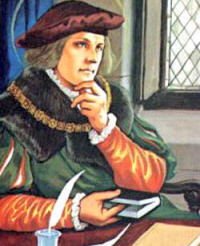
(Portrait of St. Thomas More courtesy of Catholic Culture)

Moral Clarity on Stem Cells

The Washington Times published this article today on attempts by scientists to get something like embryonic stem-cells while allegedly getting around the ethical problems.

The two methods mentioned in the Times' article are as follows: first, extracting material from embryos without destroying them; the second is to clone an embryo that cannot be implanted in a womb.

I am skeptical that the second idea originated from "ethical" concerns: rather, I believe this is yet more evidence of the truly sinister aspect of this whole slimy business: what do you do if you're so successful that the "surplus" embrionic human beings aren't enough fodder for your indusry? Hence cloning.

For those who find this area murky, there are three questions to ask that help clarify the whole matter, morally.

1. Would you do what you propose to do to a human being at a later stage of development? In the first instance, the answer is "No" -- we don't do invasive surgery on people without their consent.

2. If we're talking about procreation -- about bringing a new human life into existence -- then is the child being procreated in a human way? And to spell that out very plainly, are a man and woman, married to each other, conceiving this child through a natural, human sex act?

Catholic teaching doesn't say technology can't be used: remember, per Aquinas, all technology is itself a fruit of God's creation, and hence has a good purpose which we should seek to realize. But the purpose or meaning of technology is to serve he purpose and true end, or telos, of human existence.

So, technology that facilitates truly human means of procreation are commendable -- that is, until the humanity of the act of procreation is itself violated: hence, when conception moves from the intimacy of conjugal relations to a laboratory (recall that's where all those "surplus" embryonic human beings came from!)

All the frenzy about artificial means of conception would be really funny if it weren't so tragic, because it reveals our schizophrenia as a society: on one hand, we act as if we had a conception-deficit; simultaneously, we spend incredible engergy on combatting the conception-surplus, with human pest-control (contraceptives and abortion). The only real crisis is our frustration at not being our own gods.

3. No human being can ever be treated as a means to someone else's ends.

Pro-creating a human being that he or she may serve the advancement of another human being is always wrong. Always. A L W A Y S.

One final point.

You often hear the claim: we should keep morality/religion out of science.

Challenge that slogan every time it crops up, because it's really a lie, and here's why.

What is really at issue is not, free science vs. science-yoked-to-religion-or-morality, but rather, two competing moral/religious frameworks for scientific endeavor.

I very much doubt those who repeat this slogan really would defend Joseph Mengele, who performed experiments on the people imprisoned in the Nazi death camps. But the moment one says what he did was "wrong," that's a -- say it with me -- "MORAL JUDGMENT."

When people justify experimentation on embryonic human beings, pursuit of cloning, they argue for . . . wait for it . . . "all the good it will do for us." Well, if we extract out all moral reasoning from scientific enterprises, how do we assign any meaning to the word "good" in that last statement? In the end, one arrives not at a scientific idea, but a moral one: it's "good" to help people (be healthy, wealthy or wise) -- but why? Why, for example, shouldn't human beings be sacrificed for the flourishing of animals and plants? (Don't kid yourself -- some people believe they should be.)

So the truth is, WHOSE moral vision will govern? That's the issue.

And one reason to stand our ground, as Catholics, on preserving the natural order of procreation, and to refuse to use any human beings as instruments of others' well-being, is precisely because such moral principles are clear and timeless, and work for everyone. They are expansive: that is, they err on the side of including people in the embrace of dignity and rights, rather then err on the of exclusion, which is the problem of legal abortion, manipulation of embryonic human beings, etc.

They are non-discriminatory: regardless of race, economic status, disability, sex, religion, nationality, culture, language, sexual orientation, or what-have-you, you are protected: you have the same essential dignity as everyone else.

Yes, we Catholics derive these moral absolutes from God and his Church, but also from reason, and from Natural Law which is discovered by reason -- informed by faith, but not dependent on it. But we can -- and ought -- to appeal to others on the basis of their reason and their prudential value: i.e., even if you don't like the source of this principle, do you like the effect? It protects you, too.

Sunday, October 16, 2005

You a sucker for these quizzes too?

HASH(0x8ba0e38)
"Cultural Catholic"


You are related to longshoremen or teamsters. When
people make jokes about nuns and rulers, you
don't laugh; you get that "thousand yard
stare" instead.

See you at the next Knights of Columbus social.

Provided by Tischreden


Are You A Cultural Catholic?
brought to you by Quizilla

Go here to see all the results and I dare you to come back and say it's not funny.

'Called, anointed & sent' (Sunday homily)

Our first reading talks about
being called, anointed, and sent.

Later today, I’m going to meet with
our 8th graders preparing for
the sacrament of confirmation:

“Called, anointed, and sent”:
sounds like a good summary
of what confirmation is about.

But that applies to all of us as a parish.
We are all called, anointed, and sent.

Next week, as I hope you know,
we’re going to celebrate a very special event.
This is the 150th year of our parish.
Next Sunday we commemorate that anniversary.

And, as I hope you’ve heard by now,
part of that celebration will be
to consecrate a new altar.

Let me explain just what’s going to happen.

I know you can’t see into
this north sacristy,but there is a cut,
polished slab of marble here.

Next week at about this time, after this Mass,
we will take this piece of marble,
which is slightly larger
than the surface of this altar,
and set it on the top of this altar.
It will be a permanent addition.

Then, during the Mass at 3 PM that day,
the Archbishop will consecrate this
as a new altar—
because it has a new, stone surface.

Now, why stone?
Because the altar is a place of sacrifice:
altars in the Scriptures
were always made of stone;
so the Church, while allowing altars of wood,
such as this beautiful altar,
encourages the use of at least some stone.

So, I believed a new,
stone surface on this altar
would be a beautiful
and lasting addition to our church,
to mark 150 years behind us;
and a pledge to our future!

When the Archbishop consecrates
the new altar, he prays,
calling the Spirit down upon the altar,
and then he will pour chrism—
the same blessed,
fragrant oil used for baptisms,
confirmations and ordinations—
onto the altar, anointing it.

That’s when the lights will go on;
all the candles will be lit—
because then we have an altar:
that altar, where the Sacrifice of the Eucharist
is offered to heaven, and shared with us—
that is what makes this a Catholic church.

The anointing of the altar stands for
the anointing on each of us, and on our parish!

God has called and consecrated us:
sent us here, to Piqua—why? To do what?

Just what Paul told us in the second reading:
to share the hope we have in Jesus Christ;
sharing the Gospel not “in word alone,
but also in power and in the Holy Spirit
and with much conviction.”

This 150th Anniversary of our parish
is not about looking backward, or inward;
but about looking up: to God;
looking out: to our community;
and looking forward: to our future!

In the short time I’ve been your pastor,
one question several have raised is this:
“Father, what’s our future as a parish?”

Let me say this:
I’m not going to decide that: you will!

I know we’ve had a lot of change
in recent years,
and we know there will be more changes,
as the parishes in this area—
St. Mary’s, St. Theresa, and St. Boniface—
work more closely together.
Right now, we have five priests between us,
but that won’t always be true.

This is a reminder of how urgent it is
that we all pray for, and encourage,
more men to become priests.
As we go forward,
you’re going to hear more from me about that.

But look at our beautiful church,
which I know you love so much.
It is 140 years old this year.
The parish is 150:
this church was dedicated on October 26, 1865,
Ten years after this parish was founded,
in 1855.

Now think what was happening in 1865:
the bloodiest war in American history,
the War Between the States,
was grinding to a close.

Down in Cincinnati,
they postponed the building
of the Suspension Bridge.

But the people of this parish
did not postpone
the building of this church!
Do you think they had hope and conviction
in the power of the Holy Spirit?

I think they did! I think the knew they were
Called, anointed and sent!

So what is our future?
I’ll say it again—you will decide that!
But I believe it is as solid and permanent
as the stone altar we’ll consecrate here,
next week!

Because you and I are
called, anointed, and sent!

Saturday, October 15, 2005

My stock is soaring!


When I'm not doing what I'm supposed to be doing, I "play the market" at Blogshares, where my blog and many others are listed on a blog stock exchange.

You can't believe how fast I've made money: I've turned an intitial $500 into over $270,000 -- in a week!

Oh--did I mention it's all play money? Sorry, I forgot to tell you that.

Anyway, its fun; and my own blog has soared, from a price of $.20/share to over $36 per share. Buying opportunities abound! Catch a rising star!

Oh, and if you buy stock in me, and link me, you make the stock more valuable (hint, hint)!