This section is about the ‘problem’ texts in Mark.
Francois Dreyfus identifies those texts in Mark that might be cited as evidence against Jesus’ divinity:
Ignorance of who touched his garment (5:30);
Ignorance of Scripture (2:26; 12:36);
Denial of knowledge of the time of the end (13:32);
Refusal of title "good" (10:18);
Resistance to divine will (14:36);
Abandonment by God (15:34).
As indicated, the first three concern apparent lack of knowledge of what we might suppose God to know—or, rather, what we might expect Mark would show Jesus knowing as God. The third through fifth concern something more significant—Jesus seeming to position himself apart from God; the sixth one is not so easily categorized. I will treat each of these categories in turn, some briefly, others at more length.
The woman with the hemorrhage (5:21-34). When Jesus asks, "Who has touched my clothes," is he really ignorant of this?
The passage does not actually say Jesus did not know—it only tells us he asked. Mark himself tells us Jesus was "aware at once that power had gone out from him" (30). The disciples consider ignorance in this situation to be expected: "see how the crowd is pressing upon you?" (31). And yet we see Jesus "looked around to see who had done it." Why would Jesus ask this question if he knew the answer? Some ancient commentators can help us. Pseudo-Chrysostom observed, "although he knew her who touched him, that he might bring to light the woman, by her coming forward, and proclaim her faith, lest the virtue of his miraculous work should be consigned to oblivion." St. Bede, noting that the climax was the woman presenting herself before the Lord, adds, "the object of his question was that the woman should confess the truth of her long want of faith, her sudden belief and healing, and so herself be confirmed in her faith, and afford an example to others." Thus the climax of this encounter comes with the Lord’s parting words: "Go in peace and be free of your complaint."
Ignorance of Scripture. In Mark 2:26, the Lord refers to Abiathar giving bread to David (1 Sam. 8:17), when in fact Ahimelech did so; in 12:36, Jesus attributes Psalm 110 to David, which modern exegesis challenges. Does this show ignorance on Jesus’ part?
The "erroneous" reference to David’s authorship means little. For all we know, modern exegetes who challenge David’s authorship of Psalm 110 may be wrong. And, if Jesus did know David was not the author of the psalm, but his listeners operated on the assumption that David had written it, would it not be odd to see Jesus take this occasion to raise this question? In any case, the question we consider is not the knowledge of Christ per se, but the extent to which Mark deliberately shows Jesus as God. Attributing the psalm to David would only be a problem if we were confident Mark knew he was depicting Jesus with manifestly erroneous knowledge—and yet, it would seem that he is simply attributing to Jesus what was commonly believed to be true.
The reference to Abiathar may be of a similar nature. "Mark’s immediate source seems to have been a haggadic development of the passage. Here, Abiathar, the priest and associate of David, has replaced the lesser known Ahimelech, Abiathar’s father." Gundry gives credence to this hypothesis of Stock, by pointing out that
Jesus adds a number of features not found in the OT passage: (1) David’s having companions with him; (2) his having need; (3) his and his companions’ being hungry; (4) the house of God and David’s entering it rather than merely asking for bread; (5) Abiathar being a "high priest," not just a "priest"; (6) David’s eating the loaves…either while he is still inside the house of God or after he has come out, and (7) his giving some of the loaves to his companions.
Denial of knowledge of the time of the end (13:32). This presents a more serious challenge, because here we have Jesus’s words seeming to distinguish himself qualitatively from the Father: "But of that day or hour, no one knows, neither the angels in heaven, nor the Son, but only the Father." Many explanations of this text get at the theological issue it raises concerning Jesus’ divinity and his knowledge. But what we’re concerned about is the consistency of the portrait Mark intended to paint of Jesus—and so far we have seen a great deal of evidence for a portrait of Jesus’ divinity. So the question is, why would Mark provide this seemingly contradictory image? Before we simply accept it as an authentic saying of Christ that we can’t fully digest and move on, let us attempt a further explanation.
First, we might notice the features of the larger pericope (13:1-37), which reinforce what Mark has already given us to show Christ’s divinity. Consistent with Jesus’ self-deriving authority, Jesus answers the disciples’ questions, not with Scriptures, but with his own words. These questions are prompted by Jesus’ certain assertion that the temple will be destroyed. Hence Jesus has invited this entire discussion—he is in control. He wishes to reveal what he now recounts, concerning what will happen and what it will be like. Further, Jesus makes an astonishing claim about his words: "Heaven and earth will pass away, but my words will not pass away" (31). This is language we expect to hear about God’s word—and indeed, we do: "Though the grass withers and the flower wilts, the Word of our God stands forever" (Isa. 40:8). "Your word, LORD, stands forever; it is firm as the heavens" (Ps. 119:89).
Second, we should recall what prompted this discourse: the disciples asked two questions: "when will this happen," and "what sign will there be when all these things are about to come to an end." The Lord’s response is not to tell them directly what they ask. He describes a number of events, and says toward the end of his discourse that "when you see these things happening, know that he is near, at the gates." Fair enough—but how near? This the Lord does not answer. Instead, Jesus seems intent on tamping down their interest in this question. The emphasis in Chapter 13 is on watchfulness (9, 23, 35, 37), as opposed to readiness, in the sense of knowing just how things will turn out. Several times, the Lord cautions the disciples, "do not be alarmed" by "wars and reports of wars" (7); "do not worry beforehand about what you are to say"—instead, wait: it will be given you "at that hour" (12).
Third, we might notice that not until almost the end of this pericope does Jesus give anything like an answer to the disciples’ question—and it entails two lines that seem to contradict each other:
Amen, I say to you, this generation will not pass away until all these things have taken place.
But of that day or hour, no one knows, neither the angels in heaven, nor the Son, but only the Father.
Verse 30 by itself is most curious, in light of all Jesus does to evade being pinned down on the time of "these things"—particularly in light of verse 32. On one level, we can reconcile them this much: Mark shows Jesus saying only generally that "these things"—described in 13:1-27—will happen sometime in "this generation." Any more specific knowledge—such as the exact "day" or "hour"—"only the Father" possesses. But is Jesus really answering the original question? That is to say, is he answering on the original terms? If so, all Mark gives us in verses 4-30 seem oddly placed. If, however, we conclude that the Lord’s answer is also proposing a change in terms, as I suggest—that is, from a posture of knowing readiness versus trusting watchfulness—then the order of the material makes sense, with the bulk of the Lord’s answer stressing this very theme, then a very general time-frame, with Christ’s closing comments returning to the theme of trusting dependence on God—with even the Son of God himself as an example of this.
Why do any of us want to know "what will happen"? We want control. Armed with the knowledge they seek, the disciples could plan accordingly, and try to manage the days ahead. The Lord slams the door shut on any such ambition. They must trust God to manage things. They are not the "lord of the house," but the "servants" (13:34-35), hence the key message Jesus offers his disciples is not "when" but "Watch!"
This puts 13:32 in a different light. Instead of it being primarily about the knowledge Jesus would have as God, it is rather the supreme example of the radical dependence Jesus is recommending throughout this discourse. Even the Son—whom Mark has shown us to be YHWH in so many ways already—is yet in a relation of submission to the Father.
We’ve seen this before: at the opening of the Gospel, Jesus is the "beloved Son" receiving the Spirit and the pleasure of the Father (1:10-11); he is in the desert, assailed by Satan, dependent on God’s angels for his needs (1:12-13); in the feeding of the five thousand, and the healing of the deaf man Jesus looks up to heaven (6:41; 7:34); when Jesus speaks of his own glory, it is the glory he receives from the Father (8:38)—which is immediately confirmed in the Transfiguration (9:2-8). We might also think of the Lord’s response to James and John’s request for exaltation at his right and left (10:40). Of course, the preeminent illustration of this will come as the Lord approaches the cross. We see him praying for deliverance to "Abba, Father," in the garden—but above all, he says, "not what I will, but what you will" (14:36).
Refusal of the title good. "A man ran up, knelt down before him, and asked him, ‘Good teacher, what must I do to inherit eternal life?’ Jesus answered him, ‘why do you call me good? No one is good but God alone’" (10:17-18). As Harrington in the New Jerome Biblical Commentary observes, "A gulf between Jesus and God is contrary to much of the gospel tradition. It is explicable as either a testy reaction on Jesus’ part or a pedagogical device on Mark’s part regarding the identity of the Son of God." As the Navarre Bible explains, "It is not that Christ rejects the praise he is offered: he wants to show the depth of the young man’s words: he is good, not because he is a good man but because he is God, who is goodness itself. So, the young man has not gone far enough."
Gundry points out that the rest of the passage makes clear why we can’t leave it just as though Jesus is pointing to God, away from himself. "Jesus does something else, something astonishingly self-promoting: he tells the rich man that keeping God’s commandments will not bring him eternal life, but that carrying out Jesus’ commands will—and it is the one thing that will." We might here recall what St. Jerome observed: "The question is something like a priest who, while inwardly despising his bishop, yet continues to address him openly as ‘bishop.’ Whereupon the bishop answers, ‘To you I am not the bishop; you may leave my presence.’" Not that the man "despised" the Lord—but that he did not yet have the requisite understanding of his identity to provide a proper basis for addressing him as he did.
Resistance to divine will (14:36). See above concerning Mark 13:32.
Abandonment by God. "And at three o’clock Jesus cried out in a loud voice, ‘Eloi, Eloi, lema sabachthani?’ which is translated, ‘My God, my God, why have you forsaken me?" (15:34). This argument misses the real significance of the Lord’s words—he is citing Psalm 22, a psalm that moves from a man’s cry of desolation to his assurance of deliverance.
Francois Dreyfus’s comments bear citation here:
[I]f Jesus had wanted merely to express a personal prayer without reference to the psalm he would have said: "My Father" for Jesus never prayed "My God" apart from this single text. And the very fact that he twice repeats: "My God," a repetition, moreover, without any parallel in the prayer of Jesus, is even more of an argument Jesus quotes Scripture.
This does not mean that Jesus is not making this prayer his own. But it invites us to understand this cry in the context of the entire psalm. Let us indicate that Jesus said it in Aramaic, which implies a certain personal familiarity with this psalm since, in the liturgy, it was recited in Hebrew: now, as a matter of fact, and this is the second point, the liturgy infrequently used this psalm. The earliest testimonies regarding this relate to the Feast of Purim in which the deliverance of the Jews of Persia, who were destined for extermination by Haman, is celebrated. Psalm 22 appears to be there at its right place since it is describing a desperate situation, transformed by God into a deliverance.
With this in mind, we have no reason to see this passage at odds with Mark presenting a consistent picture of Jesus as God. Why should Jesus-as-God not be depicted citing Scripture, from the cross, that bears witness to God’s deliverance—i.e., the Resurrection? It is consistent with what we’ve seen above—Mark wishes to show the divine Son in an intimate relationship of obedience to and reliance on the Father.
Thursday, March 09, 2006


Why SNAP has zero credibility
Yesterday, the Archdiocese announced that a priest, accused of many acts of abuse of young men, had been laicized by the pope.
Here's what appeared in the Dayton Daily News today:
"Strittmatter still poses a threat to children," SNAP said. "His defrocking does not mean that he has been 'fixed.'
"It simply means that Archbishop Pilarczyk can now officially 'wash his hands' of him from now on."
Now; use your imagination to see what SNAP would have said had the Archbishop not sought the man's laicization. In fact, try to imagine all the various permutations, and then guess what SNAP would have said.
See how they work? No matter what you do, they're gonna bash you.
(Now let's see how they try to hit me because I dare to criticize their behavior.)
Here's what appeared in the Dayton Daily News today:
"Strittmatter still poses a threat to children," SNAP said. "His defrocking does not mean that he has been 'fixed.'
"It simply means that Archbishop Pilarczyk can now officially 'wash his hands' of him from now on."
Now; use your imagination to see what SNAP would have said had the Archbishop not sought the man's laicization. In fact, try to imagine all the various permutations, and then guess what SNAP would have said.
See how they work? No matter what you do, they're gonna bash you.
(Now let's see how they try to hit me because I dare to criticize their behavior.)
Tuesday, March 07, 2006
Modern Marvels

Do you ever watch "Modern Marvels" on the History Channel? I'm watching it right now. It occurs to me that we build monuments to the wrong people. We generally build monuments, and name buildings and highways after, political figures. But this episode describes the revolution wrought by such folks as McCormack, Eli Whitney, and John Deere -- the developers of mechanical harvesting machines.
Boring? Well, these folks didn't kill anybody (as far as I know) and didn't use the power of government to confiscate anyone's money. They simply invented machines that helped end starvation for millions. That's all.
The divinity of Christ in the Gospel of Mark
Over the weekend, I posted (see below) on an alleged "scholar" of Scripture who thinks there are "no traces" of divinity in Christ in the first three gospels. Someone wrote back, asking me to say more on the subject, which I am happy to do.
However, it's a huge subject, and I can only scratch the surface. Most responsible commentaries address this pretty well, at least noting the more obvious indicators.
I'll share with you some sections from work I did in the seminary. I did an extended exegesis of the Gospel of Mark (widely held to be the first Gospel written, and usually held to have a "lower," that is, more humanity-focused Christology), looking at this very question: how does the author show Christ's divinity, if at all? What intentions, on the part of the human author, may we infer, from a close reading of the text?
My conclusion was: "I believe Mark’s Gospel gives a consistent and explicit portrait of Jesus as fully divine, and I will marshal the evidence from the text to support this."
Of course, there are a few passages in Mark that can be cited against this argument. But here's the noteworthy thing: "the troublesome texts for my argument arise only in words directly attributed to Our Lord--which invites another hypothesis which allows for the unevenness and does not require us to think our human author or redactor was having some off days as he produced his work: Mark is reporting troublesome things Jesus really said--and he didn’t feel at liberty to 'fix' them."
In short, sayings by our Lord, appearing in Mark, need not undermine the conclusion that the author of the Gospel intends to portray Christ as divine, but rather point to the author faithfully presenting the enigmatic quality of Jesus. After all, if Christ is divine, yet human as well, how could he not be enigmatic to us? Some troublesome sayings should not be so surprising. Rather, we might find the whole package a little too neat and tidy without such troublesome sayings.
Anyway, we'll come to those troublesome passages eventually.
Let's look at some highlights of Mark. I'm going to insert some of my earlier work, without footnotes and all that falderall; if anyone wants further information, let me know.
In Chapter 1, Mark cites Isaiah, in reference to John the Baptist.
As it is written in Isaiah the prophet: “Behold, I am sending my messenger ahead of you; he will prepare your way. A voice of one crying out in the desert: ‘Prepare the way of the Lord, make straight his paths’" (1:2-3).
Mark here identifies John the Baptist as God’s messenger, with God speaking in the first person, in relation to Jesus’ advent. Thus Mark, in conflating Old Testament passages, has God addressing Jesus. Mark combines at least two and perhaps three, Old Testament passages: Exod. 23:20, Isa. 40:3, and Mal. 3:1. In Exodus we read, “See, I am sending an angel before you, to guard you on the way and bring you to the place I have prepared.” This seems to strike a discordant note, as the emphasis is on the messenger, rather than one to whom he points. But as Daniel Harrington observes, “In Exod. 23:20 (LXX), God promises to send his messenger before Israel and guide it to the Promised Land. Using phrases from Exod. 23:20, Mal. (MT) 3:1 placed God’s promise in an eschatological context and prepared for the identification of the precursor as Elijah”—whom Mark identifies with John the Baptist.
Note what Malachi actually says: “I am sending my messenger to prepare the way before me; and suddenly there will come to the temple the LORD whom you seek.” Thus in Malachi, the messenger (whom Mark identifies with John) precedes YHWH. The Isaiah passage confirms this: “A voice cries out: In the desert prepare the way of the LORD! Make straight in the wasteland a highway for our God!”
Let's look closer at that Malachi (3:1-3) passage being recalled here:
Lo, I am sending my messenger
to prepare the way before me;
And suddenly there will come
to the temple the LORD whom you seek,
And the messenger of the covenant
whom you desire.
Yes, he is coming,
says the LORD of hosts.
But who will endure the day of his coming?
And who can stand when he appears?
For he is like the refiner’s fire,
or like the fuller’s lye.
He will sit refining and purifying (silver),
and he will purify the sons of Levi,
Refining them like gold or like silver
that they may offer due sacrifice to the LORD.
Of course, later in Mark’s Gospel, Jesus will come “suddenly” to the temple (11:15); in Chapter 13, Mark will describe Jesus coming in power and judgment. Perhaps Mark wishes us further to connect Malachi’s image of “refining and purifying” the “sons of Levi” with Jesus’ ministry of preaching repentance (1:15), his role of judgment (13:24-27) and the new covenant of his blood, poured out for the many (14:24).
If we look at the context of our Isaiah reference, 40:1-11, we find references to expiation (2), the revelation of God’s glory (5), and of God himself coming to Jerusalem (9-10)—and while Mark doesn’t do so expressly, we can certainly make connections here, with Jesus’ passion and death, his transfiguration and his entry into Jerusalem. We can wonder if that is where Mark was intending us to go.
Then we move on to Mark 1:9-11: "The heavens being torn open…a voice came from the heavens."
The main scene for Mark’s Gospel is earth; but at several points our view expands to include the heavens. The voice that speaks here, will speak again in 9:7. What is the significance of the voice coming from heaven? Other than 13:31 (“Heaven and earth will pass away, but my words will not pass away”), heaven always denotes divinity or divine authority. Jesus looks heavenward before performing signs (6:41; 7:34), and it is precisely a “sign from heaven” that Christ’s opponents seek (8:11). When Jesus tells the high priest he will see “the Son of Man seated at the right hand of the Power and coming with the clouds of heaven,” alluding to Dan. 7:13 and Ps. 110:1, the link to divinity will be obvious enough at the Lord’s trial for the high priest to cry “blasphemy” (14:64). We see Jesus take his seat at the end (16:19).
But we discover more subtle signs of Jesus’ heavenly connection as well. When demons speak, they have startling clarity about Jesus’ identity: “I know who you are—the Holy One of God!” cries the first demoniac to meet Jesus (1:24; see also 3:11; 5:7). We get atmospheric signs—but only twice: at the Transfiguration of Jesus, when a cloud overshadows Jesus (9:7), and again at the crucifixion, when darkness covers the “whole land” for three hours (15:33).
Returning to “the heavens being torn open.” Timothy Schehr, commenting on the parallel story in Matthew, deems this momentous:
Only once in the Old Testament do we read that the skies opened for a vision of God and that was in a vision granted to Ezekiel at the time of his call…
What does it mean when God opens the sky? A reference to Isaiah might be of help here. In…[Chapters] 63 and 64 the people imagine themselves to be sealed off from God, as if the heavens were a barrier between themselves and God. They even ask God to "rend the heavens" and come down to save them. At the baptism of Jesus, there is no barrier between God and the world. The sky is opened and the Father and Jesus act as one. It seems to emphasize how close God wants to be to us.
Note what Mark does not say or do to link Jesus to heaven.
Occasionally the Lord looks heavenward before a sign (6:41; 7:34); and twice we see Jesus praying in Mark (6:46; 14:32). But we never see Jesus asking heaven for help—which is just what we do see in the Old Testament miracles that parallel Jesus’. When Elijah and Elisha raise the dead, they ask God’s intervention (1 Kings 17:21; 2 Kings 4:33). In multiplying the widow’s provisions, Elijah refers to God’s action (1 Kings 17:14). When Elisha multiplies loaves almost exactly as Jesus does, he also cites God’s action (2 Kings 4:43-44). In contrast, Mark shows a consistent pattern—Jesus either speaking or acting, and the miracle occurs. This recalls Genesis 1:3: “Then God said: ‘Let there be light,’ and there was light.” Augustine Stock points out that Mark’s Gospel opens with έν άρχή, recalling the opening words of the Greek translation of Genesis, έν άρχή.
Twice in Mark Jesus calms the sea (4:39-41; 6:50-51), recalling psalms describing YHWH doing this (Pss. 104:7; 106:9; 107:29).
In Mark 6, Jesus walks on the water. There, Mark wrote, “He meant to pass by them (6:49). For John J. Kilgallen, this “recalls that this is the description God uses of himself in showing himself to Moses [Ex. 33:18-23]. God wanted Moses to see him, but the best that the human being could be given is a glimpse of the divine being as ‘he passed them by.’”
Also on this occasion, Jesus says “έγώ εìμι,” echoing YHWH’s self-identification in Exodus 3:14. Daniel J. Harrington in the New Jerome Biblical Commentary insists on this, adding that only God walks on water (Job 9:8; 38:16). “έγώ εìμι” appears twice more in Mark—Jesus predicts false messiahs will say this (13:6); and he answers the Sanhedrin in this fashion, provoking a cry of blasphemy (14:62).
There are at least two other occasions Mark puts YHWH’s words on Jesus’ lips.
Both come in response to his disciples’ inability to grasp what Jesus is telling or doing. When the Twelve ask privately for an explanation of Christ’s first parable, he responds, “to those outside everything comes in parables, so that ‘they may look and see but not perceive, and hear and listen but not understand, in order that they may not be converted and be forgiven’” (4:12).
This is from Isaiah 6, where the prophet has been given his great epiphany of YHWH, and the Lord God commissions him to prophesy to his people. In Mark 8, the Lord is exasperated at the disciples’ lack of understanding about the feeding of the crowds. “Do you have eyes and not see, ears and not hear?” (8:18), Christ asks, his words recalling Jer. 5:12 and Ezek. 12:2.
Mark 1:13: "He remained in the desert for forty days."
Mark has already introduced the figure of Elijah. Now we begin to have allusions to Moses, and perhaps again to Elijah. What will Mark make of this?
In the ensuing narrative, Mark contrasts Jesus with both figures. To fully appreciate this, we need to make an excursus here to note one more detail: just twice Mark has Jesus going “up the mountain”: Jesus first ascends “the mountain” in 3:13, when he summoned “the twelve,” and again in Mark 9:2, the Transfiguration. We see this elsewhere in Scripture especially in relation to Moses and Elijah: when YHWH forms his covenant—at his mountain—with the twelve tribes, in Exodus 19 and 24, and with Elijah (1 Kings 19:8). (We could recall Abraham’s ascent up the mountain, but I don’t see any indication Mark is alluding to that.)
Mark is preparing to answer—especially in relation to Moses and Elijah—the questions he shows Jesus asking: “who do people say…who do you say that I am?” (8:27-29). We have seen how he introduces Elijah. How about Moses? In Mark 7, Jesus rebukes Pharisees and scribes for modifying Moses’ teaching (7:8-13). But when the Pharisees challenge him on divorce, Jesus does not flinch from modifying Moses, appealing to the original divine intent (10:1-12). I.e., they are subordinate to Moses, but Moses is subordinate to Jesus—which is consistent to his approach to the Sabbath (2:28).
All this comes to a head at the transfiguration of Jesus. W. M. Swartley and J. A. Ziesler discover parallels between the transfiguration account and Moses’ experiences on Sinai: Moses takes three individuals with him (Exod. 24:1-9); Moses too is radiant (Exod. 34:29-35). Stock points out, concerning Mark’s description of Jesus’ “dazzling white” appearance: “in the OT the glory of God is always conceived as shining brilliance or bright light. Here that language is borrowed to describe the glory of the Son of God.” Perhaps Mark was recalling the words of Isaiah:
Rise up in splendor! Your light has come,
the glory of the Lord shines upon you.
See, darkness covers the earth,
and thick clouds cover the peoples;
But upon you the LORD shines,
and over you appears his glory. Nations shall walk by your light,
and kings by your shining radiance (Isa. 60:1-3).
In the Transfiguration, Mark answers any question about the relationship of Jesus to Moses and Elijah. Here we have all three side-by-side—the second and last time Mark takes us “up a mountain” (9:2). By a process of elimination, we can identify Jesus only with YHWH. The literary genre—“that of an epiphany, a sudden manifestation of the divine” —and the selection of Elijah and Moses confirm this. They are the only two figures in the Bible who seek to “see” God—which they both do, on the mountain. But their encounter is veiled. Moses must hide, and see only God’s “back” (Exod. 33:22-23); Elijah experiences only signs (1 Kings 19:11-12). But Mark shows us Moses and Elijah no longer hiding, but “conversing” with Jesus. Moses sees YHWH’s face at last!
And he cured many who were sick (1:34). The healing ministry of Jesus figures prominently in Mark; beginning immediately in the first chapter, with the man with an “unclean spirit,” then Simon Peter’s mother-in-law (30-31), then those brought from the “whole town” (32-34)—and so on through much of the Gospel. Mark uses these stories to teach many things, but several—which include confrontations between the Lord and demonic powers—are very suggestive of Jesus’ divinity.
We see this in the first healing.
Jesus is accosted by a man with an unclean spirit, who shouts, “What do you want with us, Jesus of Nazareth? Have you come to destroy us? I know who you are: the Holy One of God.’
This is a remarkable choice of words. The complete phrase, “Holy One of God,” appears only in the Gospels, in this story or parallels to it. But the term “Holy One” appears frequently throughout the Old and New Testaments —occasionally of mere human beings (Num. 16:7, Ps. 106:16; Dan. 3:35; 4:13; 23; 8:13), but far more usually of God. It appears 62 times in the Old Testament, most frequently in Isaiah, who uses it 29 times.
There are pleasing connections we could draw—Isaiah speaks of the Holy One “in your midst” (12:6), in whom the poor and lowly rejoice, who gives sight to the blind and makes the deaf hear (29:18-19). We can only speculate whether Mark meant for us to discover these. What is clear is that, having the opportunity to cite them himself, he did not do so when it would have been convenient: when he shows Jesus healing the deaf and blind (7:32-37; 8:22-26; 9:17-29; 10:46-52), and on his entry into Jerusalem, where the poor and lowly do indeed rejoice at the Holy One in their midst (11:1-11). All the evidence suggests Mark’s use of “Holy One” draws on the term’s divine association rather than on its association with mere mortals.
The Lord’s ability to effect healing and command evil powers is rightly astonishing and inexplicable (1:27).
In the next chapter, Mark forces the question of its significance: first when he shows Jesus not only healing, but forgiving sins (2:5-12), and again when he later shows Jesus as “master even of the Sabbath” (2:28).
In the healing episode, Mark uses a device we saw already with the unclean spirit, and which we’ll see again—Mark has the enemies of Jesus immediately sensing the deeper reality. Thus the unclean spirits recognize him (1:24; 3:12; 5:7); and here the scribes ask just the right question (without, sadly, arriving at the right answer): “How can this man talk like that? He is blaspheming. Who but God can forgive sins?” (2:7).
Perhaps the scribes were recalling Isaiah 43:25: “It is I, I, who wipe out, for my own sake, your offense; your sins I remember no more.” Robert Gundry points out that “According to Jewish belief, not even the Messiah was going to forgive sins.” With high drama, Mark shows Jesus decisively resolving the question as the scribes proposed it, and proclaims healing. As we saw above, we recall the Creator’s words effecting what they describe in Genesis. The crisis of explaining this—that is, other than by admitting Jesus’ divinity—forces the Lord’s opponents to suppose Satan is at work in Jesus—a notion the Lord ridicules (3:22-27), and which has the ring of desperation about it.
Throughout Mark, we see many examples of Jesus’ word effecting healing—but there is a striking example of the opposite: the cursing of the fig tree. We might ask of this episode a question similar to the scribes’ question in Mark 2: Who can, by a word, cause life to wither but God alone? Indeed, as Harrington points out, this is a frequent image, appearing in the prophets, almost always referring to divine action:
You shall become like a tree with falling leaves,
like a garden that has no water (Isa. 1:30).
The LORD is angry with all the nations
and is wrathful against all their host;
He has doomed them and given them over to slaughter.
Their slain shall be cast out,
their corpses shall send up a stench;
The mountains shall run with their blood,
and all the hills shall rot;
The heavens shall be rolled up like a scroll,
and all their host shall wither away,
As the leaf wilts on the vine,
or as the fig withers on the tree (Isa. 34:2-4).
I will gather them all in, says the LORD:
no grapes on the vine, no figs on the fig trees,
foliage withered! (Jer. 8:13).
I will lay waste her vines and fig trees,
of which she said,
“These are the hire my lovers have given me” (Hos. 2:14).
Like the first fruits of the fig tree in its prime,
I considered your fathers…
I will love them no longer;
all their princes are rebels.
Ephraim is stricken,
their root is dried up;
They shall bear no fruit (Hos. 9:10, 15-16).
Taylor points out, “The story, as Mark records it, is a miracle-story intended to illustrated the divine power of Jesus.” We might note that, right after the fig tree account Mark gives us comes the parable of the vineyard tenants (12:1-12), that so strongly echoes Isaiah 5.
Well, if you've read this far, and want more, let me know.
However, it's a huge subject, and I can only scratch the surface. Most responsible commentaries address this pretty well, at least noting the more obvious indicators.
I'll share with you some sections from work I did in the seminary. I did an extended exegesis of the Gospel of Mark (widely held to be the first Gospel written, and usually held to have a "lower," that is, more humanity-focused Christology), looking at this very question: how does the author show Christ's divinity, if at all? What intentions, on the part of the human author, may we infer, from a close reading of the text?
My conclusion was: "I believe Mark’s Gospel gives a consistent and explicit portrait of Jesus as fully divine, and I will marshal the evidence from the text to support this."
Of course, there are a few passages in Mark that can be cited against this argument. But here's the noteworthy thing: "the troublesome texts for my argument arise only in words directly attributed to Our Lord--which invites another hypothesis which allows for the unevenness and does not require us to think our human author or redactor was having some off days as he produced his work: Mark is reporting troublesome things Jesus really said--and he didn’t feel at liberty to 'fix' them."
In short, sayings by our Lord, appearing in Mark, need not undermine the conclusion that the author of the Gospel intends to portray Christ as divine, but rather point to the author faithfully presenting the enigmatic quality of Jesus. After all, if Christ is divine, yet human as well, how could he not be enigmatic to us? Some troublesome sayings should not be so surprising. Rather, we might find the whole package a little too neat and tidy without such troublesome sayings.
Anyway, we'll come to those troublesome passages eventually.
Let's look at some highlights of Mark. I'm going to insert some of my earlier work, without footnotes and all that falderall; if anyone wants further information, let me know.
In Chapter 1, Mark cites Isaiah, in reference to John the Baptist.
As it is written in Isaiah the prophet: “Behold, I am sending my messenger ahead of you; he will prepare your way. A voice of one crying out in the desert: ‘Prepare the way of the Lord, make straight his paths’" (1:2-3).
Mark here identifies John the Baptist as God’s messenger, with God speaking in the first person, in relation to Jesus’ advent. Thus Mark, in conflating Old Testament passages, has God addressing Jesus. Mark combines at least two and perhaps three, Old Testament passages: Exod. 23:20, Isa. 40:3, and Mal. 3:1. In Exodus we read, “See, I am sending an angel before you, to guard you on the way and bring you to the place I have prepared.” This seems to strike a discordant note, as the emphasis is on the messenger, rather than one to whom he points. But as Daniel Harrington observes, “In Exod. 23:20 (LXX), God promises to send his messenger before Israel and guide it to the Promised Land. Using phrases from Exod. 23:20, Mal. (MT) 3:1 placed God’s promise in an eschatological context and prepared for the identification of the precursor as Elijah”—whom Mark identifies with John the Baptist.
Note what Malachi actually says: “I am sending my messenger to prepare the way before me; and suddenly there will come to the temple the LORD whom you seek.” Thus in Malachi, the messenger (whom Mark identifies with John) precedes YHWH. The Isaiah passage confirms this: “A voice cries out: In the desert prepare the way of the LORD! Make straight in the wasteland a highway for our God!”
Let's look closer at that Malachi (3:1-3) passage being recalled here:
Lo, I am sending my messenger
to prepare the way before me;
And suddenly there will come
to the temple the LORD whom you seek,
And the messenger of the covenant
whom you desire.
Yes, he is coming,
says the LORD of hosts.
But who will endure the day of his coming?
And who can stand when he appears?
For he is like the refiner’s fire,
or like the fuller’s lye.
He will sit refining and purifying (silver),
and he will purify the sons of Levi,
Refining them like gold or like silver
that they may offer due sacrifice to the LORD.
Of course, later in Mark’s Gospel, Jesus will come “suddenly” to the temple (11:15); in Chapter 13, Mark will describe Jesus coming in power and judgment. Perhaps Mark wishes us further to connect Malachi’s image of “refining and purifying” the “sons of Levi” with Jesus’ ministry of preaching repentance (1:15), his role of judgment (13:24-27) and the new covenant of his blood, poured out for the many (14:24).
If we look at the context of our Isaiah reference, 40:1-11, we find references to expiation (2), the revelation of God’s glory (5), and of God himself coming to Jerusalem (9-10)—and while Mark doesn’t do so expressly, we can certainly make connections here, with Jesus’ passion and death, his transfiguration and his entry into Jerusalem. We can wonder if that is where Mark was intending us to go.
Then we move on to Mark 1:9-11: "The heavens being torn open…a voice came from the heavens."
The main scene for Mark’s Gospel is earth; but at several points our view expands to include the heavens. The voice that speaks here, will speak again in 9:7. What is the significance of the voice coming from heaven? Other than 13:31 (“Heaven and earth will pass away, but my words will not pass away”), heaven always denotes divinity or divine authority. Jesus looks heavenward before performing signs (6:41; 7:34), and it is precisely a “sign from heaven” that Christ’s opponents seek (8:11). When Jesus tells the high priest he will see “the Son of Man seated at the right hand of the Power and coming with the clouds of heaven,” alluding to Dan. 7:13 and Ps. 110:1, the link to divinity will be obvious enough at the Lord’s trial for the high priest to cry “blasphemy” (14:64). We see Jesus take his seat at the end (16:19).
But we discover more subtle signs of Jesus’ heavenly connection as well. When demons speak, they have startling clarity about Jesus’ identity: “I know who you are—the Holy One of God!” cries the first demoniac to meet Jesus (1:24; see also 3:11; 5:7). We get atmospheric signs—but only twice: at the Transfiguration of Jesus, when a cloud overshadows Jesus (9:7), and again at the crucifixion, when darkness covers the “whole land” for three hours (15:33).
Returning to “the heavens being torn open.” Timothy Schehr, commenting on the parallel story in Matthew, deems this momentous:
Only once in the Old Testament do we read that the skies opened for a vision of God and that was in a vision granted to Ezekiel at the time of his call…
What does it mean when God opens the sky? A reference to Isaiah might be of help here. In…[Chapters] 63 and 64 the people imagine themselves to be sealed off from God, as if the heavens were a barrier between themselves and God. They even ask God to "rend the heavens" and come down to save them. At the baptism of Jesus, there is no barrier between God and the world. The sky is opened and the Father and Jesus act as one. It seems to emphasize how close God wants to be to us.
Note what Mark does not say or do to link Jesus to heaven.
Occasionally the Lord looks heavenward before a sign (6:41; 7:34); and twice we see Jesus praying in Mark (6:46; 14:32). But we never see Jesus asking heaven for help—which is just what we do see in the Old Testament miracles that parallel Jesus’. When Elijah and Elisha raise the dead, they ask God’s intervention (1 Kings 17:21; 2 Kings 4:33). In multiplying the widow’s provisions, Elijah refers to God’s action (1 Kings 17:14). When Elisha multiplies loaves almost exactly as Jesus does, he also cites God’s action (2 Kings 4:43-44). In contrast, Mark shows a consistent pattern—Jesus either speaking or acting, and the miracle occurs. This recalls Genesis 1:3: “Then God said: ‘Let there be light,’ and there was light.” Augustine Stock points out that Mark’s Gospel opens with έν άρχή, recalling the opening words of the Greek translation of Genesis, έν άρχή.
Twice in Mark Jesus calms the sea (4:39-41; 6:50-51), recalling psalms describing YHWH doing this (Pss. 104:7; 106:9; 107:29).
In Mark 6, Jesus walks on the water. There, Mark wrote, “He meant to pass by them (6:49). For John J. Kilgallen, this “recalls that this is the description God uses of himself in showing himself to Moses [Ex. 33:18-23]. God wanted Moses to see him, but the best that the human being could be given is a glimpse of the divine being as ‘he passed them by.’”
Also on this occasion, Jesus says “έγώ εìμι,” echoing YHWH’s self-identification in Exodus 3:14. Daniel J. Harrington in the New Jerome Biblical Commentary insists on this, adding that only God walks on water (Job 9:8; 38:16). “έγώ εìμι” appears twice more in Mark—Jesus predicts false messiahs will say this (13:6); and he answers the Sanhedrin in this fashion, provoking a cry of blasphemy (14:62).
There are at least two other occasions Mark puts YHWH’s words on Jesus’ lips.
Both come in response to his disciples’ inability to grasp what Jesus is telling or doing. When the Twelve ask privately for an explanation of Christ’s first parable, he responds, “to those outside everything comes in parables, so that ‘they may look and see but not perceive, and hear and listen but not understand, in order that they may not be converted and be forgiven’” (4:12).
This is from Isaiah 6, where the prophet has been given his great epiphany of YHWH, and the Lord God commissions him to prophesy to his people. In Mark 8, the Lord is exasperated at the disciples’ lack of understanding about the feeding of the crowds. “Do you have eyes and not see, ears and not hear?” (8:18), Christ asks, his words recalling Jer. 5:12 and Ezek. 12:2.
Mark 1:13: "He remained in the desert for forty days."
Mark has already introduced the figure of Elijah. Now we begin to have allusions to Moses, and perhaps again to Elijah. What will Mark make of this?
In the ensuing narrative, Mark contrasts Jesus with both figures. To fully appreciate this, we need to make an excursus here to note one more detail: just twice Mark has Jesus going “up the mountain”: Jesus first ascends “the mountain” in 3:13, when he summoned “the twelve,” and again in Mark 9:2, the Transfiguration. We see this elsewhere in Scripture especially in relation to Moses and Elijah: when YHWH forms his covenant—at his mountain—with the twelve tribes, in Exodus 19 and 24, and with Elijah (1 Kings 19:8). (We could recall Abraham’s ascent up the mountain, but I don’t see any indication Mark is alluding to that.)
Mark is preparing to answer—especially in relation to Moses and Elijah—the questions he shows Jesus asking: “who do people say…who do you say that I am?” (8:27-29). We have seen how he introduces Elijah. How about Moses? In Mark 7, Jesus rebukes Pharisees and scribes for modifying Moses’ teaching (7:8-13). But when the Pharisees challenge him on divorce, Jesus does not flinch from modifying Moses, appealing to the original divine intent (10:1-12). I.e., they are subordinate to Moses, but Moses is subordinate to Jesus—which is consistent to his approach to the Sabbath (2:28).
All this comes to a head at the transfiguration of Jesus. W. M. Swartley and J. A. Ziesler discover parallels between the transfiguration account and Moses’ experiences on Sinai: Moses takes three individuals with him (Exod. 24:1-9); Moses too is radiant (Exod. 34:29-35). Stock points out, concerning Mark’s description of Jesus’ “dazzling white” appearance: “in the OT the glory of God is always conceived as shining brilliance or bright light. Here that language is borrowed to describe the glory of the Son of God.” Perhaps Mark was recalling the words of Isaiah:
Rise up in splendor! Your light has come,
the glory of the Lord shines upon you.
See, darkness covers the earth,
and thick clouds cover the peoples;
But upon you the LORD shines,
and over you appears his glory. Nations shall walk by your light,
and kings by your shining radiance (Isa. 60:1-3).
In the Transfiguration, Mark answers any question about the relationship of Jesus to Moses and Elijah. Here we have all three side-by-side—the second and last time Mark takes us “up a mountain” (9:2). By a process of elimination, we can identify Jesus only with YHWH. The literary genre—“that of an epiphany, a sudden manifestation of the divine” —and the selection of Elijah and Moses confirm this. They are the only two figures in the Bible who seek to “see” God—which they both do, on the mountain. But their encounter is veiled. Moses must hide, and see only God’s “back” (Exod. 33:22-23); Elijah experiences only signs (1 Kings 19:11-12). But Mark shows us Moses and Elijah no longer hiding, but “conversing” with Jesus. Moses sees YHWH’s face at last!
And he cured many who were sick (1:34). The healing ministry of Jesus figures prominently in Mark; beginning immediately in the first chapter, with the man with an “unclean spirit,” then Simon Peter’s mother-in-law (30-31), then those brought from the “whole town” (32-34)—and so on through much of the Gospel. Mark uses these stories to teach many things, but several—which include confrontations between the Lord and demonic powers—are very suggestive of Jesus’ divinity.
We see this in the first healing.
Jesus is accosted by a man with an unclean spirit, who shouts, “What do you want with us, Jesus of Nazareth? Have you come to destroy us? I know who you are: the Holy One of God.’
This is a remarkable choice of words. The complete phrase, “Holy One of God,” appears only in the Gospels, in this story or parallels to it. But the term “Holy One” appears frequently throughout the Old and New Testaments —occasionally of mere human beings (Num. 16:7, Ps. 106:16; Dan. 3:35; 4:13; 23; 8:13), but far more usually of God. It appears 62 times in the Old Testament, most frequently in Isaiah, who uses it 29 times.
There are pleasing connections we could draw—Isaiah speaks of the Holy One “in your midst” (12:6), in whom the poor and lowly rejoice, who gives sight to the blind and makes the deaf hear (29:18-19). We can only speculate whether Mark meant for us to discover these. What is clear is that, having the opportunity to cite them himself, he did not do so when it would have been convenient: when he shows Jesus healing the deaf and blind (7:32-37; 8:22-26; 9:17-29; 10:46-52), and on his entry into Jerusalem, where the poor and lowly do indeed rejoice at the Holy One in their midst (11:1-11). All the evidence suggests Mark’s use of “Holy One” draws on the term’s divine association rather than on its association with mere mortals.
The Lord’s ability to effect healing and command evil powers is rightly astonishing and inexplicable (1:27).
In the next chapter, Mark forces the question of its significance: first when he shows Jesus not only healing, but forgiving sins (2:5-12), and again when he later shows Jesus as “master even of the Sabbath” (2:28).
In the healing episode, Mark uses a device we saw already with the unclean spirit, and which we’ll see again—Mark has the enemies of Jesus immediately sensing the deeper reality. Thus the unclean spirits recognize him (1:24; 3:12; 5:7); and here the scribes ask just the right question (without, sadly, arriving at the right answer): “How can this man talk like that? He is blaspheming. Who but God can forgive sins?” (2:7).
Perhaps the scribes were recalling Isaiah 43:25: “It is I, I, who wipe out, for my own sake, your offense; your sins I remember no more.” Robert Gundry points out that “According to Jewish belief, not even the Messiah was going to forgive sins.” With high drama, Mark shows Jesus decisively resolving the question as the scribes proposed it, and proclaims healing. As we saw above, we recall the Creator’s words effecting what they describe in Genesis. The crisis of explaining this—that is, other than by admitting Jesus’ divinity—forces the Lord’s opponents to suppose Satan is at work in Jesus—a notion the Lord ridicules (3:22-27), and which has the ring of desperation about it.
Throughout Mark, we see many examples of Jesus’ word effecting healing—but there is a striking example of the opposite: the cursing of the fig tree. We might ask of this episode a question similar to the scribes’ question in Mark 2: Who can, by a word, cause life to wither but God alone? Indeed, as Harrington points out, this is a frequent image, appearing in the prophets, almost always referring to divine action:
You shall become like a tree with falling leaves,
like a garden that has no water (Isa. 1:30).
The LORD is angry with all the nations
and is wrathful against all their host;
He has doomed them and given them over to slaughter.
Their slain shall be cast out,
their corpses shall send up a stench;
The mountains shall run with their blood,
and all the hills shall rot;
The heavens shall be rolled up like a scroll,
and all their host shall wither away,
As the leaf wilts on the vine,
or as the fig withers on the tree (Isa. 34:2-4).
I will gather them all in, says the LORD:
no grapes on the vine, no figs on the fig trees,
foliage withered! (Jer. 8:13).
I will lay waste her vines and fig trees,
of which she said,
“These are the hire my lovers have given me” (Hos. 2:14).
Like the first fruits of the fig tree in its prime,
I considered your fathers…
I will love them no longer;
all their princes are rebels.
Ephraim is stricken,
their root is dried up;
They shall bear no fruit (Hos. 9:10, 15-16).
Taylor points out, “The story, as Mark records it, is a miracle-story intended to illustrated the divine power of Jesus.” We might note that, right after the fig tree account Mark gives us comes the parable of the vineyard tenants (12:1-12), that so strongly echoes Isaiah 5.
Well, if you've read this far, and want more, let me know.
Monday, March 06, 2006
Will President Bush drag down the GOP this year?
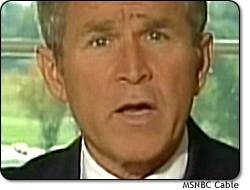
There's a lot of discussion about President Bush's awful poll numbers, and all his many problems, and how this will affect the GOP in the fall elections.
Let me be clear: I make no predictions. Political predictions are perilous, and a little suspect, for reasons I may get around to explaining by the end of this post.
But let me say this, first, about this year's elections.
I am skeptical of the notion that what people think about Bush will be a huge factor in how people vote in Congressional elections.
Rather, I think the issue will be the way the actions of Congress itself.
It may be (nb: not a prediction) that the GOP will lose seats in either house of Congress; but if so, it will be because the Republicans failed to give the components of their winning coalition sufficient reason to care about their re-election. The signs of that are abudant:
* Spending that is outrageously out of control.
* Creating a new entitlement, the Medicare prescription goodie.
* Enacting the so-called Campaign Finance 'Reform' (aka the Free Speech Restriction Act).
* Failing to advance legislation of concern, such as the National Right to Work Act; while I don't pay close attention to other issues, I rather suspect gun-rights advocates might have a similar complaint. Let me know.
If this is correct, then it may be that the House is more vulnerable; the Senate, at least, can point to the confirmation of two justices.
Plus, while the House, in the wrong hands, can be a source of mischief, if the Senate stays GOP, anything bad can be stopped there. In short, GOP House members might have a harder time getting activists to care about their re-election, than Senators. That said, the GOP may still hold onto the House.
But back to the "Will Bush pull them down?" question.
Recall that in 1998, the GOP tried this approach with Clinton -- instead of forcing votes in Congress that put the Democrats actually on the ballot that fall, on the defensive, it pursued impeachment. The GOP attempted to make the President the issue. President Clinton's poll numbers were very low at that time.
The strategy backfired; the GOP lost ground in 1998. Perhaps because a "don't you hate Clinton?" campaign had one, key flaw: Clinton wasn't on the ballot! Most people might be a little puzzled by the argument, "If you hate him, you should vote against her, because they belong to the same party!" It doesn't follow. So why should it work any better this year, for the "Hate Bush" crowd?
Finally, I said above the political predictions are a little suspect. I say this tentatively, because it may just be I'm not smart enough to do it right; but really smart people I know also don't do them. And their reason is that there are enough variables that remain unknowns ahead of time as to make an accurate prediction more a matter of luck than anything else. (That is, barring some events that make predictions irrelevant. If, for example, the Congressional GOP all held a news conference to announce they'd joined al Qaeda, a subsequent prediction that they'd lose this fall isn't terribly insightful.)
Put it another way: the thing with elections is, someone has to win! No matter how stupidly a candidate behaves, he can still win, provided his opponent behaves similarly, or worse. So someone looking at the current situation and saying, "the GOP has so many vulnerabilities, they are bound to lose" omits consideration of a key fact -- it remains to be seen whether the Dems will supply their own stupidities, and give the GOP a relative advantage.
Also, most of these assertions are making judgments about the "big picture," the national mood. But Congressional elections are a series of individual elections. National mood and national issues certainly play a part, but individual characteristics of the makeup of the district, of the candidates, etc., cannot be accounted for in such broad-brush approaches.
Third, you should know that most of the people who offer these comments on TV, in print and on the Internet are not asked to give their opinion because they're so astute; but because they are merely plausible as sources of this information, and they are available for comment, and for various reasons, all to happy to spout an opinion. Very few of them are terribly concerned about making wrong preditions, because they'll have plenty of opportunities to give a different prediction; and even if they are flat-wrong, odds are they'll still be asked again--because they'll remain plausible and available.
The sort of people who really have something intelligent to say about these things are usually not as glib -- e.g., they won't answer stupid-question-number-one: who will win this fall? -- and therefore they don't make good copy; so even if asked, they don't make it into print; and they don't get asked often.
So, what you get is fewer of the really smart folks, and more of the really airheaded-but-love-to-be-quoted folks; as it is, the proportion of the latter is bound to be greater than the former.
Having said all that, I will say this: people who I think are more insightful in these matters include Michael Barone, whom I link at your right; Robert Novak, whose column I check regularly; Tom Bethel, who is fairly astute in politics, and writes for the American Spectator and occasionally the National Review, but alas, doesn't write about politics all that often. Fred Barnes, who edits the Weekly Standard and appears on the Fox Network, is usually sensible, and not easily taken in by a particular trend, although a little too much of a cheerleader for the Bush White House for my taste.
Sunday, March 05, 2006
Do you have to be gay to enter a gay marriage?
Today I went down to Dayton for a special liturgy with the Bishop, called the "Rite of Election," at which the bishop recognizes those approaching baptism. After which, one of our RCIA team members and I went out for dinner.
He told me a story over a plate of ribs about two men who plan to contract marriage, in Canada, despite both being heterosexual! Why would they do this? Because they get tax benefits, and can still have fun with girls without having to marry them!
I have no idea if this is actually true, or how many heterosexual men would do this. But it raises a question for those who advocate "gay marriage," is this okay with you? Do you have to be gay to enter a gay marriage? And if so, why? And how exactly shall the state regulate this? Disgusting posts (as are all of them) are subject to deletion.
He told me a story over a plate of ribs about two men who plan to contract marriage, in Canada, despite both being heterosexual! Why would they do this? Because they get tax benefits, and can still have fun with girls without having to marry them!
I have no idea if this is actually true, or how many heterosexual men would do this. But it raises a question for those who advocate "gay marriage," is this okay with you? Do you have to be gay to enter a gay marriage? And if so, why? And how exactly shall the state regulate this? Disgusting posts (as are all of them) are subject to deletion.
Why are Bible debunkers not smarter?
The Washington Post has an article today, "The Book of Bart," about the author of Misquoting Jesus, which no doubt will have its run among dilettantish folks who think they've really found something that "gets the goods" on all the Bible nonsense.
Well, I've read the Post article (click the headline above to read for yourself), and -- while allowing for the possibility the reporter gets the story wrong, and pending my own opportunity to peruse the man's book myself -- the guy embarrasses himself with some of his assertions.
Here's the set-up: Bart Ehrman used to be a "seminarian," he was graduated from the Moody Bible Institute, and is a "New Testament expert." Only after studying Scripture, he lost his faith.
Ehrman's latest book, "Misquoting Jesus: The Story Behind Who Changed the Bible and Why," has become one of the unlikeliest bestsellers of the year. A slender book of textual criticism, currently at No. 16 on the New York Times bestseller list, it casts doubt on any number of New Testament episodes that most Christians take as, well, gospel.
From the Post:
Example: A crowd readies itself to stone an adulterous woman to death. Jesus leans down, doodles in the dust. Says, let the one without sin cast the first stone. The crowd melts away. It's one of the most famous stories in the Bible.
And it's most likely fiction, says Ehrman, seconding other scholars who say scribes added the episode to the biblical canon centuries after the life of Christ.
OK, well, ahem. In fairness, I have to see what his argument actually is, in his own words. But let's think about this: no matter what anyone says, no one is in a position to say, "yup, that's fiction--didn't happen." Just how does someone prove such a claim?
The most one can assert is that the text shows evidence of some editing -- that this story was "stitched in" at this point. One could argue it was stitched in further along. But that doesn't say, one way or the other, whether the episode happened or not.
Take note: this field is crowded with smart people who say dumb things. They make assertions (such as this) far stronger than any evidence they can marshall in support of their statements. In a word, hubris.
But it gets better.
Again, from the Post:
Ehrman ruthlessly pounces on the anomalies -- in this Gospel [of John], Jesus isn't born in Bethlehem, he doesn't tell any parables, he never casts out a demon, there's no last supper. "None of that is found in John!" The crucifixion stories are different -- in Mark, Jesus is terrified on the cross; in John, he's perfectly composed. Key dates are different. The resurrection stories are different. Ehrman reels them off, rapid-fire, shell bursts against the bulwark of tradition.
So Professor Ehrman has discovered how different the first three Gospels, and the fourth, are from each other? Wow--folks who never attended college figure that out on their own! So where it is written that John was supposed to tell his story the same way? In fact, John simply omits (as does Mark) any discussion of Jesus' birth altogether. It begins the story later. So what? So what it omits the parables.
There are many possible reasons for this, one of which seems rather obvious: if the author of John had access to the other Gospels, then why plow the same ground? Even if he didn't, why is he bound to use the same outline of his story?
The only really important question here is whether the varying portraits are contradictory, or merely complementary.
And a truly dispassionate scholar would, in addition to the variations (that are problematic, no denying) in the crucifixion and resurrection accounts, note that for these few, there is substantial agreement: and the curiosity of this is that, if they all made up these stories, divergence is not notable, but rather, convergence is. All four Gospels tell an amazing story, and these quibbles, even if they impinged on inspiration, do not discredit their fundamental witness that something happened.
Again:
"In Matthew, Mark and Luke, you find no trace of Jesus being divine,"* he says, his voice urgent. "In John, you do." He points out that in the other three books, it takes the disciples nearly half of Christ's ministry to learn who he is. John says no, no, everyone knew it from the beginning. "You shouldn't think something just because you believe it. You need reasons. That applies to religion. That applies to politics . . . just because your parents believe something isn't good enough."
Well, that first claim is utter crap, I'm sorry. And any scholar of Scripture knows better. "No trace"? There are abundant "traces" -- indeed, all I need do is offer a single "trace" and his claim is exploded. In another post -- if any readers express interest in this subject -- I'll be happy to offer some, just to show the ludicrousness of this assertion.
All four Gospels contain extensive material pointing to the divinity of Jesus, in such a way that there's no doubt, I think, the writers were consciously dealing with this question. Can you also point to other material that clouds the question? Certainly. Can you explain the evidence of Jesus' divinity in such a way as to reach a negative answer? Yes, although with difficulty. But to say there's "no trace"? That's nonsense, I'm sorry.
If you want to discuss this more, leave a comment; I'm happy to say more, but this will do for now . . .
* Update: for a detailed exegesis of Mark that demolishes this ridiculous assertion, see this post.
Well, I've read the Post article (click the headline above to read for yourself), and -- while allowing for the possibility the reporter gets the story wrong, and pending my own opportunity to peruse the man's book myself -- the guy embarrasses himself with some of his assertions.
Here's the set-up: Bart Ehrman used to be a "seminarian," he was graduated from the Moody Bible Institute, and is a "New Testament expert." Only after studying Scripture, he lost his faith.
Ehrman's latest book, "Misquoting Jesus: The Story Behind Who Changed the Bible and Why," has become one of the unlikeliest bestsellers of the year. A slender book of textual criticism, currently at No. 16 on the New York Times bestseller list, it casts doubt on any number of New Testament episodes that most Christians take as, well, gospel.
From the Post:
Example: A crowd readies itself to stone an adulterous woman to death. Jesus leans down, doodles in the dust. Says, let the one without sin cast the first stone. The crowd melts away. It's one of the most famous stories in the Bible.
And it's most likely fiction, says Ehrman, seconding other scholars who say scribes added the episode to the biblical canon centuries after the life of Christ.
OK, well, ahem. In fairness, I have to see what his argument actually is, in his own words. But let's think about this: no matter what anyone says, no one is in a position to say, "yup, that's fiction--didn't happen." Just how does someone prove such a claim?
The most one can assert is that the text shows evidence of some editing -- that this story was "stitched in" at this point. One could argue it was stitched in further along. But that doesn't say, one way or the other, whether the episode happened or not.
Take note: this field is crowded with smart people who say dumb things. They make assertions (such as this) far stronger than any evidence they can marshall in support of their statements. In a word, hubris.
But it gets better.
Again, from the Post:
Ehrman ruthlessly pounces on the anomalies -- in this Gospel [of John], Jesus isn't born in Bethlehem, he doesn't tell any parables, he never casts out a demon, there's no last supper. "None of that is found in John!" The crucifixion stories are different -- in Mark, Jesus is terrified on the cross; in John, he's perfectly composed. Key dates are different. The resurrection stories are different. Ehrman reels them off, rapid-fire, shell bursts against the bulwark of tradition.
So Professor Ehrman has discovered how different the first three Gospels, and the fourth, are from each other? Wow--folks who never attended college figure that out on their own! So where it is written that John was supposed to tell his story the same way? In fact, John simply omits (as does Mark) any discussion of Jesus' birth altogether. It begins the story later. So what? So what it omits the parables.
There are many possible reasons for this, one of which seems rather obvious: if the author of John had access to the other Gospels, then why plow the same ground? Even if he didn't, why is he bound to use the same outline of his story?
The only really important question here is whether the varying portraits are contradictory, or merely complementary.
And a truly dispassionate scholar would, in addition to the variations (that are problematic, no denying) in the crucifixion and resurrection accounts, note that for these few, there is substantial agreement: and the curiosity of this is that, if they all made up these stories, divergence is not notable, but rather, convergence is. All four Gospels tell an amazing story, and these quibbles, even if they impinged on inspiration, do not discredit their fundamental witness that something happened.
Again:
"In Matthew, Mark and Luke, you find no trace of Jesus being divine,"* he says, his voice urgent. "In John, you do." He points out that in the other three books, it takes the disciples nearly half of Christ's ministry to learn who he is. John says no, no, everyone knew it from the beginning. "You shouldn't think something just because you believe it. You need reasons. That applies to religion. That applies to politics . . . just because your parents believe something isn't good enough."
Well, that first claim is utter crap, I'm sorry. And any scholar of Scripture knows better. "No trace"? There are abundant "traces" -- indeed, all I need do is offer a single "trace" and his claim is exploded. In another post -- if any readers express interest in this subject -- I'll be happy to offer some, just to show the ludicrousness of this assertion.
All four Gospels contain extensive material pointing to the divinity of Jesus, in such a way that there's no doubt, I think, the writers were consciously dealing with this question. Can you also point to other material that clouds the question? Certainly. Can you explain the evidence of Jesus' divinity in such a way as to reach a negative answer? Yes, although with difficulty. But to say there's "no trace"? That's nonsense, I'm sorry.
If you want to discuss this more, leave a comment; I'm happy to say more, but this will do for now . . .
* Update: for a detailed exegesis of Mark that demolishes this ridiculous assertion, see this post.
One Baptism is an awesome Gift (Sunday homily)
Our first reading is very familiar story,
Noah, the ark, and the flood.
We know that God told Noah
he would send a flood.
We know that, at God’s word,
Noah built a huge boat;
and he filled that boat full of animals.
But, there is an interesting detail
I bet you never noticed.
We all remember that Noah
brought a pair of each animal,
right? We remember that.
But if you look at Chapter 7 of Genesis,
you’ll find something interesting.
After Noah has done this, God says again,
Go get more animals:
“seven pairs, male and female.”
Did you know that?
Isn’t that curious?
Think about it: the whole thing
had been carefully planned by God.
Recall he gave Noah exact measurements.
So how did it happen
that there was unexpected room
for a lot more animals?
May I suggest that all that extra room
wasn’t originally intended for animals!
It was meant for human beings.
And that changes the story, doesn’t it?
That great flood?
It was about washing away sin and evil;
not about destroying human life:
that, God wanted to rescue.
Sadly, just a handful
of human beings took advantage.
Notice the animals responded better!
That’s a warning for us—a wake-up call.
The other point of the story is:
a fresh start.
After the flood,
after they all come out of the ark, God says:
“I am establishing my covenant with you…
for all ages to come.”
There are a lot of connections there,
for us, this Lent.
In our second reading,
St. Peter makes one connection:
Baptism.
Just as that flood of old
washed the world clean
of every trace of sin and evil,
so baptism does for us.
Baptism makes us a Christian;
In baptism, what happened on the Cross—
the shed blood of Jesus washing away all sin—
is applied to our lives, washing us clean, too.
So Lent is a time to prepare for baptism,
but for all of us who are baptized,
it’s a time to recall that awesome gift,
and to renew it.
That’s why the holy water
is still at the doors,
and there is water in the baptismal font:
we need to remember
our baptism all the more!
And when we make frequent use
of the sacrament of confession—
we are, in a sense, being “rebaptized”:
with our daily acts of penance,
our daily prayers asking forgiveness,
and especially in the sacrament of confession,
you and I reclaim
that awesome gift of baptism.
Just as a flood came over the entire earth,
a flood of God’s grace
poured into our lives in baptism.
Just as Christ died but once—
that was enough;
so one baptism is more than enough
for each of us.
And so powerful is that sacrament,
we never do it again!
By the way,
this is a chance to explain something.
We believe as Catholics
that whether a Protestant,
Orthodox or Catholic does the baptism,
if it’s done right,
it’s real—it counts.
And in an emergency,
anyone can baptize.
A few weeks back,
I came to the emergency room.
A baby was in danger of death.
Did they want me to baptize?
“No,” the grandmother said:
we had a previous emergency situation,
and when that happened,
“My husband baptized him.”
Exactly right!
What if, in an emergency,
someone says to you:
“Please, I want to be a Christian:
baptize me?”
What will you say?
I’m going to tell you right now how to do it.
You need natural, clean water.
Ocean water would work,
but fresh water is better.
Even bottled water,
as long as it’s nothing but water.
You pour water on the person’s head,
three times.
As much as you can,
but even a small amount, if need be.
You say: “I baptize you
in the name of the Father”—pour water;
“And of the Son”—pour a second time;
“And of the Holy Spirit”—pour a third time.
Now, this is serious business!
Don’t go baptizing someone
without his permission,
And never do it secretly.
This is only for an emergency.
Afterward, let the priest know.
Now, for us who are already baptized,
Our 40 days of Lent, our acts of penance,
Our frequent use of confession,
Help us become what our baptism promises.
It isn’t easy to obey Christ’s call to repent.
So we get 40 days of Lent, not just one.
That’s why we gather at Mass every Sunday.
We get a lifetime of opportunities.
God renews his offer of mercy again and again.
God’s everlasting covenant,
made on the Cross,
And shared with us through the sacraments,
are designed for people
who need lots of help.
In Noah’s time, that was…everybody.
And it’s still true today.
Noah, the ark, and the flood.
We know that God told Noah
he would send a flood.
We know that, at God’s word,
Noah built a huge boat;
and he filled that boat full of animals.
But, there is an interesting detail
I bet you never noticed.
We all remember that Noah
brought a pair of each animal,
right? We remember that.
But if you look at Chapter 7 of Genesis,
you’ll find something interesting.
After Noah has done this, God says again,
Go get more animals:
“seven pairs, male and female.”
Did you know that?
Isn’t that curious?
Think about it: the whole thing
had been carefully planned by God.
Recall he gave Noah exact measurements.
So how did it happen
that there was unexpected room
for a lot more animals?
May I suggest that all that extra room
wasn’t originally intended for animals!
It was meant for human beings.
And that changes the story, doesn’t it?
That great flood?
It was about washing away sin and evil;
not about destroying human life:
that, God wanted to rescue.
Sadly, just a handful
of human beings took advantage.
Notice the animals responded better!
That’s a warning for us—a wake-up call.
The other point of the story is:
a fresh start.
After the flood,
after they all come out of the ark, God says:
“I am establishing my covenant with you…
for all ages to come.”
There are a lot of connections there,
for us, this Lent.
In our second reading,
St. Peter makes one connection:
Baptism.
Just as that flood of old
washed the world clean
of every trace of sin and evil,
so baptism does for us.
Baptism makes us a Christian;
In baptism, what happened on the Cross—
the shed blood of Jesus washing away all sin—
is applied to our lives, washing us clean, too.
So Lent is a time to prepare for baptism,
but for all of us who are baptized,
it’s a time to recall that awesome gift,
and to renew it.
That’s why the holy water
is still at the doors,
and there is water in the baptismal font:
we need to remember
our baptism all the more!
And when we make frequent use
of the sacrament of confession—
we are, in a sense, being “rebaptized”:
with our daily acts of penance,
our daily prayers asking forgiveness,
and especially in the sacrament of confession,
you and I reclaim
that awesome gift of baptism.
Just as a flood came over the entire earth,
a flood of God’s grace
poured into our lives in baptism.
Just as Christ died but once—
that was enough;
so one baptism is more than enough
for each of us.
And so powerful is that sacrament,
we never do it again!
By the way,
this is a chance to explain something.
We believe as Catholics
that whether a Protestant,
Orthodox or Catholic does the baptism,
if it’s done right,
it’s real—it counts.
And in an emergency,
anyone can baptize.
A few weeks back,
I came to the emergency room.
A baby was in danger of death.
Did they want me to baptize?
“No,” the grandmother said:
we had a previous emergency situation,
and when that happened,
“My husband baptized him.”
Exactly right!
What if, in an emergency,
someone says to you:
“Please, I want to be a Christian:
baptize me?”
What will you say?
I’m going to tell you right now how to do it.
You need natural, clean water.
Ocean water would work,
but fresh water is better.
Even bottled water,
as long as it’s nothing but water.
You pour water on the person’s head,
three times.
As much as you can,
but even a small amount, if need be.
You say: “I baptize you
in the name of the Father”—pour water;
“And of the Son”—pour a second time;
“And of the Holy Spirit”—pour a third time.
Now, this is serious business!
Don’t go baptizing someone
without his permission,
And never do it secretly.
This is only for an emergency.
Afterward, let the priest know.
Now, for us who are already baptized,
Our 40 days of Lent, our acts of penance,
Our frequent use of confession,
Help us become what our baptism promises.
It isn’t easy to obey Christ’s call to repent.
So we get 40 days of Lent, not just one.
That’s why we gather at Mass every Sunday.
We get a lifetime of opportunities.
God renews his offer of mercy again and again.
God’s everlasting covenant,
made on the Cross,
And shared with us through the sacraments,
are designed for people
who need lots of help.
In Noah’s time, that was…everybody.
And it’s still true today.
Wednesday, March 01, 2006
Ash Wednesday homily
As we all know, today begins Lent.
During Lent, we strip down,
we clear out the extras.
Look around church—things are sparser.
That’s what we do with our lives.
That’s why we eat less food today.
Why we go without meat today and on Fridays.
Maybe you will give up candy, or dessert,
Or something else you like, for Lent.
You might wonder why we do this?
Well, we do it for several reasons.
We do it as a sign that we are sorry;
And that we want to change.
The very act of self-denial itself changes us.
If you go without ice cream, or candy,
During Lent—you may find, at the end,
It isn’t so important to you after all!
If you decide, during Lent,
to pray some extra prayers,
You may find
you’ll keep praying them, ever after!
If you decide, during Lent,
to be more helpful to others—
That can only help make you
a more generous and caring person.
But be clear what
our acts of penance do not do:
They do not “pay” for our sins,
The Cross paid for our sins—
Not going without chocolate!
I know many of you will get “Rice Bowls”—
Your teachers will help you collect money
to help feed hungry people
elsewhere in the world.
That’s a good thing to do; very important.
But that won’t make God love you,
He already loves you.
Rather—it is how you show your love for him!
There’s one special thing we do today,
“Ash Wednesday.”
In a moment, we will come forward,
And one of the teachers
or I will put ashes on your head.
When you come forward,
you’ll see the ashes look like dirt!
The ashes remind us that everything
that seems so important is like ashes—dirt!
Compared to what really matters: knowing Jesus!
Most things in life
will end up like these ashes—
burned up, worth nothing.
But our friendship with God—
that will last forever!
These ashes—this dirt—
are just a small reminder
that when we sin:
-- when we lie, we cheat,
-- when we are greedy and selfish,
-- when we hurt others with our fists or our words,
-- when we forget to put God first in our lives,
-- when we neglect to care for other people…
All these things are dirt on our souls—
We don’t realize just how dirty they make us.
But when we realize we’re dirty,
Then we want all the more to be . . . clean!
And that’s when we realize
how wonderful God is!
He makes us clean!
More than clean, as in taking a bath;
But clean through and through!
Only God can do that!
So, during Lent,
we feel sorrow and joy at the same time!
Sorrow for sin, for being dirty;
But joy—joy!—because
we get to be friends with God;
God looks past the sin, the dirt,
in our lives;
God changes us—and makes us clean.
During Lent, we strip down,
we clear out the extras.
Look around church—things are sparser.
That’s what we do with our lives.
That’s why we eat less food today.
Why we go without meat today and on Fridays.
Maybe you will give up candy, or dessert,
Or something else you like, for Lent.
You might wonder why we do this?
Well, we do it for several reasons.
We do it as a sign that we are sorry;
And that we want to change.
The very act of self-denial itself changes us.
If you go without ice cream, or candy,
During Lent—you may find, at the end,
It isn’t so important to you after all!
If you decide, during Lent,
to pray some extra prayers,
You may find
you’ll keep praying them, ever after!
If you decide, during Lent,
to be more helpful to others—
That can only help make you
a more generous and caring person.
But be clear what
our acts of penance do not do:
They do not “pay” for our sins,
The Cross paid for our sins—
Not going without chocolate!
I know many of you will get “Rice Bowls”—
Your teachers will help you collect money
to help feed hungry people
elsewhere in the world.
That’s a good thing to do; very important.
But that won’t make God love you,
He already loves you.
Rather—it is how you show your love for him!
There’s one special thing we do today,
“Ash Wednesday.”
In a moment, we will come forward,
And one of the teachers
or I will put ashes on your head.
When you come forward,
you’ll see the ashes look like dirt!
The ashes remind us that everything
that seems so important is like ashes—dirt!
Compared to what really matters: knowing Jesus!
Most things in life
will end up like these ashes—
burned up, worth nothing.
But our friendship with God—
that will last forever!
These ashes—this dirt—
are just a small reminder
that when we sin:
-- when we lie, we cheat,
-- when we are greedy and selfish,
-- when we hurt others with our fists or our words,
-- when we forget to put God first in our lives,
-- when we neglect to care for other people…
All these things are dirt on our souls—
We don’t realize just how dirty they make us.
But when we realize we’re dirty,
Then we want all the more to be . . . clean!
And that’s when we realize
how wonderful God is!
He makes us clean!
More than clean, as in taking a bath;
But clean through and through!
Only God can do that!
So, during Lent,
we feel sorrow and joy at the same time!
Sorrow for sin, for being dirty;
But joy—joy!—because
we get to be friends with God;
God looks past the sin, the dirt,
in our lives;
God changes us—and makes us clean.
Monday, February 27, 2006
Mother Dagmar re-emerges

This story originated from a post at Seminarian Patrick Gallagher's blog, Veritas nunquam perit.
He describes the latest doings of Ohio's former first lady, Dagmar Braun Celeste, more recently "ordained" by a renegade, ex-Catholic bishop.
His post is hilarious; no comment is necessary on that.
Back already? Okay, so Mr. Gallagher's post gets me curious; what else has been going on with "Mother" Dagmar?
So I google her; and I find an interview with the priestess at the Ohio Free Times
"Are you still a practicing Roman Catholic?
I abide not being able to take communion, but what has happened is that ordinary lay people bring me communion. I have not felt deprived of the sacrament particularly, even though that is the intent of the excommunication. My priesthood is more important in terms of presence than in terms of presiding. What's really important is to empower people to nurture each other."
Umm . . . if she's a valid, Catholic priest, why would she need anyone to bring her communion?
Really, this is just too funny; alas, I am not good enough to satirize this. Perhaps those lovable smart alecs at the Shrine of the Holy Whapping can do it justice?
More progress on state abortion laws
Below, I posted about my disappointment with National Review and what I consider it's muddle-headed thinking on South Dakota's new law prohibiting abortion.
Online, today, I read about Kentucky considering such a law; and in an email, I got a note from Rep. Tom Brinkman, sponsoring similar legislation here in Ohio.
He shared with me, and I share with you, a web site about his legislation, House Bill 228.
Online, today, I read about Kentucky considering such a law; and in an email, I got a note from Rep. Tom Brinkman, sponsoring similar legislation here in Ohio.
He shared with me, and I share with you, a web site about his legislation, House Bill 228.
Sunday, February 26, 2006
Why I badger you for comments on my homilies
I confess I enjoy preparing and offering homilies.
If I can't prepare one -- if I end up offering extemporaneous thoughts at a daily Mass -- I enjoy it much less. But when I have time and inclination fully to prepare a homily: to pray over the readings, to consult various commentaries and resources, and to be able, in relative quiet and peace, with coffee at hand, to craft the text, drawing on all the blessings of my life that can enrich it -- and then, to be able to edit, edit, edit, making it tight and polished . . .
And then, to be with my parishioners, and to share it . . . and, to have another chance at it, because inevitably, feedback or sudden insights will improve it . . .
Yes, I enjoy that.
There are many other things a priest does that matter more. A man collapsed at Mass today, and someone helpfully waved me down, right during the Lamb of God, to him; and so I went. I brought him holy communion before the paramedics took him to the hospital (I offered to anoint him, but he said no). I would make a big bet that the family will remember my attention to him far more than my homily.
As much as I enjoy homilies, the rest of the Mass matters far more in my estimation; as much as I want folks to get a helpful homily -- I pray that whatever I offer is enriching to their faith -- I also want folks to look past the homily; the better it is, the more I want that. Too often, I fear, we are dazzled by externals and impressive packaging. A good homily can -- in the words of St. Augustine, teach, delight and persuade. But the Mass is an infinite treasure; and it grieves when someone says, "the main thing for me is the homily." Oh God, no!
Yet I read what folks say about the homilies they experience; and I wonder, can it be that bad?
I think folks who tend to complain and overstate things are over-represented on blogs; I think there are folks, young and old, who when they complain, ought to be challenged: "Don't tell me there was nothing for you; it was there. Instead of focusing on the problems of others, focus on the problem of yourself." The "I get nothing out of Mass" attitude, in my judgment, is itself utterly without merit; that it gets any sympathy from me is not because it's valid, but because I think I will do more good in getting the person out of that narcissism with softness than with the eight-letter response it strictly merits: bull----!" Occasionally, the latter, blunt answer is appropriate."
But I can't dismiss the comments folks far and wide offer about their experiences of the Mass, and of homilies, simply as "complaining." And then it hit me, as I thought about this, that it has been some time now since I was in that situation.
After all, for some 4 years now, most of the homilies I've heard at Mass were my own. As I like to say, I haven't gone to Mass in years; I offer it -- and that's a very different experience. I forget what it's like to "go to" Mass.
For six years, I was in the seminary. And yes, I heard some inane homilies in those years; but I had the advantage of being nourished in my faith many other ways. It's been some time since I was just a "regular Joe" Catholic attending Sunday Mass.
So I have to defer to you, dear reader, and to my dear parishioners: it's been too long since I walked in their shoes, and I really no longer have the ability to do so, in this regard.
So: if you tell me you aren't getting nourished in homilies, then that makes me say to myself, it does matter that I get it right. And that is why I solicit your feedback.
When you say you like a homily, thank you; but if you want to help me, tell me why. This may sound very odd, but it's true: just what makes a homily effective is pretty much a mystery! Oh, I don't deny all the insights, all the valid observations about technique (and I know some of them, and when I have time, I try to use them).
I mean, rather, that after all that, one can give a homily that flunks all the tests, and yet it elicits the same, "good homily Father!" Too often, I have prepared a homily I didn't like very much; but many folks at Mass, did. Too many times, folks have said I said such-and-such, and I thought, "when did I say that?" -- that's what they heard. How did that happen? A mystery to me.
I write all my Sunday homilies; I know what I said. But only you can tell me what you heard; and what it meant. Only you can tell me why you liked it; what was good about it (for you).
Also, I figure if you get into the habit of giving me specific feedback on my homilies, it can only help you be able to offer that to your own parish priest. I realize how daunting offering that to him could be; but he needs to know.
You are obliged to be charitable, and constructive, but your feedback is vital, whether he's doing well or -- even more -- badly. If you find your bishop, priest or deacon's homilies wanting, how do you expect him to change, if no one will step up and in true charity, offer some pointed feedback? (I assure you, everyone from mediocrity and up has more than enough "good homilies" bolstering their present habits.)
So, don't hold back, please. I want your feedback, and I need it.
If I can't prepare one -- if I end up offering extemporaneous thoughts at a daily Mass -- I enjoy it much less. But when I have time and inclination fully to prepare a homily: to pray over the readings, to consult various commentaries and resources, and to be able, in relative quiet and peace, with coffee at hand, to craft the text, drawing on all the blessings of my life that can enrich it -- and then, to be able to edit, edit, edit, making it tight and polished . . .
And then, to be with my parishioners, and to share it . . . and, to have another chance at it, because inevitably, feedback or sudden insights will improve it . . .
Yes, I enjoy that.
There are many other things a priest does that matter more. A man collapsed at Mass today, and someone helpfully waved me down, right during the Lamb of God, to him; and so I went. I brought him holy communion before the paramedics took him to the hospital (I offered to anoint him, but he said no). I would make a big bet that the family will remember my attention to him far more than my homily.
As much as I enjoy homilies, the rest of the Mass matters far more in my estimation; as much as I want folks to get a helpful homily -- I pray that whatever I offer is enriching to their faith -- I also want folks to look past the homily; the better it is, the more I want that. Too often, I fear, we are dazzled by externals and impressive packaging. A good homily can -- in the words of St. Augustine, teach, delight and persuade. But the Mass is an infinite treasure; and it grieves when someone says, "the main thing for me is the homily." Oh God, no!
Yet I read what folks say about the homilies they experience; and I wonder, can it be that bad?
I think folks who tend to complain and overstate things are over-represented on blogs; I think there are folks, young and old, who when they complain, ought to be challenged: "Don't tell me there was nothing for you; it was there. Instead of focusing on the problems of others, focus on the problem of yourself." The "I get nothing out of Mass" attitude, in my judgment, is itself utterly without merit; that it gets any sympathy from me is not because it's valid, but because I think I will do more good in getting the person out of that narcissism with softness than with the eight-letter response it strictly merits: bull----!" Occasionally, the latter, blunt answer is appropriate."
But I can't dismiss the comments folks far and wide offer about their experiences of the Mass, and of homilies, simply as "complaining." And then it hit me, as I thought about this, that it has been some time now since I was in that situation.
After all, for some 4 years now, most of the homilies I've heard at Mass were my own. As I like to say, I haven't gone to Mass in years; I offer it -- and that's a very different experience. I forget what it's like to "go to" Mass.
For six years, I was in the seminary. And yes, I heard some inane homilies in those years; but I had the advantage of being nourished in my faith many other ways. It's been some time since I was just a "regular Joe" Catholic attending Sunday Mass.
So I have to defer to you, dear reader, and to my dear parishioners: it's been too long since I walked in their shoes, and I really no longer have the ability to do so, in this regard.
So: if you tell me you aren't getting nourished in homilies, then that makes me say to myself, it does matter that I get it right. And that is why I solicit your feedback.
When you say you like a homily, thank you; but if you want to help me, tell me why. This may sound very odd, but it's true: just what makes a homily effective is pretty much a mystery! Oh, I don't deny all the insights, all the valid observations about technique (and I know some of them, and when I have time, I try to use them).
I mean, rather, that after all that, one can give a homily that flunks all the tests, and yet it elicits the same, "good homily Father!" Too often, I have prepared a homily I didn't like very much; but many folks at Mass, did. Too many times, folks have said I said such-and-such, and I thought, "when did I say that?" -- that's what they heard. How did that happen? A mystery to me.
I write all my Sunday homilies; I know what I said. But only you can tell me what you heard; and what it meant. Only you can tell me why you liked it; what was good about it (for you).
Also, I figure if you get into the habit of giving me specific feedback on my homilies, it can only help you be able to offer that to your own parish priest. I realize how daunting offering that to him could be; but he needs to know.
You are obliged to be charitable, and constructive, but your feedback is vital, whether he's doing well or -- even more -- badly. If you find your bishop, priest or deacon's homilies wanting, how do you expect him to change, if no one will step up and in true charity, offer some pointed feedback? (I assure you, everyone from mediocrity and up has more than enough "good homilies" bolstering their present habits.)
So, don't hold back, please. I want your feedback, and I need it.
'Moving Past' as an Archdiocese (Sunday homily)
That first reading comes from
the Prophet Hosea.
It is a very passionate book.
God is speaking to his people
as if he is a husband,
and his people are his wife.
So it starts out negatively,
Talking about unfaithfulness and adultery—
And God says, "you are not my people."
But then comes today’s reading.
"I will allure her"—God woos his people!
"I will espouse you to me forever."
God always wants to move past our sins.
We may hold on to them,
but God is always ready to forget.
Every year, we have an annual appeal
for a number of needs of the Archdiocese.
Today I’m making that annual appeal.
There’s a painful reality here
I might as well acknowledge.
Because of unfaithfulness
on the part of some who wear this collar—
because of how the Archbishop handled things—
There’s a lot pain and hurt
and it affects this fund drive.
Unfortunately, a lot of good causes
suffer as a result.
Let me tell you about some of them.
Retired priests. Last December,
you were very generous
in supporting the fund
for retired sisters and brothers.
That fund is for those in religious orders—
such as Franciscans, Sisters of Charity, and so forth.
Retired, diocesan priests—such as Father Ang—
are provided for by this fund.
Catholic Social Services. Last year,
when the hurricane hit,
hundreds of thousands of our fellow Americans
were refugees; Catholic Social Services helped.
Every year, couples seek adoption and need help;
folks get in trouble, and need counseling;
someone is faced with an unexpected pregnancy,
and needs guidance;
Catholic Social Services
meets these and many other needs.
Our seminary. From time to time,
you will say to me,
"Father, we like your homilies!" or,
"Father, we like how you offer Mass,"
or other words of encouragement—
for which I thank you.
Well, I give my parents a lot of credit,
But as far as being trained as a priest,
Knowing Scripture, liturgy,
the teachings of the Church—
I learned them through our seminary.
The Athanaeum of Ohio provides everything
our future priests need—free!
It also trains folks for lay ministry
and as permanent deacons.
The St. Rita School for the Deaf
provides for children
from kindergarten through high school
who have hearing disabilities—
especially those with profound hearing loss.
As you might imagine, it’s expensive;
It requires teachers with special gifts and training.
I don’t have to say much more, except:
Aren’t you proud to support such a school?
One more good cause, especially now:
Our vocation programs
to attract more sisters, brothers, priests and deacons.
When I first called the vocation office,
Father Mark Watkins did a lot to help me.
I think you agree, these are all good causes.
But I know many wonder:
will the money go where I want it to go?
So here’s my suggestion.
You have a choice.
If you want, write your check
to the Archdiocesan Fund—
or just tuck cash into the envelope in your pew.
And that’s where it will go.
But you might prefer to designate a cause.
You’ll find a yellow slip of paper in your pews,
just like this.
It mentions some, not all,
of the causes being supported.
If you write your check,
payable as listed on that slip,
your donation will go directly to them.
We’ll separate them out,
And when we turn what is given for this appeal,
I’ll tell the Archdiocese
how you want the money spent.
If they don’t agree—I’ll give you your check back.
Our parish goal is $15,200.
If every family gives $25,
we will make that goal.
Of course, some have more, some have less.
Please do whatever the Lord leads you to do.
I invite you to put your contribution
in today’s collection,
or drop it off another week, or send it by mail.
Only what is in these envelopes
will go to this fund.
I began with Hosea, let me return there.
Despite infidelity, despite the hurt of that,
God cannot abandon his People.
You have shown that quality!
Despite the hurts and wrongs we all know about,
Here you are:
Faithful to your parish,
faithful to our Catholic Church.
Lent begins this Wednesday.
For all of us,
may God give us the grace "to move past":
Just as God moves past our sins,
may we be able to do the same for each other,
and to move forward as a parish and his Church.
the Prophet Hosea.
It is a very passionate book.
God is speaking to his people
as if he is a husband,
and his people are his wife.
So it starts out negatively,
Talking about unfaithfulness and adultery—
And God says, "you are not my people."
But then comes today’s reading.
"I will allure her"—God woos his people!
"I will espouse you to me forever."
God always wants to move past our sins.
We may hold on to them,
but God is always ready to forget.
Every year, we have an annual appeal
for a number of needs of the Archdiocese.
Today I’m making that annual appeal.
There’s a painful reality here
I might as well acknowledge.
Because of unfaithfulness
on the part of some who wear this collar—
because of how the Archbishop handled things—
There’s a lot pain and hurt
and it affects this fund drive.
Unfortunately, a lot of good causes
suffer as a result.
Let me tell you about some of them.
Retired priests. Last December,
you were very generous
in supporting the fund
for retired sisters and brothers.
That fund is for those in religious orders—
such as Franciscans, Sisters of Charity, and so forth.
Retired, diocesan priests—such as Father Ang—
are provided for by this fund.
Catholic Social Services. Last year,
when the hurricane hit,
hundreds of thousands of our fellow Americans
were refugees; Catholic Social Services helped.
Every year, couples seek adoption and need help;
folks get in trouble, and need counseling;
someone is faced with an unexpected pregnancy,
and needs guidance;
Catholic Social Services
meets these and many other needs.
Our seminary. From time to time,
you will say to me,
"Father, we like your homilies!" or,
"Father, we like how you offer Mass,"
or other words of encouragement—
for which I thank you.
Well, I give my parents a lot of credit,
But as far as being trained as a priest,
Knowing Scripture, liturgy,
the teachings of the Church—
I learned them through our seminary.
The Athanaeum of Ohio provides everything
our future priests need—free!
It also trains folks for lay ministry
and as permanent deacons.
The St. Rita School for the Deaf
provides for children
from kindergarten through high school
who have hearing disabilities—
especially those with profound hearing loss.
As you might imagine, it’s expensive;
It requires teachers with special gifts and training.
I don’t have to say much more, except:
Aren’t you proud to support such a school?
One more good cause, especially now:
Our vocation programs
to attract more sisters, brothers, priests and deacons.
When I first called the vocation office,
Father Mark Watkins did a lot to help me.
I think you agree, these are all good causes.
But I know many wonder:
will the money go where I want it to go?
So here’s my suggestion.
You have a choice.
If you want, write your check
to the Archdiocesan Fund—
or just tuck cash into the envelope in your pew.
And that’s where it will go.
But you might prefer to designate a cause.
You’ll find a yellow slip of paper in your pews,
just like this.
It mentions some, not all,
of the causes being supported.
If you write your check,
payable as listed on that slip,
your donation will go directly to them.
We’ll separate them out,
And when we turn what is given for this appeal,
I’ll tell the Archdiocese
how you want the money spent.
If they don’t agree—I’ll give you your check back.
Our parish goal is $15,200.
If every family gives $25,
we will make that goal.
Of course, some have more, some have less.
Please do whatever the Lord leads you to do.
I invite you to put your contribution
in today’s collection,
or drop it off another week, or send it by mail.
Only what is in these envelopes
will go to this fund.
I began with Hosea, let me return there.
Despite infidelity, despite the hurt of that,
God cannot abandon his People.
You have shown that quality!
Despite the hurts and wrongs we all know about,
Here you are:
Faithful to your parish,
faithful to our Catholic Church.
Lent begins this Wednesday.
For all of us,
may God give us the grace "to move past":
Just as God moves past our sins,
may we be able to do the same for each other,
and to move forward as a parish and his Church.
Saturday, February 25, 2006
National Review is wrong on S.D. abortion law
The venerable National Review has this comment, about the forthcoming South Dakota law banning virtually all abortions, in it's "Window on the Week" column:
"Federal courts will almost certainly strike down the law before it takes effect, and South Dakota will have to pay the fees of the abortion clinics’ attorneys. Subsidizing the ACLU and Planned Parenthood may not be the legislators’ intent, but it is the effect of their actions. There may be some value in putting the state’s opposition to abortion on record. But the legislators could have accomplished that by passing a resolution committing themselves to the goal of protecting unborn human life from unjust killing as soon as it becomes possible — and committing themselves to participating in a practical strategy, combining legislation and litigation, to make it possible. The current bill, though idealistic, is a distraction from that task."
I am very sorry the National Review has taken this tack. The legislators in South Dakota have done exactly the correct thing here, and all over the country, stouthearted legislators are eager to do the same. Now this National Review comment will be thrown up to them, and have the (surely unintended) consequence of aiding and abetting the promise-everything-but-do-nothing-meaningful phony prolifers who already have too much power in our political system.
Yes, it's true the the litigation will likely come out as NR predicts, and that means paying the pro-aborts' legal fees. But by that argument, you never do anything that isn't a sure thing when it gets litigated, and that's a ridiculous standard to set. And it is not certain how the resulting litigation will result. To the extent that pursuing litigation is worthwhile, it is necessary to make cases happen. Imagine, back in the 50s, if folks had given similar advice to the NAACP: "don't go there--all you'll do is lose this case, just like before, segregation will be ratified again!, and you'll put money in the segregationists' pockets!"
The relatively small amount of money that unsuccessful litigation would actually put into the pro-aborts' pockets is far outweighed by the tax money that flows to these folks -- and that's deliberate and voluntary, where -- according to the principle of double effect -- this transfer of funds is an unavoidable evil consequence of an otherwise good and worthwhile action.
Now, as to NR's charge that this is a "distraction" -- well, it depends on what your goal really is. If the NR's goal is more litigation, well that's foolish and they should know better. Litigation of such cases has some value, but it's not the main pursuit. Even if we could win every case we could present in every courtroom -- a highly dubious notion! -- we won't curb abortions there, but through legislation.
And it's rather stupid to argue that the way to pass legislation is not to try! But believe it or not, this is precisely what politicians, addle-brained activists, misguided lobbyists, and now the NR, advocates.
This is standard fare: you bring a controversial bill to the legislature (and everything that will make a significant difference will be controversial), and finding a politician to introduce it, sponsor it, say nice things about it, is one thing; start insisting that it come to a vote, and you will here advice remarkably similar to the NR's: not now, not expedient, wrong move, a distraction, etc.
The argument so-called insiders offer is, oh, you don't want to push for a vote till you have the votes! Ah, how do will you know you have them--till you have a vote? And how do you change the vote count -- until you (1) have a vote and (2) hold the politicians accountable for that vote at the next election?
Now, the NR said, oh, you can have the same effect by having a "resolution." Sorry, NR, but a non-binding, changes-nothing resolution ain't the same as a law that does change things. Know how I know? Because meaningless resolutions pass all the time when effective legislation on the same subject doesn't. Guess why? Because the other side gets a lot less upset about change-nothing resolutions. If you can guess why, you win the prize... Sorry the NR can't figure that out.
Year after year, an awful lot of good legislation is stymied when supposed allies say, "oh, that'll never pass" -- and it never gets a vote.
Thanks to the doughty Legislature of South Dakota, they can't say that there, anymore.
"Federal courts will almost certainly strike down the law before it takes effect, and South Dakota will have to pay the fees of the abortion clinics’ attorneys. Subsidizing the ACLU and Planned Parenthood may not be the legislators’ intent, but it is the effect of their actions. There may be some value in putting the state’s opposition to abortion on record. But the legislators could have accomplished that by passing a resolution committing themselves to the goal of protecting unborn human life from unjust killing as soon as it becomes possible — and committing themselves to participating in a practical strategy, combining legislation and litigation, to make it possible. The current bill, though idealistic, is a distraction from that task."
I am very sorry the National Review has taken this tack. The legislators in South Dakota have done exactly the correct thing here, and all over the country, stouthearted legislators are eager to do the same. Now this National Review comment will be thrown up to them, and have the (surely unintended) consequence of aiding and abetting the promise-everything-but-do-nothing-meaningful phony prolifers who already have too much power in our political system.
Yes, it's true the the litigation will likely come out as NR predicts, and that means paying the pro-aborts' legal fees. But by that argument, you never do anything that isn't a sure thing when it gets litigated, and that's a ridiculous standard to set. And it is not certain how the resulting litigation will result. To the extent that pursuing litigation is worthwhile, it is necessary to make cases happen. Imagine, back in the 50s, if folks had given similar advice to the NAACP: "don't go there--all you'll do is lose this case, just like before, segregation will be ratified again!, and you'll put money in the segregationists' pockets!"
The relatively small amount of money that unsuccessful litigation would actually put into the pro-aborts' pockets is far outweighed by the tax money that flows to these folks -- and that's deliberate and voluntary, where -- according to the principle of double effect -- this transfer of funds is an unavoidable evil consequence of an otherwise good and worthwhile action.
Now, as to NR's charge that this is a "distraction" -- well, it depends on what your goal really is. If the NR's goal is more litigation, well that's foolish and they should know better. Litigation of such cases has some value, but it's not the main pursuit. Even if we could win every case we could present in every courtroom -- a highly dubious notion! -- we won't curb abortions there, but through legislation.
And it's rather stupid to argue that the way to pass legislation is not to try! But believe it or not, this is precisely what politicians, addle-brained activists, misguided lobbyists, and now the NR, advocates.
This is standard fare: you bring a controversial bill to the legislature (and everything that will make a significant difference will be controversial), and finding a politician to introduce it, sponsor it, say nice things about it, is one thing; start insisting that it come to a vote, and you will here advice remarkably similar to the NR's: not now, not expedient, wrong move, a distraction, etc.
The argument so-called insiders offer is, oh, you don't want to push for a vote till you have the votes! Ah, how do will you know you have them--till you have a vote? And how do you change the vote count -- until you (1) have a vote and (2) hold the politicians accountable for that vote at the next election?
Now, the NR said, oh, you can have the same effect by having a "resolution." Sorry, NR, but a non-binding, changes-nothing resolution ain't the same as a law that does change things. Know how I know? Because meaningless resolutions pass all the time when effective legislation on the same subject doesn't. Guess why? Because the other side gets a lot less upset about change-nothing resolutions. If you can guess why, you win the prize... Sorry the NR can't figure that out.
Year after year, an awful lot of good legislation is stymied when supposed allies say, "oh, that'll never pass" -- and it never gets a vote.
Thanks to the doughty Legislature of South Dakota, they can't say that there, anymore.
Being human is extrinsic to who you are...
Domenico Bettenelli has a post about a Vatican conference on the issues raised by research involving stem cells derived from embryonic human beings (linked above).
The article he cites, at Catholic World News, observes that the Catholic Church's opposition to such research "is now under attack, the Italian bishop noted, with advocates of embryonic research and of the “morning-after” pill advancing the argument that human life does not begin until the fetus is implanted in the uterus" (emphasis added).
Now, let's think about this -- not theo-logically, but merely logically.
Shall we say that "being human" depends on this exterior interaction -- i.e., the fetus being implanted in the uterus?"
Consider: what if a human embryo could mature fully without ever being implanted in a woman's uterus? Not too many years ago, that would have sounded rather fantastic, but is it any longer? Let's not kid ourselves -- someone has to be working on this -- an artificial womb.
So, shall we really say, "this? This is human, because she or he was implanted in a uterus; but here? No; because it never was."
No theology here; just basic reason. Is that reasonable? Someone defend this, please.
Because what that means is that being human is not an intrinsic quality -- but an extrinsic quality. And if that's true -- if it's something "added from outside," then others -- not the putative human subject we're talking about -- decides.
And, of course, that's where we've been with legal abortion thus far. The actual legal reasoning at work in our present law on the subject is that location makes one a person -- specifically, the location of your head: if the fetus' head is located inside the womb, he or she is not a person. Hence partial-birth abortion.
Those of us who live in societies with the expectation of safeguarding that gift of Christian civilization -- universal human rights -- live every day in the expectation that our humanity is not in question; we don't have to prove it; we don't consider that anything exterior to ourselves would make, or unmake, our humanity.
Try thinking about life without that...go ahead: imagine living in a world in which whether you are human depends on what someone else says about you; or what someone did -- or didn't do -- to you at some stage of your development. Two "beings" are in all ways essentially the same; one is human because of where he gestated; the other is not.
The article he cites, at Catholic World News, observes that the Catholic Church's opposition to such research "is now under attack, the Italian bishop noted, with advocates of embryonic research and of the “morning-after” pill advancing the argument that human life does not begin until the fetus is implanted in the uterus" (emphasis added).
Now, let's think about this -- not theo-logically, but merely logically.
Shall we say that "being human" depends on this exterior interaction -- i.e., the fetus being implanted in the uterus?"
Consider: what if a human embryo could mature fully without ever being implanted in a woman's uterus? Not too many years ago, that would have sounded rather fantastic, but is it any longer? Let's not kid ourselves -- someone has to be working on this -- an artificial womb.
So, shall we really say, "this? This is human, because she or he was implanted in a uterus; but here? No; because it never was."
No theology here; just basic reason. Is that reasonable? Someone defend this, please.
Because what that means is that being human is not an intrinsic quality -- but an extrinsic quality. And if that's true -- if it's something "added from outside," then others -- not the putative human subject we're talking about -- decides.
And, of course, that's where we've been with legal abortion thus far. The actual legal reasoning at work in our present law on the subject is that location makes one a person -- specifically, the location of your head: if the fetus' head is located inside the womb, he or she is not a person. Hence partial-birth abortion.
Those of us who live in societies with the expectation of safeguarding that gift of Christian civilization -- universal human rights -- live every day in the expectation that our humanity is not in question; we don't have to prove it; we don't consider that anything exterior to ourselves would make, or unmake, our humanity.
Try thinking about life without that...go ahead: imagine living in a world in which whether you are human depends on what someone else says about you; or what someone did -- or didn't do -- to you at some stage of your development. Two "beings" are in all ways essentially the same; one is human because of where he gestated; the other is not.
Tuesday, February 21, 2006
Sunny & about 60 in Charleston
It's a lovely day in Charleston, South Carolina, near the College of Charleston. My friend, with whom I traveled down here, had a friend to visit, so we came up to Charleston. Very pleasant city in which to walk, but not so nice in which to drive.
Heard its cold up north...
Heard its cold up north...
Friday, February 17, 2006
Gay Cowboys or talking animals--who wins?
 Probably glad he missed the "gay cowboy" movie...
 With all the hoop-de-do about the gay-cowboy movie (if you don't know, can you tell me what sort of rock you've been under the last two months?), you might have thought it was a big money-maker. If you have a "my yahoo" web page, you might see the movie ranked #8. Meanwhile, a movie that came out the very same day has faded from view, marginalized as either a children's movie or as something "those Christians liked": The Chronicles of Narnia. Guess it didn't do so well?
Turns out...
Brokeback Mountain: $66 million nationwide, cumulative (over $100 mil. worldwide)
Chronicles of Narnia: $284 million nationwide (over $500 mil. worldwide)
How about that?
Off South in a few hours...
Tomorrow (barely) I'm heading for South Carolina for some vacation. I just checked the weather report: 73 degrees today! (Yay!) High tomorrow? 59 -- hmmm . . .
I haven't blogged much, lately -- lots doing in the parish. It may be I'll blog more next week, on vacation. If you see me here, you know the weather is unpleasant . . .
I haven't blogged much, lately -- lots doing in the parish. It may be I'll blog more next week, on vacation. If you see me here, you know the weather is unpleasant . . .
Saturday, February 11, 2006
How convinced--and convincing--are you? (Sunday homily)
Father Tim Schehr,
who teaches at our seminary,
often has a column in the Catholic Telegraph
about the Sunday readings—
and it’s always good.
About our first reading, he says,
It’s a little distasteful,
talking about "scabs and pustules"!
We might wonder,
what this has to do
with our relationship with God?
Leprosy was a threat
to the community’s physical health.
Shift our focus to the spiritual level:
What if we were just as careful about
hazards to the spiritual
well-being of the community?
He points out,
"the Bible includes plenty of examples,"
not of physical epidemics,
but "of spiritual epidemics
threatening their lives."
A "spiritual epidemic"—
isn’t that what sin is?
We all have an influence,
either bad, or good:
If I cheat on my homework or an exam,
will that infection
spread to others at school?
On the other hand…
What happens if a friend says to another,
"Let’s go help at the Bethany Center"?
We really aren’t loners,
even if we think we are.
We influence each other;
and if we pull back,
we’re being selfish
about sharing our good influence.
St. Paul reminds us that the most important way
you and I use that influence
is to bring others to salvation!
Our first task is get to heaven;
Second: bring as many others with us as we can!
And heaven helped—Heaven came to us!
Jesus Christ: He alone makes us clean.
When that leper came to Jesus,
he was being very bold.
The first reading said, stay away.
There are a lot of folks who stay away.
They don’t come to church,
they don’t practice faith:
maybe they were hurt;
maybe they just got out of the habit;
maybe they don’t know how to come back.
Or, maybe no one showed them how
in the first place?
That leper was bold: he came to Jesus.
Can you and I be bold—
and go find those lepers,
and bring them to Jesus?
We often talk about the future,
for the Church, our school, our parish.
We see the empty pews
and we get fatalistic.
Well, what about filling those pews?
Here we are: you and I have "caught" the bug:
We’ve been influenced!
And we’re supposed to spread it!
Every weekend, 1400 people
come to Mass in Piqua.
What if 1400 people in this area
had the Bird Flu?
You and I can do this!
We can spread our Faith!
We have all the tools we need!
What holds us back? Two things…
First: do we really believe it?
Or, are we lukewarm?
Second: do we live it?
Do we "walk the walk"?
And that leads to an obvious insight.
If leprosy is a symbol of sin,
then every one of us
needs to say what the leper said:
"Jesus, if you will, you can make me clean."
That’s what we do when we go to confession.
What did the Lord say?
"Go, show yourself to the priest."
It’s not just about "me and God";
It’s about me, God,
and his Church of which I am part.
Receiving the sacrament of reconciliation—
requires me to admit…
that I did wrong;
and that my sins affect not just me,
but the whole Body of Christ.
When my sins weaken me, they weaken us.
The first reading identifies the problem.
The Gospel shows the remedy:
Jesus! He’s the remedy.
The leper said, if you will it…
And Jesus responds,
I DO WILL IT! BE MADE CLEAN!
Those are awesome words!!
Don’t ever doubt
that Jesus wills to make you clean!
Never doubt that! Never doubt it!
When you go to confession,
it is Jesus who meets you.
And I am as serious as a heart attack here:
He absolutely DOES WILL TO MAKE YOU CLEAN!
That’s what "absolve" means!
There’s no detergent on earth
that can do what Jesus can do!
He said: "I do will it—be made clean"…
And what did we hear?
"the leprosy left him…IMMEDIATELY!"
That’s how fast—that’s how completely—
Jesus washes away our sins
in the sacrament of reconciliation.
And it’s as simple as this:
The more powerfully you experience that,
the more deeply you believe it,
and the more convincingly
you bear witness to it!
That leper—was he convinced?
Was he convincing?
He couldn’t shut up! He had to tell!
I said a moment ago that 1400 people
go to Mass every Sunday in Piqua.
What if there were 1400 lepers
in this town, who said,
"Look! He made me clean!"?
who teaches at our seminary,
often has a column in the Catholic Telegraph
about the Sunday readings—
and it’s always good.
About our first reading, he says,
It’s a little distasteful,
talking about "scabs and pustules"!
We might wonder,
what this has to do
with our relationship with God?
Leprosy was a threat
to the community’s physical health.
Shift our focus to the spiritual level:
What if we were just as careful about
hazards to the spiritual
well-being of the community?
He points out,
"the Bible includes plenty of examples,"
not of physical epidemics,
but "of spiritual epidemics
threatening their lives."
A "spiritual epidemic"—
isn’t that what sin is?
We all have an influence,
either bad, or good:
If I cheat on my homework or an exam,
will that infection
spread to others at school?
On the other hand…
What happens if a friend says to another,
"Let’s go help at the Bethany Center"?
We really aren’t loners,
even if we think we are.
We influence each other;
and if we pull back,
we’re being selfish
about sharing our good influence.
St. Paul reminds us that the most important way
you and I use that influence
is to bring others to salvation!
Our first task is get to heaven;
Second: bring as many others with us as we can!
And heaven helped—Heaven came to us!
Jesus Christ: He alone makes us clean.
When that leper came to Jesus,
he was being very bold.
The first reading said, stay away.
There are a lot of folks who stay away.
They don’t come to church,
they don’t practice faith:
maybe they were hurt;
maybe they just got out of the habit;
maybe they don’t know how to come back.
Or, maybe no one showed them how
in the first place?
That leper was bold: he came to Jesus.
Can you and I be bold—
and go find those lepers,
and bring them to Jesus?
We often talk about the future,
for the Church, our school, our parish.
We see the empty pews
and we get fatalistic.
Well, what about filling those pews?
Here we are: you and I have "caught" the bug:
We’ve been influenced!
And we’re supposed to spread it!
Every weekend, 1400 people
come to Mass in Piqua.
What if 1400 people in this area
had the Bird Flu?
You and I can do this!
We can spread our Faith!
We have all the tools we need!
What holds us back? Two things…
First: do we really believe it?
Or, are we lukewarm?
Second: do we live it?
Do we "walk the walk"?
And that leads to an obvious insight.
If leprosy is a symbol of sin,
then every one of us
needs to say what the leper said:
"Jesus, if you will, you can make me clean."
That’s what we do when we go to confession.
What did the Lord say?
"Go, show yourself to the priest."
It’s not just about "me and God";
It’s about me, God,
and his Church of which I am part.
Receiving the sacrament of reconciliation—
requires me to admit…
that I did wrong;
and that my sins affect not just me,
but the whole Body of Christ.
When my sins weaken me, they weaken us.
The first reading identifies the problem.
The Gospel shows the remedy:
Jesus! He’s the remedy.
The leper said, if you will it…
And Jesus responds,
I DO WILL IT! BE MADE CLEAN!
Those are awesome words!!
Don’t ever doubt
that Jesus wills to make you clean!
Never doubt that! Never doubt it!
When you go to confession,
it is Jesus who meets you.
And I am as serious as a heart attack here:
He absolutely DOES WILL TO MAKE YOU CLEAN!
That’s what "absolve" means!
There’s no detergent on earth
that can do what Jesus can do!
He said: "I do will it—be made clean"…
And what did we hear?
"the leprosy left him…IMMEDIATELY!"
That’s how fast—that’s how completely—
Jesus washes away our sins
in the sacrament of reconciliation.
And it’s as simple as this:
The more powerfully you experience that,
the more deeply you believe it,
and the more convincingly
you bear witness to it!
That leper—was he convinced?
Was he convincing?
He couldn’t shut up! He had to tell!
I said a moment ago that 1400 people
go to Mass every Sunday in Piqua.
What if there were 1400 lepers
in this town, who said,
"Look! He made me clean!"?
Sunday, February 05, 2006
Jesus is our Word of healing (Sunday homily)
In our first reading, poor Job calls
"man’s life on earth a drudgery"—
"I shall not see happiness again," he mourns.
Job needed a word of healing.
And, like Job, so do we.
For many, life is a drudgery;
Many struggle from paycheck to paycheck;
Others would just be happy to have a paycheck.
Many are afflicted
with by the "demon" of addiction.
On radio this week, I heard about a man
who gave up everything for gambling:
his savings, his job, even his family.
The same happens with alcohol,
drugs, pornography, you name it.
Some get into relationships
that are destructive.
Haven’t we all seen it?
Someone we know gets out
of one awful relationship,
only to do it all over again!
We can’t heal ourselves;
we stay in the same cycle.
The answer has to come from outside:
We need a Savior.
The Gospel of Mark tells the story of Jesus,
The Son of God who indeed came from "outside"—
And who quickly starts making things happen.
Last week we heard
how astonished everyone was,
because he "spoke with authority"—
they couldn’t explain it,
but they knew they had experienced
some awesome power:
he spoke—and it was so;
he spoke—and people were healed;
he spoke—and demons fled!
Jesus, the Son of God,
from outside, from heaven,
came inside—he became human;
Jesus is our Savior.
He speaks with authority,
To bring healing and cast out evil.
What can he speak to your situation?
Perhaps we want the physical healing
Peter’s mother-in-law received.
But she still died, you know!
I often visit folks facing a terminal illness,
and we pray for physical healing,
and miracles do happen.
But what strikes me is how often
I hear words like these:
"I can accept this—
I’m not afraid to die.
My only concern is for my family,
for how this will affect them."
I’ve seen people lit up from within,
with a peace no one can explain:
that’s the healing!
A lot of us would love a financial healing:
How often do we think,
"If only I had X-number of dollars
more a week…"
The other day, I read about a man
who’d won the lottery—
he’d never much of anything before.
He ended up losing everything:
he went through the money; he got in debt;
friends and family turned on him;
he’s in jail today!
Whatever that man needs—
it’s not more money!
The healing we need
is to know the authority
of Jesus in our lives!
Think about this:
all those folks who came to Jesus,
whom he fed, or cast demons out of,
or he healed.
Why didn’t that fix everything?
You’d think that would be enough.
Yet, where were they
when Jesus got arrested?
What was missing?
They needed one more thing:
they needed Jesus at the center of their lives!
That’s the Word of healing!
No, it doesn’t change our bodies,
so we never get sick;
It doesn’t change our minds,
so we never make bad decisions;
It doesn’t change our checkbook,
so we never get in the hole.
But, when Jesus is at the center,
He changes us—so we’re not afraid;
He changes us—so we need not be
slaves to the world,
slaves to the past, slaves to sin;
He fills us—so we are no longer empty inside;
He fills us—so we have a center of gravity,
a Rock, that cannot be moved even in the worst of storms!
Jesus fills us with Himself: He is the Word of healing,
He is the Life that can never be taken away;
that’s healing that never fades;
that’s power that cannot be conquered;
that’s confidence; that’s peace.
Thomas Aquinas, the great, scholarly saint,
had just completed
one of his great works on the Eucharist.
He was praying one day,
and he heard the Lord
speak to him from the crucifix.
"Thomas," the Lord said,
"you have written well concerning me—
what reward would you have?"
What might Thomas have asked for?
With money, he could do so many good works;
With more wisdom, or just time,
he could have written even more.
He could have asked for
any number of good and needful things.
Instead he responded:
"Nothing, Lord—only You."
"man’s life on earth a drudgery"—
"I shall not see happiness again," he mourns.
Job needed a word of healing.
And, like Job, so do we.
For many, life is a drudgery;
Many struggle from paycheck to paycheck;
Others would just be happy to have a paycheck.
Many are afflicted
with by the "demon" of addiction.
On radio this week, I heard about a man
who gave up everything for gambling:
his savings, his job, even his family.
The same happens with alcohol,
drugs, pornography, you name it.
Some get into relationships
that are destructive.
Haven’t we all seen it?
Someone we know gets out
of one awful relationship,
only to do it all over again!
We can’t heal ourselves;
we stay in the same cycle.
The answer has to come from outside:
We need a Savior.
The Gospel of Mark tells the story of Jesus,
The Son of God who indeed came from "outside"—
And who quickly starts making things happen.
Last week we heard
how astonished everyone was,
because he "spoke with authority"—
they couldn’t explain it,
but they knew they had experienced
some awesome power:
he spoke—and it was so;
he spoke—and people were healed;
he spoke—and demons fled!
Jesus, the Son of God,
from outside, from heaven,
came inside—he became human;
Jesus is our Savior.
He speaks with authority,
To bring healing and cast out evil.
What can he speak to your situation?
Perhaps we want the physical healing
Peter’s mother-in-law received.
But she still died, you know!
I often visit folks facing a terminal illness,
and we pray for physical healing,
and miracles do happen.
But what strikes me is how often
I hear words like these:
"I can accept this—
I’m not afraid to die.
My only concern is for my family,
for how this will affect them."
I’ve seen people lit up from within,
with a peace no one can explain:
that’s the healing!
A lot of us would love a financial healing:
How often do we think,
"If only I had X-number of dollars
more a week…"
The other day, I read about a man
who’d won the lottery—
he’d never much of anything before.
He ended up losing everything:
he went through the money; he got in debt;
friends and family turned on him;
he’s in jail today!
Whatever that man needs—
it’s not more money!
The healing we need
is to know the authority
of Jesus in our lives!
Think about this:
all those folks who came to Jesus,
whom he fed, or cast demons out of,
or he healed.
Why didn’t that fix everything?
You’d think that would be enough.
Yet, where were they
when Jesus got arrested?
What was missing?
They needed one more thing:
they needed Jesus at the center of their lives!
That’s the Word of healing!
No, it doesn’t change our bodies,
so we never get sick;
It doesn’t change our minds,
so we never make bad decisions;
It doesn’t change our checkbook,
so we never get in the hole.
But, when Jesus is at the center,
He changes us—so we’re not afraid;
He changes us—so we need not be
slaves to the world,
slaves to the past, slaves to sin;
He fills us—so we are no longer empty inside;
He fills us—so we have a center of gravity,
a Rock, that cannot be moved even in the worst of storms!
Jesus fills us with Himself: He is the Word of healing,
He is the Life that can never be taken away;
that’s healing that never fades;
that’s power that cannot be conquered;
that’s confidence; that’s peace.
Thomas Aquinas, the great, scholarly saint,
had just completed
one of his great works on the Eucharist.
He was praying one day,
and he heard the Lord
speak to him from the crucifix.
"Thomas," the Lord said,
"you have written well concerning me—
what reward would you have?"
What might Thomas have asked for?
With money, he could do so many good works;
With more wisdom, or just time,
he could have written even more.
He could have asked for
any number of good and needful things.
Instead he responded:
"Nothing, Lord—only You."
Saturday, February 04, 2006
Those Mohammed Cartoons
Who knew that some satirical cartoons, penned in Denmark, would make such a splash?
By now, I'm sure you've read, or seen, stories about these cartoons, and how enraged demonstrations have followed.
Many note, as a double-standard, that politicians and others are quick to commiserate with aggrieved Muslims, but the commonplace sacrileges and blasphemies against Christians merit hardly a shrug.
That the headquarters of Rolling Stone magazine have not been surrounded by cross-bearing mobs, and torched; and the publishers, employees, and anyone in any way sympathetic, not marked down, Lafarge-like, for "annihilation," is no doubt merely coincidental.
Of course that is a credit to the Christians, although after we congratulate ourselves for not being bloodthirsty, honesty demands we ask: is it that, or have we simply stopped caring all that much?
But one remains highly suspicious of just what motivated all the handwringing.
Yes, of course, one should deplore mockery of what others deem sacred; although we draw the line somewhere -- was St. Boniface, for example, wrong to destroy the pagans' sacred tree-idol? Should the pagan goddess Victory have remained in the Senate?
Even so, there are two issues here. One is the question of courtesy -- and I agree, let us show courtesy to Muslim beliefs, as for anyone else.
But the other is freedom. One may deplore a misuse of it -- as I deplore Rolling Stones narcissistic mockery of our Incarnate Savior -- yet the fact remains, Rolling Stone has a right to publish such images, and so do the publishers of these cartoons.
And on that matter, I take a pretty hard line. The First Amendment isn't perfect, and it isn't Divine Writ; but it strikes me as awfully wise and awfully good.
Here, then, is a very telling point: these mobs, who would pause before a proffered copy of the First Amendment, only so long as to decide which to burn first -- it, or you -- are the ones our intrepid President assures us are ready for democracy.
Hmmm. Now we know what he meant when he said their democracy wouldn't look "exactly" like ours.
You will note I am not putting the cartoons on my web page. I shall be candid with you about my process of reasoning on that subject.
I don't wish to offend Muslims unnecessarily. I can't help offending them, if proclaiming the Christian Faith does so; but I could see no necessity to publishing those cartoons here. (They are certainly available.)
And yet, it does dismay me that so many secular publications are shying away -- again, how did they so suddenly become so solicitous of religious sensibilities?
Candidly, I do not wish to attract the ire of the sorts who threaten "massacre" in reaction to these cartoons. That may seem silly, except that there are millions of Muslims in this country; and I don't presume to know how they feel. I give them the benefit of the doubt; but I use my head, too.
(It's similar, by the way, to why advocates of Right to Work, of which I am one, do not use bumper stickers. They found out why this was unwise the hard way, in years past: cars with such bumper stickers invited the sort of retaliation that union bullyboys take pride in.)
You may think what you like about that. I see no merit in needlessly annoying Muslims -- I emphasize "needlessly" -- but I can't stop you from doing it, if its a point of honor for you.
The risk likely is small, and yet the sort of evil that these "protesters" are threatening, it is not my place to bring down on my parish or others associated with me.
But such is the calculation that a responsible person feels the need to make, in such an environment, even as I am safely (?) ensconced in mid-Ohio, mid-America . . . it bears some reflecting, does it not? What might it be like to be in Britain, today? In France, and other places in Europe. And what lies ahead?
"Islam is a religion of peace," President Bush assures us. Yes -- don't I feel better now?
By now, I'm sure you've read, or seen, stories about these cartoons, and how enraged demonstrations have followed.
Many note, as a double-standard, that politicians and others are quick to commiserate with aggrieved Muslims, but the commonplace sacrileges and blasphemies against Christians merit hardly a shrug.
That the headquarters of Rolling Stone magazine have not been surrounded by cross-bearing mobs, and torched; and the publishers, employees, and anyone in any way sympathetic, not marked down, Lafarge-like, for "annihilation," is no doubt merely coincidental.
Of course that is a credit to the Christians, although after we congratulate ourselves for not being bloodthirsty, honesty demands we ask: is it that, or have we simply stopped caring all that much?
But one remains highly suspicious of just what motivated all the handwringing.
Yes, of course, one should deplore mockery of what others deem sacred; although we draw the line somewhere -- was St. Boniface, for example, wrong to destroy the pagans' sacred tree-idol? Should the pagan goddess Victory have remained in the Senate?
Even so, there are two issues here. One is the question of courtesy -- and I agree, let us show courtesy to Muslim beliefs, as for anyone else.
But the other is freedom. One may deplore a misuse of it -- as I deplore Rolling Stones narcissistic mockery of our Incarnate Savior -- yet the fact remains, Rolling Stone has a right to publish such images, and so do the publishers of these cartoons.
And on that matter, I take a pretty hard line. The First Amendment isn't perfect, and it isn't Divine Writ; but it strikes me as awfully wise and awfully good.
Here, then, is a very telling point: these mobs, who would pause before a proffered copy of the First Amendment, only so long as to decide which to burn first -- it, or you -- are the ones our intrepid President assures us are ready for democracy.
Hmmm. Now we know what he meant when he said their democracy wouldn't look "exactly" like ours.
You will note I am not putting the cartoons on my web page. I shall be candid with you about my process of reasoning on that subject.
I don't wish to offend Muslims unnecessarily. I can't help offending them, if proclaiming the Christian Faith does so; but I could see no necessity to publishing those cartoons here. (They are certainly available.)
And yet, it does dismay me that so many secular publications are shying away -- again, how did they so suddenly become so solicitous of religious sensibilities?
Candidly, I do not wish to attract the ire of the sorts who threaten "massacre" in reaction to these cartoons. That may seem silly, except that there are millions of Muslims in this country; and I don't presume to know how they feel. I give them the benefit of the doubt; but I use my head, too.
(It's similar, by the way, to why advocates of Right to Work, of which I am one, do not use bumper stickers. They found out why this was unwise the hard way, in years past: cars with such bumper stickers invited the sort of retaliation that union bullyboys take pride in.)
You may think what you like about that. I see no merit in needlessly annoying Muslims -- I emphasize "needlessly" -- but I can't stop you from doing it, if its a point of honor for you.
The risk likely is small, and yet the sort of evil that these "protesters" are threatening, it is not my place to bring down on my parish or others associated with me.
But such is the calculation that a responsible person feels the need to make, in such an environment, even as I am safely (?) ensconced in mid-Ohio, mid-America . . . it bears some reflecting, does it not? What might it be like to be in Britain, today? In France, and other places in Europe. And what lies ahead?
"Islam is a religion of peace," President Bush assures us. Yes -- don't I feel better now?
Friday, February 03, 2006
I got tagged four ways
The Lady in the Pew "tagged" me to participate in this . . . thing -- what do you call it? A game? Anyway, I'm supposed to answer a series of questions, post it, and then subject four other unfortunates...
Four jobs I've had (in chronological order):
1. Paperboy
2. Journalist
3. Men's clothing salesman
4. Political operative
Four movies I watch over and over again (in order of quality):
1. The Godfather
2. "It's a Wonderful Life"
3. The Big Sleep
4. Dude, Where's My Car?
Four places I've lived (in chronological order):
1. Cincinnati, Ohio
2. Greater Washington, D.C. (Northern Virginia)
3. Fort Wayne, Indiana (for a summer)
4. Suwon, (South) Korea (for a month)
5. Dayton, Ohio
6. Piqua, Ohio
(Yeah, I know, I gave too many; report me!)
Four shows I watch (in order of frequency):
1. "Special Report" with Brit Hume
2. The Situation with Tucker Carlson
3. The West Wing
4. Mythbusters
Four places I've vacationed (in order of frequency):
1. Outer Banks, North Carolina
2. New York City
3. Rome, Italy
4. Gyeongju, Korea
Four web sites I visit daily (besides my own):
Dappled Things
OpenBook
RealClearPolitics
Ten Reasons
Four of my favorite foods:
Beer
Steak
Brownies
Skyline Chili
(A complete meal!)
Four places I'd like to be right now:
Someplace I've never been (only briefly, if it's awful)
Someplace sunny, warm and exotic
Eating Oysters at the Union Street Public House in Alexandria Virginia
Soaking in a jacuzzi with music playing, and several favorite foods and beers with easy reach.
Four people I'm tagging:
The first four people who read this and want to participate.
Four jobs I've had (in chronological order):
1. Paperboy
2. Journalist
3. Men's clothing salesman
4. Political operative
Four movies I watch over and over again (in order of quality):
1. The Godfather
2. "It's a Wonderful Life"
3. The Big Sleep
4. Dude, Where's My Car?
Four places I've lived (in chronological order):
1. Cincinnati, Ohio
2. Greater Washington, D.C. (Northern Virginia)
3. Fort Wayne, Indiana (for a summer)
4. Suwon, (South) Korea (for a month)
5. Dayton, Ohio
6. Piqua, Ohio
(Yeah, I know, I gave too many; report me!)
Four shows I watch (in order of frequency):
1. "Special Report" with Brit Hume
2. The Situation with Tucker Carlson
3. The West Wing
4. Mythbusters
Four places I've vacationed (in order of frequency):
1. Outer Banks, North Carolina
2. New York City
3. Rome, Italy
4. Gyeongju, Korea
Four web sites I visit daily (besides my own):
Dappled Things
OpenBook
RealClearPolitics
Ten Reasons
Four of my favorite foods:
Beer
Steak
Brownies
Skyline Chili
(A complete meal!)
Four places I'd like to be right now:
Someplace I've never been (only briefly, if it's awful)
Someplace sunny, warm and exotic
Eating Oysters at the Union Street Public House in Alexandria Virginia
Soaking in a jacuzzi with music playing, and several favorite foods and beers with easy reach.
Four people I'm tagging:
The first four people who read this and want to participate.
Thursday, February 02, 2006
Time for some politics
I haven't offered any (overtly) political comments, on this blog, for awhile; perhaps you thought I wasn't feeling well. Rather, I've been busy, which is nice.
Several topics merit some comment: the confirmation of Alito, the President's "State of the Union" address Tuesday night, and Rep. John Boehner's elevation to Majority Leader of the U.S. House of Representatives.
Justice Alito. I agree with my classmate and brother priest, Father Larry Gearhart, (read him at his blog, Eyes of Faith) who noted in his ascerbic fashion, "this chicken has not yet hatched," but "hope is not yet ill-founded. "
Even so, I endorsed Alito; I would have preferred Edith Jones, but Alito was a very good choice; far better than Harriet Miers, and better than Roberts, precisely because we knew more about Alito's fundamental philosophy.
I can't help recalling the dire predictions many made, back last summer; that someone like Alito would result in a terrible battle, that unless the White House had to engage in a lot of deal-making and arm-twisting, they'd have a devil of a time getting him through; meanwhile, the Left could fire at will, and who knows what mischief they could bring about?
I wrote in this space on September 7: ". . . the sort of political fight--such as a Supreme Court pick (or a tax bill)--that Bush is supposedly "too weak" to pursue right now, is exactly what he needs--what will strengthen him..."
On September 19, I opined,
I think we need to insist, rather loudly, that President Bush's next nominee be someone whose position on "privacy" is clear-cut. Oh, of course the opposition will howl and threaten; they did so when Rehnquist, on record against Roe, was nominated as Chief Justice, yet he was confirmed. Yes, it'll be a battle; but unless the President nominates someone on record pro-Roe, it'll be a battle anyway; why not have someone worth fighting for; someone who will energize prolifers, too?
(emphasis added)
Well, now we can look back and see how things played out...
Alito veritably sailed through; politically, the opposition took some serious hits; Sen. Ted Kennedy continues to prove himself the most valuable Senator to both sides -- he's extremely effective for his side, but he does worlds of good for the Children of Light as well, as a bogeyman. His hounding of Mrs. Alito from the room, in tears, followed by his bellowing, purple-faced, on the floor of the Senate last week, could not have been better scripted by, well, me.
The filibuster was not ruined, as the muddle-headed GOP seemed willing to consider doing last year. (I have a feeling they may have thought better of their enthusiasm for wrecking this great bulwark of liberty. And while I'm on the subject, if there's one monument that really ought to be erected in Washington, it is a monument to the Filibuster. I'll donate $100.)
Indeed, the filibuster was a filifizzle, for precisely the reasons I've said in the past, and why we shouldn't tamper with it: a filibuster cannot be sustained in the face of something the people demand. So either a filibuster pursues an end that the public wants, or it may be something not enough care about.
Which means that the collapse of the filibuster against Alito can mean but one thing: the politicians knew which way the wind was blowing on this nomination. Which explains why Senator Kennedy looked like he was going to explode (a sight I enjoyed thoroughly, although I would have felt guilty if he had, really).
So what do we learn?
The argument that we need stealthy nominees falls. Roberts was stealthy; Alito not. Difference? One got confirmed by a wider margin. Oh well. Alito is just as confirmed.
And you know what? Think he feels good about what the Left tried to do to him? Did he look like a man who would care what they might say about him in the future? Unlike that esteemed jurist, Justice Anthony "What did the Post say about me today?" Kennedy, who is probably luxuriating in the prospect of being the "swing vote" for awhile. Reminds me of St. Thomas More's line from "A Man for All Seasons": "Richard, but for Wales?
The whole "political capital" theory is worthless. Note bene: with Bush's poll numbers in the 30s, you have to say his so-called "political capital" (as usually measured) was pretty thin. So, if the "he can't spend his capital" theory folks were right, Alito should have been toast -- finito!
The truth is, Alito and what he stood for, was Bush's "political capital" -- i.e., by picking a fight with the Left, around which Bush's allies could mobilize, wouldn't "cost" him capital -- it gained it for him!
In short, this was the play that should be run the next time -- if Bush gets another pick as many hope.
The State of the Union. Did Bush learn the lesson? After listening to his speech the other night, I wonder. It was mostly mush, moderated by the fact that it was less-ambitious mush. Ethanol has been a scandal of vast proportions beyond Jack Abrahamoff, but no one will go to jail for it, although in my opinion, hundreds of Senators and Congressmen deserve the pokey for that boondoggle. You might think that cabal in D.C., the greedy and the shameless, have milked the Ethanol thing for all they could, ah but here comes the Prez, riding to their rescue: we can make ethanol from wood chips! That'll save the day!
One of the talking heads on TV the other night said it best: it looks like Alito will be Bush's greatest domestic accomplishment.
John Boehner. I am disappointed, although I haven't touched base with my sources in the VRWC* to see what they think. I liked what I heard from Shadegg.
Rep. Boehner does not look, to me, as anything really new or different; just a fresh version of the same old, same old.
I have to tell you, I got disillusioned about the feckless Congressional GOP during the Clinton Administration, so I've gotten used to this mess. Back then, our hero was Rep. Dick Armey, who really was a hero to the Right. Then he went all native once he came under the spell -- or thumb -- of that human Trojan Horse, Newt Gingrich. It wasn't long before Dick Armey was muscling through pork-barrel spending, and squashing votes on conservative issues -- the exact opposite of what he stood for, and practiced, when he was our hero.
So Boehner looks to be another (bad) Dick Armey, without the consolation of thinking, perhaps the old, good Dick Armey is still there, somewhere.
One bit of evidence: when Boehner was merely a Congressman, he said he'd vote for a National Right to Work Act. Guess what he did, once he became chairman of the committee with jurisdiction? Squashed the bill! Won't let it out of committee; won't hold a vote; won't hold hearings, on the bill he once vowed to help pass.
Will conservative voters turn out this fall to help the GOP? The Senators gave them reason to; has the House?
Stay tuned . . .
*Vast, Right-Wing Conspiracy
Several topics merit some comment: the confirmation of Alito, the President's "State of the Union" address Tuesday night, and Rep. John Boehner's elevation to Majority Leader of the U.S. House of Representatives.
Justice Alito. I agree with my classmate and brother priest, Father Larry Gearhart, (read him at his blog, Eyes of Faith) who noted in his ascerbic fashion, "this chicken has not yet hatched," but "hope is not yet ill-founded. "
Even so, I endorsed Alito; I would have preferred Edith Jones, but Alito was a very good choice; far better than Harriet Miers, and better than Roberts, precisely because we knew more about Alito's fundamental philosophy.
I can't help recalling the dire predictions many made, back last summer; that someone like Alito would result in a terrible battle, that unless the White House had to engage in a lot of deal-making and arm-twisting, they'd have a devil of a time getting him through; meanwhile, the Left could fire at will, and who knows what mischief they could bring about?
I wrote in this space on September 7: ". . . the sort of political fight--such as a Supreme Court pick (or a tax bill)--that Bush is supposedly "too weak" to pursue right now, is exactly what he needs--what will strengthen him..."
On September 19, I opined,
I think we need to insist, rather loudly, that President Bush's next nominee be someone whose position on "privacy" is clear-cut. Oh, of course the opposition will howl and threaten; they did so when Rehnquist, on record against Roe, was nominated as Chief Justice, yet he was confirmed. Yes, it'll be a battle; but unless the President nominates someone on record pro-Roe, it'll be a battle anyway; why not have someone worth fighting for; someone who will energize prolifers, too?
(emphasis added)
Well, now we can look back and see how things played out...
Alito veritably sailed through; politically, the opposition took some serious hits; Sen. Ted Kennedy continues to prove himself the most valuable Senator to both sides -- he's extremely effective for his side, but he does worlds of good for the Children of Light as well, as a bogeyman. His hounding of Mrs. Alito from the room, in tears, followed by his bellowing, purple-faced, on the floor of the Senate last week, could not have been better scripted by, well, me.
The filibuster was not ruined, as the muddle-headed GOP seemed willing to consider doing last year. (I have a feeling they may have thought better of their enthusiasm for wrecking this great bulwark of liberty. And while I'm on the subject, if there's one monument that really ought to be erected in Washington, it is a monument to the Filibuster. I'll donate $100.)
Indeed, the filibuster was a filifizzle, for precisely the reasons I've said in the past, and why we shouldn't tamper with it: a filibuster cannot be sustained in the face of something the people demand. So either a filibuster pursues an end that the public wants, or it may be something not enough care about.
Which means that the collapse of the filibuster against Alito can mean but one thing: the politicians knew which way the wind was blowing on this nomination. Which explains why Senator Kennedy looked like he was going to explode (a sight I enjoyed thoroughly, although I would have felt guilty if he had, really).
So what do we learn?
The argument that we need stealthy nominees falls. Roberts was stealthy; Alito not. Difference? One got confirmed by a wider margin. Oh well. Alito is just as confirmed.
And you know what? Think he feels good about what the Left tried to do to him? Did he look like a man who would care what they might say about him in the future? Unlike that esteemed jurist, Justice Anthony "What did the Post say about me today?" Kennedy, who is probably luxuriating in the prospect of being the "swing vote" for awhile. Reminds me of St. Thomas More's line from "A Man for All Seasons": "Richard, but for Wales?
The whole "political capital" theory is worthless. Note bene: with Bush's poll numbers in the 30s, you have to say his so-called "political capital" (as usually measured) was pretty thin. So, if the "he can't spend his capital" theory folks were right, Alito should have been toast -- finito!
The truth is, Alito and what he stood for, was Bush's "political capital" -- i.e., by picking a fight with the Left, around which Bush's allies could mobilize, wouldn't "cost" him capital -- it gained it for him!
In short, this was the play that should be run the next time -- if Bush gets another pick as many hope.
The State of the Union. Did Bush learn the lesson? After listening to his speech the other night, I wonder. It was mostly mush, moderated by the fact that it was less-ambitious mush. Ethanol has been a scandal of vast proportions beyond Jack Abrahamoff, but no one will go to jail for it, although in my opinion, hundreds of Senators and Congressmen deserve the pokey for that boondoggle. You might think that cabal in D.C., the greedy and the shameless, have milked the Ethanol thing for all they could, ah but here comes the Prez, riding to their rescue: we can make ethanol from wood chips! That'll save the day!
One of the talking heads on TV the other night said it best: it looks like Alito will be Bush's greatest domestic accomplishment.
John Boehner. I am disappointed, although I haven't touched base with my sources in the VRWC* to see what they think. I liked what I heard from Shadegg.
Rep. Boehner does not look, to me, as anything really new or different; just a fresh version of the same old, same old.
I have to tell you, I got disillusioned about the feckless Congressional GOP during the Clinton Administration, so I've gotten used to this mess. Back then, our hero was Rep. Dick Armey, who really was a hero to the Right. Then he went all native once he came under the spell -- or thumb -- of that human Trojan Horse, Newt Gingrich. It wasn't long before Dick Armey was muscling through pork-barrel spending, and squashing votes on conservative issues -- the exact opposite of what he stood for, and practiced, when he was our hero.
So Boehner looks to be another (bad) Dick Armey, without the consolation of thinking, perhaps the old, good Dick Armey is still there, somewhere.
One bit of evidence: when Boehner was merely a Congressman, he said he'd vote for a National Right to Work Act. Guess what he did, once he became chairman of the committee with jurisdiction? Squashed the bill! Won't let it out of committee; won't hold a vote; won't hold hearings, on the bill he once vowed to help pass.
Will conservative voters turn out this fall to help the GOP? The Senators gave them reason to; has the House?
Stay tuned . . .
*Vast, Right-Wing Conspiracy
Subscribe to:
Posts (Atom)