Today is my day off; so far, so good...
Out of bed at the crack of...well, it was nice to sleep late, then head over to Panera where a young lady was managing the cash register well, moving things along; give her a bonus!
Beautiful weather, especially for August, I sat outside and watched Oakleyites and Hyde Parkers go by.
I drove down to Newport on the Levee, what a great improvement this was. It cost me a few bucks to park all day (and if you plan it right you can park a few blocks away for free), and you can wander the bookstore, catch a movie, and get something to eat. I have done, or am doing, all those things today; along the way I watched some kids fooling around in something called 'the hamster ball': they get in an inflated, giant clear beach ball type thing and then get pushed out onto a pool. Then they float on the pool and try to stand up; they seem to fail 99 per cent of the time and always hilariously. The guy running the amusement said it is possible to stand.
Nothing of interest at Barnes and Noble; it never ceases to amuse me to note the seemingly boundless market for paperback books with shirtless guys on them. For all I know, there are six of the "novels" being endlessly recirculated. Does anyone know? Does anyone dare admit knowing?
I had set as a goal to see a movie today, but not much of interest playing. I chose 'The Expendables' for mindless entertainment and it did not disappoint in that regard. I think some of the fossils (Stallone, Ahnold, Jean-Claude, et al) may have been shirtless, but not that I recall. They did kill a lot of baddies, and blow up lots of stuff.
So now I'm sitting outside one of the restaurants, gazing upon a beautiful scene. It's remarkably quiet-- except when the train goes by. Not a CSX freighter, but a kiddie train, every 15 minutes.
To my left is the Central Bridge-- this is relatively new. I like the way it was designed: wide open, so you can see through it. To my right is the 'Purple People Bridge,' which the sign says is privately owned, and there is a section where you can, it seems, walk along the crest of the bridge. Alas, the gate was locked. This seems to be called 'The Pagan Path,' so perhaps just as well.
As I gaze upon downtown, I remember when some of the buildings had different names-- CG&E, Central Trust, Post Times-Star--when the Kroger Building was the colors of the sky, and when several of them weren't there. But I also remember an uglier ballpark and Fort Washington Way. I remember coming down here when the Bicentennial Park was new. That was 24 years ago, and the purple bridge was the L&N. And where I'm sitting? I don't know what was here, but it wasn't so nice and I couldn't sit here, connecting to the Web and writing this post. Life goes on; and either we are in God's Hand or not. Much of the world suffers terribly. I am at peace and I am grateful.
Monday, August 20, 2012


Sunday, August 19, 2012
What the Mass really is (Sunday homily)
If there is anyone here who ever said,
“I don’t understand what the Mass is all about,”
this is your day; this homily is for you!
I’m going to explain some critical things about the
Mass—
which, I suspect, a lot of folks, even Catholics,
don’t understand about the Mass.
The Lord’s words in the Gospel are blunt, even
shocking:
‘Eat my flesh
and drink my blood…my flesh is real food,
and my blood is real drink’;
and unless you do, “you do not have life in you.”
Sometimes people try to soften the sharp edges
of things our Lord says in the Gospel—
this passage is a case in point.
People will try to say our Lord
was only speaking symbolically or metaphorically.
But notice: his hearers didn’t take it that way.
They were shocked by his words:
“eat my flesh” and “drink my blood.”
So why does
our Lord say these things?
Jesus is talking about sacrifice and covenant.
If I agree to mow your lawn each week for, say, $20—that’s
a contract.
If I don’t show up, or I don’t do a good job, you
fire me; no more contract.
A covenant is something deeper—it binds forever, and
it’s claim is total.
A covenant included a sacrifice to express how
serious it was.
The idea was, what happened to the animal, happens
to me,
if I don’t honor this covenant.
And sometimes, they would eat the sacrifice as a
meal.
God’s People were slaves in Egypt.
When God delivered them, remember what they did?
They took a lamb, put the blood on the doorpost;
And on that night, when the first-born of Egypt
died,
God saved his people—by the blood of the lamb.
Remember what John the Baptist called Jesus?
The priest says it at every single Mass,
right before we receive communion:
“Behold the Lamb of God—
behold him who takes away the sins of the world!”
When the Lord goes to the cross, that is the
offering—
he is both the high priest making the offering,
and the Lamb being offered.
So what is Mass? Mass is our Passover!
That sacrifice, back then, becomes real and present
here and now.
The Cross comes to us; or—if you prefer—we are taken
there.
Again, this is no metaphor.
The Mass is a true and real sacrifice.
This is why we don’t mess around with the Mass;
because nothing is more sacred, nothing is more
solemn than this.
This is why attending Mass is a requirement on all
Catholics—
and it’s a mortal sin to skip Mass without a good
reason.
This is why receiving communion is not a thing to be
casual about.
If we have any mortal sins, we go to confession
first.
And, this is why we don’t invite anyone to come to
communion.
A lot of our fellow Christians have developed their
own ideas about this,
but as Catholics, we’ve had the same practice since
the first century:
we share the Eucharist only with fellow Catholics
who have confessed their sins.
Some will say, “I don’t like Mass to be too solemn;
it should be joyful!”
Well…it’s both.
You and I are standing at the Cross. Mary is right
here with us,
so are Mary Magdalene and the others. They’re here.
They are gazing at Jesus on the Cross as he dies for
us.
That’s pretty solemn.
Yet, we come, knowing He rose from the dead.
We know that blood we see is our salvation!
That’s pretty joyful!
Nothing else in the universe is like the Mass.
We come here and shed tears: tears of sorrow; and
tears of joy.
Friday, August 17, 2012
Saint Rose Parish
I thought you'd like to see a picture of the parish where I'm stationed, when not working at the Archdiocese...
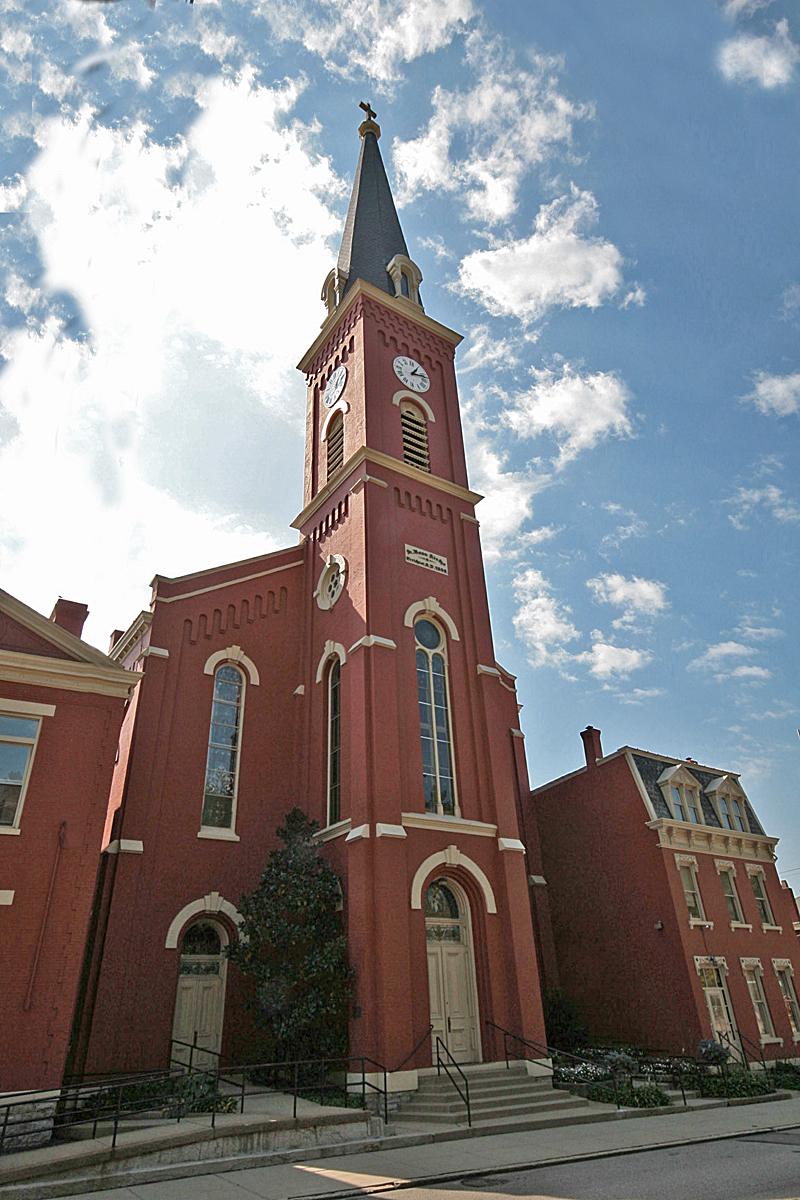 |
| Saint Rose Church, Cincinnati Ohio |
Wednesday, August 15, 2012
Devotion to Mary: crank it up! (Assumption homily)
 |
| The Assumption of the Virgin by Botticini, ca. 1475, from Fisheaters.com |
In the words of Pope Pius XII,
today we remember that “the ever Virgin Mary,
having completed the course of her earthly life,
was assumed body and soul into heavenly glory.”
Two questions:
First, since some of our friends may challenge us,
why we believe this?
And second, what does it mean for us in the year 2012?
First, we believe it because the early Church believed it.
And we believe it because it makes sense.
It makes sense as the generosity of God,
responding to Mary’s generous “yes” to God’s Plan.
A priest friend said this to me:
“God will never be outdone in generosity.”
So for the other question: what this means for us?
Her assumption into heaven is a sign of hope.
Where Mary is, that’s where we are headed.
What she got early, we will all receive.
Remember, we believe in resurrection;
meaning, not only does our soul live after death,
But one day, when God brings all things to completion,
We will have our bodies back--but new and improved!
A lot of folks want to keep God far away.
They deny that God has anything to say to us.
The thing about Mary is, you can’t talk about her,
without talking about her Son.
Her Son who is God, who became man.
There was a time, in recent decades,
when we Catholics tried to dial down
our devotion to Mary--
to fit in with our secular culture.
I think we need to crank it up--like a boom box!
Then folks will know we mean it when we say,
God is real--and we have hope!
Tuesday, August 14, 2012
Vague penances: what to do?
One of the blessings of working in downtown Cincinnati, and living only three miles away, is lots of options for confession.
It being a nice day, and I being overdue to go to confession, I took a walk a few blocks away. There was a short line (I'm glad there was a line! And I'm glad, for selfish reasons, that it was short!).
I made my confession, and listened closely to the priest. He mentioned the gifts of the Holy Spirit, and encouraged me to reflect on several in particular. Then he asked me to make my act of contrition--and as I began it, I realized I didn't know what my penance was. Before he imposed absolution, I asked, "I'm sorry Father, what's my penance?"
"Pray for the Gifts of the Holy Spirit."
"Yes Father, thank you."
Outside the confessional--grateful for the inestimable gift of absolution for my sins, I went over to sit near the tabernacle; however, I saw candles lit at the altar, and realized Mass was probably going to begin soon. Sure enough, the server and the priest emerged just then from the sacristy.
I didn't want to remain and pray my own prayers while Mass was underway, particularly in clerical attire; it's not the worst thing, but it might give a bad example, and someone might wonder why I was attending Mass in that fashion.So I got up and headed back to the office, weighing the question I had coming out of the confessional:
"How do I do that penance?"
I write about this because I know this sort of thing happens to lots of us; and some folks will find a vague penance particularly difficult, if they are susceptible to scruples.
You might wonder, why do priests go down this road?
A penance has two objectives: first, the penitent commits himself to making some (albeit slight and--objectively speaking, insufficient) satisfaction or offering for her own sins; and, second, to assist the healing work of the sacrament. So while the first objective involves an obligation, the second, I think, does not.
So for example, suppose a priest says, "offer a decade of the rosary for spiritual growth in the parish." On one level, the offering of a prayer is the penitent's concrete response to God's mercy. It doesn't "pay" for our sins, Christ did that; but it keeps us from being entirely passive. It is just that we offer something, however truly insignificant it is; and it is generous of God to treat our meager offering as if it really were something; and--here is the marvelous part--when it is offered, God's grace does make it something wonderful: because it is united to God's work, and is thus transformed.
But insofar as this is a "sacrament of healing," the confessor may well want to suggest a penance that in some way facilitates that--and makes that element more meaningful to the penitent. This is why many priests will say, "pray three Our Fathers for such-and-such an intention." This is also why a priest might suggest a penance involving some gesture toward a particular person--perhaps someone the penitent wronged or neglected.
And this, of course, is where a penance goes from being concrete--thus enabling the penitent to know she's completed it--to being vague, and thus maddening to many of us.
So what's my solution?
I would argue that whenever there is an obligation binding on us, the Church deems that obligation to be satisfied my minimum reasonable observance. So, for example, tomorrow is a holy day of obligation. The obligation to attend Mass is satisfied if you attend Mass once, either on the vigil or the day; you don't have to understand the homily, or even the language in which the Mass is offered; you don't have to receive communion, you don't have to sing or say any of the prayers out loud. You don't have to be enthusiastic or perky. As good as all those things might be, those exceed the obligation.
So when the priest gives you a penance, you've completed your penance when you've done a reasonable minimum. If he says, "do a good deed," then even a small good deed counts. If he says--as he did to me--"pray for the gifts of the Holy Spirit," then I would have satisfied the obligation when I had (a) actually prayed, and (b) for all the Gifts.
So: as I walked back, I prayed a Hail Mary for God to increase in me each of the seven gifts.
Of course I know that Father intended me to make it more fruitful; and in that spirit, I'm going to reflect, later, more deeply on the gifts. But that goes beyond the obligation. And it is entirely right for me, and for any penitent, to move quickly to fulfill ones commitments. I accepted the obligation of that penance and it isn't right to delay fulfilling it.
If this is not sufficiently helpful--as I can imagine it might not be, given some of the vague penances priests sometimes give--there are two other bits of advice I will now give:
1. You can always seek out the same priest, or any priest, and ask him to "commute" your penance. In that case, the priest simply gives you a different penance. The reason would be that you didn't understand the penance, didn't know how to do what was asked, or found it too difficult to do. I don't know for sure, but I am utterly confident any priest will help you in this regard.
2. (Notice I put this in bold type.) Remember that your absolution is NOT contingent on you completing your penance! (Stop! Re-read that!) When the priest gives you absolution, you are absolved. Period. Full stop. (The only exception would be if you engaged in an essentially fraudulent confession--you deliberately, knowingly, consciously withheld what you know, and are certain, without doubt, was a mortal sin. Stop and read that carefully so you notice the qualifying language.)
So when you go to confession, you do your best, you accept your penance even without understanding it--and, OK, maybe you should have asked about it, but sometimes you don't think to do it, that's not a sin--and there you are, wondering how to do the penance...
I'll make it even clearer. Let's say you walk out, and you have a very clear idea of your penance. Yet your phone rings, or a friend waves at you, or you have to use the bathroom--whatever it is, you fail to do your penance; and you forget, or neglect it, whatever...
Nevertheless, you were and remain absolved.
Should you have done your penance? Yes.
If you go to confession again, and still didn't do your penance, should you mention it? Yes.
Should you consider yourself not to have been absolved? NO!
The point being, no matter in what way the penance part gets messed up--your neglect, your confusion, or the priest's vagueness...you are still forgiven.
When I reflect later on the Gifts of the Holy Spirit, I'll offer that time up for all priests who give vague penances, and for the penitents who wrestle with that.
Sunday, August 12, 2012
The Eucharist: it is real (Sunday homily)
Just as people murmured--when Jesus said, “I am the bread of life,”
so too do people “murmur” when, as Catholics, we say,
the Eucharist is truly and really God--
the real, true Body and Blood of Jesus Christ.
People will say, “oh, they mean it’s a symbol of Christ.”
No, that’s not what we mean.
We mean what we say--because we mean what our Lord said.
We believe that during the Mass, when the priest is at the altar,
and he speaks the words of Jesus, Jesus acts through the priest;
and the bread and wine are changed into him--
his Body, Blood, Soul and Divinity.
Now, we might murmur, but it doesn’t look like flesh and blood--
come on, it’s still bread and wine!
There aretwo several* points to make about that.
Realize that our Faith is premised on miracles.
First, So believing this is a matter of believing Jesus.
Either you believe his words or you don’t.
Second, the way our Lord does this makes perfect sense
when you think about it.
Jesus tells us: you must eat my flesh and drink my blood.
He is the true Lamb of God.
On the Cross, he will be the offering, the Lamb of Sacrifice.
The thing is, when Jesus says, “take and eat,”
he’s giving you and me a choice.
We can stand apart from his suffering and death--
and instead, stand on our own merits.
Or, by sharing in the sacrifice,
we become part of him--and he with us.
If all you think you’re eating is bread and wine--
what’s valuable about that? How does that save you?
But when you know it’s the crucified body of the Lord--
when you know it’s the Blood shed on the Cross you put to your lips…
How can that not shatter our world?
The Eucharist makes no sense if it’s not his true Body and Blood.
As the writer Flannery O’Connor said,
“if it’s a symbol, then to hell with it!”
Yet it keeps the taste and appearance of bread and wine.
Or would you prefer the alternative?
You might be interested to know that, from time to time,
That has happened. There are many well attested miracles,
where the bread and wine really did turn to flesh and blood--
because people would murmur and scoff and say, it’s not real.
It is real.
We might wish the Lord would do more such miracles.
In fact, there have been a lot of Eucharistic miracles.
But remember what he said:
even if one were to be raised from the dead, they will not believe.
The Lord gives us his Body and Blood not to convince us,
but to sustain us, like Elijah, for our journey.
In the words of St. Therese, the Little Flower,
“the best means to reach perfection
is through receiving Holy Communion frequently.”
* The parts in red were not in my text, but I added while delivering this homily.
so too do people “murmur” when, as Catholics, we say,
the Eucharist is truly and really God--
the real, true Body and Blood of Jesus Christ.
People will say, “oh, they mean it’s a symbol of Christ.”
No, that’s not what we mean.
We mean what we say--because we mean what our Lord said.
We believe that during the Mass, when the priest is at the altar,
and he speaks the words of Jesus, Jesus acts through the priest;
and the bread and wine are changed into him--
his Body, Blood, Soul and Divinity.
Now, we might murmur, but it doesn’t look like flesh and blood--
come on, it’s still bread and wine!
There are
Realize that our Faith is premised on miracles.
If we don't believe in miracles, go home! Christianity is a waste of time.
For our Faith to be true, at least two miracles must be true:
First, that God united with a human nature in Mary's womb;
and second, after he died on the Cross, he rose from the dead.
So to be a Christian is to believe in miracles--
including the miracle of the Eucharist.Either you believe his words or you don’t.
Second, the way our Lord does this makes perfect sense
when you think about it.
Jesus tells us: you must eat my flesh and drink my blood.
He is the true Lamb of God.
On the Cross, he will be the offering, the Lamb of Sacrifice.
The thing is, when Jesus says, “take and eat,”
he’s giving you and me a choice.
We can stand apart from his suffering and death--
and instead, stand on our own merits.
Or, by sharing in the sacrifice,
we become part of him--and he with us.
If all you think you’re eating is bread and wine--
what’s valuable about that? How does that save you?
But when you know it’s the crucified body of the Lord--
when you know it’s the Blood shed on the Cross you put to your lips…
How can that not shatter our world?
The Eucharist makes no sense if it’s not his true Body and Blood.
As the writer Flannery O’Connor said,
“if it’s a symbol, then to hell with it!”
Yet it keeps the taste and appearance of bread and wine.
Or would you prefer the alternative?
You might be interested to know that, from time to time,
That has happened. There are many well attested miracles,
where the bread and wine really did turn to flesh and blood--
because people would murmur and scoff and say, it’s not real.
It is real.
We might wish the Lord would do more such miracles.
In fact, there have been a lot of Eucharistic miracles.
But remember what he said:
even if one were to be raised from the dead, they will not believe.
The Lord gives us his Body and Blood not to convince us,
but to sustain us, like Elijah, for our journey.
In the words of St. Therese, the Little Flower,
“the best means to reach perfection
is through receiving Holy Communion frequently.”
* The parts in red were not in my text, but I added while delivering this homily.
Thursday, August 09, 2012
Moral Options under HHS Coercion
Father Steve Angi, Chancellor of the Archdiocese of Cincinnati, passed onto me (and others) a copy of special August issue of Ethics and Medics, published by the National Catholic Bioethics Center on Health Care and the Life Sciences. It addresses options for those who come under the heel of President Obama's mandate--through the Department of Health and Human Services--that all of us, with few exceptions, must have contraception, sterilization and abortion-causing drugs as part of our health plans.
While religious bodies--narrowly defined by the government--are exempt, many religiously affiliated organizations are not, not to mention all the rest of us whose "private" religious beliefs matter not at all to this administration.
So the question is, what are our options for response to this mandate?
The article gives four choices and evaluates them:
1. Willing assent. This represents formal--i.e., intentional--cooperation, and is morally indefensible. The article does not touch upon those putatively Catholic institutions which have willingly gone along with this, till now, even without any compulsion from the government. (And you may be interested to know that because they did, there is some question, I'm told, about whether they are legally free to refuse now. See what happens when you go along with evil? You get trapped.)
2. Defiance by providing morally acceptable insurance. Under this option, a business or other institution would continue to provide insurance--but would not provide the newly mandated elements that are contrary to Catholic Faith. Doing so would invite fines from the government. The article mentions a fine of $100 per employee per day; but I think I read somewhere there's a yearly fine that is less than the per-diem rate. Either way, such fines could be crushing.
As a result, the authors of the article deem this morally acceptable, but perhaps imprudent--because the result could be the financial destruction of the organization and loss of livelihood for the employees.
If I understood his recent statement correctly, this is the path chosen by Father Frank Pavone of Priests for Life.
3. Defiance by dropping all coverage. This is deemed the "most morally sound" approach, because it means less damage to the institution and thus makes loss of livelihood for the employees less certain. But the authors point out this involves fines as well, but less onerous. (Note that, as others have: the government's penalties are focused most on spreading acceptance of contraception. Of all options, the one they will punish most severely is health insurance without contraception and abortion.)
The authors recognize, however, the many problems with this, including the loss of health insurance by employees, who may not be able to get health care on their own.
4. Compliance under protest. The authors examine this option in light of the problems created by the prior two, particularly for those whose health needs may suffer greatly. The article says, "Employer-provided insurance coverage is often a life-saving measure...Many employees depend on access to medications and treatments that are necessary to preserve their health or even their lives." The authors add that it is "the federal government" that is putting "the health and very lives of its citizens at risk."
Thus, facing a "terrible" choice between conscience and the well being of their employees, employers may opt for this, provided they do all in their power to oppose and mitigate the mandate, and provided compliance ends once insurance exchanges are available to employees in 2014.
The authors deem this "licit mediate material cooperation"; meaning the ones cooperating don't share the intention (i.e., formal cooperation), and it's not immediate cooperation because its somewhat indirect--the employer is providing health care in general, not specifically contraception or abortion drugs directly, and doing so under duress.
My thoughts...
Insofar as this is an evaluation of the moral culpability of various acts--I would tend to agree about number 4. That is to say, if an employer came to me, in confession, describing exactly this sort of dilemma, I'd have to reach the same conclusion about his or her own culpability.
However...
My own view is that whoever can, should opt for either choice 2 or 3: DEFIANCE!
I have said it from the beginning: make the Obama Administration act against us. Make them fine us. Then refuse to pay the fines. Not one penny. Make them take collection action. Make them file liens. Make them seize our properties.
That's when it will be clear what's going on. In my view, that will be so outrageous, so shocking, the Obama Administration will do anything to avoid that outcome. They won't want to use actual coercion; they want us to go along meekly. Make them point the gun in front of everyone.
But that's easy for me to say.
Meanwhile, keep praying. Remember, the whole country came under this coercion eight days ago. The religious organizations were given a year to get ready to operate under the heel of the government.
Wednesday, August 08, 2012
Pope's key man to visit Cincinnati for 'Year of Faith'

One of them is a big "get": Archbishop J. Augustine DiNoia, OP, Vice President for the Pontifical Commission Ecclesia Dei*, will deliver the annual Le Blond Lecture on Sept. 12, 2012 at 7:30 PM in the Athenaeum’s Bartlett Pastoral Center. The theme will be “What is the New Evangelization?”
To add spice, Archbishop DiNoia is widely taken to be the point-man who--if it comes to pass--will help bring about peace between the Tradition-focused Society of Saint Pius X (SSPX) and Rome. The SSPX, you may recall, has spent 40 years in a kind of limbo: not exactly in schism; yet not completely obedient to Rome, either. In recent months, efforts to bring about a resolution have heated up; but the outcome is still in question.
Yours truly will be there. You come too!
* In my initial post, I misidentified the Archbishop as with the Congregation for Divine Worship; that was his old job. He was recently named to this present position, which is concerned with facilitating the provision of the older form of the Mass and sacraments where there is desire to have them. Sorry for the mistake!
Still the best pizza on the east side...
On the (long) way home from the Chancery, I stopped by Adriatico's in University Heights. I ate that pizza in college, and again when I was in the seminary (less often; we couldn't persuade them to deliver to Mount Washington!), and tonight I'm having it again after nine years' wait.
Oh! So good!
Now, I warn you; some reading this won't like it, because:
The sauce (in my opinion, the key to good pizza) is spicy;
The pepperonis are big enough to float on in a pool, and the sausage pieces are small asteroids;
They sprinkle Oregano all over the top.
In short, this has a lot of taste!
Anyway, I think it's the best pizza east of the Mill Creek Expressway (Trottas is best in the West)--but I'm open to persuasion.
If you go up there, Adriaticos has moved from its long-time Jefferson Avenue location (which still shows up via Google). It's now on West McMillan, close to the University (natch). They have a dining room now, and wow! What a selection of beers! (I had one while I waited.) The menu is pretty simple: pizza, pizza turnovers (called "zonis"), wings, etc. Whaddya expect? It's near a college campus!
But don't worry, it's not all college kids. When I came back from the lavatory, a man--about my age or younger, stopped me to ask a question. He was discussing with his son--who looked around 17--a passage in Genesis. We talked for a few minutes; I was able to give some answers I think. (See the advantage of wearing your clerics while out and about?) Not long after, my pizza was ready, and it was off for home. I thought I was going to be able to eat my pizza while listening to the ballgame; but, alas, the Reds were defeated earlier today! Swept! By the Brewers! O tempores! O mores!
Fair warning: if you go, expect parking problems. Adriatico's has a small parking lot, several lots beyond the restaurant; while there's a huge parking lot, next to the place, owned by someone else. Don't park there, I was warned on the phone; "he gets anal about it." I was able to park on the street, but that's always dicey up in Clifton Heights.
As I polish off another slice of pie, I think about:
> Saint Paul, who fought for our freedom to eat a pizza like this;
> Saint Thomas Aquinas, who reflected so profoundly on the intrinsic goodness of Creation, and how its infinite variations of goodness both serve to make God's goodness better known to us, and thus make us that much happier; and
> That day in the seminary when Father Rob Jack was explaining an aspect of the Trinity to us, and he chanced upon an illustration involving pizza, which delighted us all, most especially my beloved, and too-soon-departed, classmate, Father Dan Shuh. When I eat pizza, I often think of that day, and my classmate, who loved pizza, loved conviviality, and would have been good company to help me eat this one. Requiescat in pace.
Monday, August 06, 2012
Chick-Fil-A: tastes like freedom
I finally made it out to Chick-Fil-A today. I drove out to Kenwood and got in line, only to remember -- thankfully before I got to the counter! -- that I had no cash! So I stepped out of line, and to get to my bank I had to go a half mile down Montgomery Road -- a big deal if you know the intersection. But, I had come this far! So down to the bank, and back, for a sandwich and lemonade. As the lady gave me my drink I said, "I'm sorry I couldn't come last Wednesday. I am sorry the politicians are trying to bully your company."
Sunday, August 05, 2012
Food that Endures (Sunday homily)
I’d like to hone in on one statement in the Lord’s words we just heard:
“Do not work for food that perishes
but for the food that endures for eternal life,
which the Son of Man will give you.”
“Do not work for food that perishes…”
If we used that to measure what we value, what would we find?
A lot of us are getting excited about the Reds--including me.
But it’s “food that perishes.”
Yet how many folks will skip Mass--
and skip receiving the Bread of Life--
for an autograph, or a good parking spot?
Computers and gadgets are wonderful tools.
I use them every day.
They can also be a cozy world we retreat into--
where we spend hours with a video game,
Or looking at pretty pictures, or reading all the latest news,
while the people in our own houses become strangers.
Again, food that perishes--
whereas the love that is fostered around the dinner table
is food that endures.
This is a good time to explain one of our Catholic practices:
the practice of doing penances, acts of self-denial, throughout the year.
Nowadays, most Catholics only do that during Lent.
But did you realize that every Friday is a day of penance?
Not just during Lent, but every Friday through the year?
Now, a lot of folks will say, wait--
didn’t the bishops abolish that?
No, they didn’t. What they did was to say,
you can either abstain from meat--
or you can do another penance.
But the obligation to do some penance on Fridays is still in place.
I’d bet real money most Catholics don’t know that.
They just think Fridays stopped being a day of penance.
This is why a number of Catholics
are returning to no-meat-on-Fridays;
because while there are other ways to do it,
it’s still a good form of penance.
But let’s talk about that: we do we do penance?
Many reasons.
First, while we can never “pay” for our sins,
we can make some offering--even a very small one.
Second, doing penance unites us with others.
When we know someone else is suffering,
choosing to fast is a way to stand with them.
And, coming back to our Gospel:
Acts of self-denial can be powerful ways
we overcome our lust for the food that perishes,
and learn to hunger for the food that endures.
Sometimes it’s the only tool that helps us really change.
We all like the good life: good food, good times.
And that’s not bad, so long as keep it in balance.
It’s the difference between enjoying a drink--and living for one.
What makes the good things of life, good,
is that they connect us to the goodness of God.
This is what Saint Augustine said.
If the good and beautiful things of life could speak,
they would say, “We are not God--but he made us.”
Pray for me: you can see I like food!
Let’s pray for each other, to seek the Food that endures.
Saturday, August 04, 2012
Lingering effects of theological insanity
I recently went out to have Mass in another parish. I edited out a lot of details.
The parish was established in 1904, and in 1907 it opened a school. The present church was consecrated in 1951. The neighborhoods around the church--and nearby churches--have, unfortunately, changed drastically for the worse in the years since. One wonders if the folks at that time--under the leadership of his grace, Archbishop Karl J. Alter--could have known they were at or near the high-water mark for city parishes?
When we pulled in, I noticed immediately the paving is a mess; these things are terribly expensive. (The school has been closed since the 60s.) The church has no air conditioning, but all the windows were open, and that helped create something of a breeze.
One of the seminarians living at the parish came with me; as we pulled away after Mass, I said to him, "if you want to know what not to do to a church--that's it!"
It was a classic example of what "wreckovation" looks like. And it is examples of this sort of wreckovation that causes me--when asked by folks, "why did this things happen?" I simply say, "we went insane." There's a much longer answer, but it boils down to that.
You can see how lovely it might have been, and might be again.
It has a beautiful mosaic where the altar once was--no doubt the tabernacle as well. I can only imagine what sort of altar had been there; now nothing is but some marble steps, leading nowhere. In front of these steps--toward the nave--is a newer platform, carpeted, likely wood, on which sits a table altar. I would be curious to see what it looks like; however it was covered a couple of cloths. Approximately six feet to the left of the void (as you face the void where the altar had stood) is the tabernacle, on a--I'm sorry, but a rinky-dink table. Up on the wall are two ledges mounted--a perfect place for a pair of statues; no doubt they were there once. In their place were bouquets of artificial flowers. I wondered what became of the statues?
All the chairs and tables in the sanctuary, as well as the pulpit, were mediocre. They all looked not more than 40 years old, some much less. My point being not to fault the folks for not affording better; but to wonder why the older stuff was cleared out for this stuff?
After Mass, as I made my way back to hear confessions, one of the volunteers whispered, "you may not realize it, but they don't use the old confessionals; those are used for storage. Go back where the water fountain is and turn right, that's the room for confessions." So I walked by the beautiful, carved-wood confessionals, and found the room mentioned. Because of a table, a refrigerator, and some other items, there was only room for two chairs--no option for anonymous. There wasn't even room to move the chairs further from the door to allow folks to remain anonymous by standing. Why was this arrangement better than the old confessionals?
Oh, and by the way, I found the statues: they were literally in the closet. What was probably an ushers' closet, in the back corner of the nave, had had its door removed, and was now home to lovely statues of our Lady and Saint Joseph.
So back to my conversation with the seminarian as we left. He asked: if you're going to move the tabernacle, what is accomplished by moving it six feet? I can't explain it. All I could come up with was either a bureaucratic mindset, that says, "Someone sent an edict to move the tabernacle, so that's what we'll do"--without bothering to ask if it made sense; or else it was someone who was enthusiastic about the "move the tabernacle" movement, without having enough understanding to wonder if it even applied in this case.
I know what you're thinking: so why did they move tabernacles?
All right, I'm going to explain it to you. And you're not going to believe this: but it's absolutely true.
Some time after the Second Vatican Council, someone developed the idea that our Lord's "static" presence in the tabernacle would be a "distraction" from, or in competition with, his "dynamic" presence on the altar, during the celebration of the Mass. A related idea was that when the "Eucharistic Assembly" gathered for the liturgy, their focus should be on the proclaimed word, or on the presence of Christ in the people, or on the work of Christ in the liturgical action--not on the reserved sacrament...which, by the way, was mainly about keeping the Eucharist for the sick; the reservation of the Eucharist wasn't for adoration! As another priest I know was told (and I heard this too): Jesus said "take and eat," not keep and adore.
Now, let me be plain: there is absolutely nothing in the documents of Vatican II about any of this; any more than you will find a thing about shoving statues into closets, or ripping out altars and throwing out, or selling off, beautiful furnishings; or removing altar rails, or whitewashing artwork; or painting over multicolor statues with beige (this really happened in one parish I know of; it was the compromise in lieu of removing them altogether).
So why did they do these things?
Because someone told them to; because someone thought it reflected badly on the Gospel to have too many fancy items decorating the church (never mind they had already been purchased, with some money coming from the wealthy, yes, but much of it from folks of limited means who wanted God's House to be beautiful); because somehow it's more "authentic" to have drab things rather than attractive things--because of course, our Lord would never have worn, or used, anything elegant, even if someone gave it to him. And our proof for this is...er...um...let me get back to you.
In short, someone thought this would help you pray better.
Make any sense to you? Me neither.
That's why, when folks ask me why these things happened, I tell them:
We went insane.
Thursday, August 02, 2012
A convivial dinner
I'm sitting here, enjoying some ginger ale (diet--a concession to my accumulating years), thinking about such a pleasant evening tonight.
This summer, at Saint Rose, we have seminarians living here. It really is a blessing to have them--they are fun to talk to, to go to ball games with, and to hear share their faith. I remember when I was a seminarian, I was so grateful for priests who were kind and helpful--and I am very glad to do my part, now, in turn, to help and support seminarians.
In any case, an extra blessing is a seminarian who likes to cook--and knows how! When I arrived at the beginning of July, he was concerned I wouldn't let him cook the meals. Well, I'm no fool! I said, let's make a deal: you cook all you want, and I'll eat it! We get along just great!
So not only does this exemplary seminarian like to cook, he likes to have folks over to eat it. So for the past month, we've had over a number of his seminarian friends, as well as my priest friends. He whips up some amazing dish, and everyone oohs and ahhs, and I sit there, and play host! How great is that?
Tonight, it was two of our seminary professors. One, who taught me when I was there, and one who entered after me, has been ordained, and is now teaching! (Rotten kid!)
Anyway, we had:
> Some toast with some sort of cheese and pesto stuff--anyway, it was delicious;
> Some home-made bread with bacon and cheese on it, and maybe mushrooms--I can't remember, because I ate it so fast;
> Hanger Steak, with green beans and roasted potatoes (the older priest is particular about his steak--he doesn't just want it rare, he likes the cow to stand in front of the stove for a few minutes before you send it over to his table). I never heard of Hanger Steak, but it was mighty tasty!
> A couple of varieties of ice cream, plus coffee (I made that!), plus--in good Roman fashion, a proper digestivo: Limoncello!
(It goes without saying we had various libations both hard and soft.)
Amidst all this splendor, we had such a good time talking about old times: remembering so many priests and seminarians, including some--sadly--who have gone to their reward. Finally, after three hours, the visiting clergy headed back to the seminary.
Sorry I can't show you pictures, but I have an El Cheapo cell phone, $9.88 at Wal Mart, so no pictures. So you'll just have to imagine...
Monday, July 30, 2012
Slumming around the East Side...
Today's my day off...here's how it's gone so far...
> I slept in, woke up around 8:30 am; remembered I need to get an alarm clock. Note for later...
> Went to find my shoes...where are my shoes? Not in my bedroom or my bathroom. Must be downstairs...not there either. I haven't had coffee yet, so I'm a little slow; I sat down to check the news on my laptop while I waited for the hard-drive in my head to warm up. About an hour later, I look up: there they are under the coffee table. Thank you, Saint Anthony!
> Off to Panera; detoured by street work on Wasson. Avoid it today.
> I love Panera for lots of things, but not the quickness of its service. If you have several cash registers, maybe one of the folks milling around at the sandwich counter could come over when the single line gets to be four- and five-deep?
> Not too hot to sit outside; nice!
> I went over to Old Navy--I need to replenish my supply of baggy cotton shirts and golf shirts. It's been awhile since I went to Old Navy; it looks like they are skewing younger. I found what I wanted, and as I was checking out, I said, "maybe you could start a new branch, called the "Really Old Navy" for us fat old guys?" She laughed.
> Oh yeah, the alarm clock; where to go? After looking around the Rookwood Commons mini-mall, in vain, for something suitable, I powered up my iPad and searched for Wal-Mart. Over on Red Bank. How do I get there again? (Sad how nine years up north makes me forget things like this.) Over Wasson? Nope; how about Brotherton? After a few uncertain turns, I remembered how quirky that section of Red Bank is--nothing seems to connect to it. Drove by the old Frisch's Mainliner: the old drive-in is gone, but the old signs are still there.
> In Wal Mart, I made my way to the hi-fi section; at least, I think we'd have called it that, back in the day. Seriously, boys and girls, I can remember when a "clock radio" was the new thing! It took me awhile, but they still have them. Two alarms! De Luxe! That's what I wanted!
While there, I browsed around, in case seeing something reminded me I needed it. (I.e., otherwise I'd drive back home, and think--oh yeah, I could have picked that up while at Wal-Mart!) That's when I thought, yeah, I could use a couple of key rings; couldn't find what I wanted, so it's off to a proper hardware store. Do they still exist?
> Back to the iPad! It directed me back to Hyde Park; but on the way there, I found an old fashioned hardware store in Oakley. I love those old places, with rows upon rows of gizmos and varying sizes of gaskets and plumbing fixtures. And, sure enough, they had simple key rings (Wal-Mart's were star-shaped and Hello-Kitty themed, or something absurd like that) in varying sizes. I bought a couple, to have an extra one. Headed back home...
I still have the rest of the day!
Sunday, July 29, 2012
The Apostles almost missed it--so might you (Sunday homily)
Of all the Lord’s miracles, the one you just heard
ended up making a huge impact on the Apostles.
But as you’ll see in a moment, it could have been otherwise.
Let’s notice some things in this passage:
The Apostles were the primary focus of this miracle.
The Lord was sitting with them when all this begins.
He is teaching them; most likely about the Passover
and how God fed his people in the desert.
Notice something else.
A lot of our fellow Christians see Christianity as a book-centered Faith;
but that’s not what we see in the Gospels.
Our Lord did not give anyone a book;
nor do we hear him telling his Apostles to write anything down.
Rather, he focused on what the Apostles
would experience and remember;
and he showed them how they were to keep that alive:
Of course in the sacraments, and above all, the Mass.
Here’s a cautionary detail.
The Apostles are direct witnesses
to him multiplying these loaves and fish.
Then they go around and gather every fragment:
twelve baskets means one basket per Apostle.
And yet, notice how this passage ends, however.
When the people go to make him a king--
in other words, missing the point--he departs “alone.”
Why don’t the Apostles go with him?
Maybe because, at this point,
they are thinking more like the crowd.
So what takeaways do we have from this?
First: the Lord didn’t rely on a book but on people;
it starts with the Apostles, and what they do--
in the sacraments--
to make him present in our midst.
In short, this is why every Sunday at Mass matters.
Look: if the Apostles could have missed it,
isn’t that a huge warning for every one of us?
Second: like the Apostles,
we will find ourselves pulled between
what “the crowd” thinks is right, and what the Lord wants.
An example is the drum-beat for redefining what marriage is.
In recent weeks, a prominent businessman let it be known
he believed in marriage as it has always been understood--
and not only was he labeled a “bigot,”
but now folks are moving to wreck his business.
Members of my own family--who were raised Catholic--
call me and our Church “bigots”
for opposing any redefinition of marriage and family.
It’s not easy facing that sort of crowd.
Other than spending time with the Lord--above all in Mass--
where will we find the clarity and the resolve
to choose him over the crowd?
Tuesday, July 24, 2012
Work, play and pray
FROM AN UNDISCLOSED LOCATION ON THE SHORE OF LAKE SUPERIOR...
I'm gathered with a group of priests; it's lovely outside and I'm using my iPad, so this will be brief. We're having edifying discussions, including formal talks of a scholarly nature, as well as informal ones. It is not a heavy schedule, however; in a moment, I will offer Mass, then some quiet time before evening prayer, preprandials and dinner, followed assuredly by more conviviality. Yet work is not being neglected; I am checking messages and doing business by phone and email.
I will offer Mass today for the people of Saint Rose.
Saturday, July 21, 2012
'What are you prepared to do?' (Sunday homily)
Two things in the Gospel I noticed.
First: the Lord said to the Apostles, you need rest.
Sometimes priests need rest--
and it’s good to have the boss himself tell you that!
Second: even then, folks kept coming; and the Lord took care of them.
I didn’t become a priest for short hours or big pay.
When I talk to men about the priesthood--
and maybe you’ve noticed,
I encourage most of the boys and men I talk to,
to think about the priesthood--
and the rest I talk to about being deacons!
But when I talk to you guys about it,
sometimes guys say, “sounds hard!”
It can be. So what?
Some of the guys will say, “oh, I’m not worthy.”
You’re right. I’m not worthy either.
When Simon Peter met the Lord, that’s what he said too.
It’s worth noting what’s going on in this passage--
because it explains something about being a priest.
All these folks kept coming. All the Apostles were busy.
But the reason was Jesus Christ.
That’s what drew them.
The priest exists to bring Christ to people.
People honor a priest because they honor Christ.
I often think about the day the Lord entered Jerusalem on Palm Sunday.
Think of it from the donkey’s perspective: “wow, they really like me!”
No--it was who he was carrying!
That’s a priest.
Now, a deacon plays that role--but since deacons are usually married,
they have the challenge of what comes first.
This is one reason priests don’t marry.
When I get that call at 3 am, I don’t have to decide:
go to the hospital, or watch my children?
Or, I can put it this way. When someone asks me,
what do you think about priests being married,
I say, “I’m amused that you think my life would be easier
if I had a wife and children.”
As I mentioned, I am always encouraging boys and men
to think about the priesthood.
I’m always encouraging women to consider the religious life.
I love being a priest--
and I’d never be here if I hadn’t opened my heart to the idea.
But most of us won’t take that path.
And yet folks are still pressing in--they are looking for Christ.
You’re not a priest; but you’re a Christian!
What are you prepared to do to bring others to Jesus Christ?
Your children; your family; your neighbors and coworkers.
It’s not as though we can afford to take it easy.
Our society is not a place flourishing with the Christian Faith.
It’s becoming a desert, thirsting for God.
Sheep without a shepherd.
What are you prepared to do?
Tuesday, July 17, 2012
Thoughts on the priesthood and the Eucharist
I started to work on my homily...
About an hour ago, I started writing some notes that I hoped would be my Sunday homily. I was reflecting, of course, on the readings for Sunday, which you can find here. After awhile, I had way too much for a homily; but rather than delete it, I thought I'd just make it a blog post. Whether I draw on any of these ideas for my homily? Stay tuned...
When I read the Gospel (for Sunday), two things struck me.
First, our Lord said to his Apostles, “let’s get some rest.”
At some times in my priesthood, I’ve really needed some rest; and hearing the
Lord say it helps!
But, then notice what happens. Folks keep coming. And it
says the Lord felt compassion for them. It’s not clear whether the Apostles got
any rest!
What this Gospel doesn’t say—you’ll hear it next Sunday—is that
this is when the Lord performed the miracle of multiplying the handful of
loaves and fed at least 5,000 people.
Again, as you’ll hear next Sunday, part of what’s important
about that miracle is how the Lord was interacting with the Apostles. Remember
what he said to them? You give them something to eat. They came up with a few
loaves and fish from a boy—and that is what the Lord multiplied.
And then, after the miracle—and to drive the point home—the Lord
directs the Apostles to gather all the fragments. They gathered 12 baskets.
Note that number: twelve baskets…twelve apostles.
So…I am going through all this to show what’s going on here.
A lot of this is about the Apostles.
Remember, the Lord knew he would remain on earth only a
short time. How would the work of gathering all nations into his Church
proceed? Notice he didn’t write anything, that we know of. Instead, he poured
his time into the Twelve.
There are a lot of lessons here about the priesthood.
A lot of folks think there’s nothing special about the
priesthood, or at least, that’s how they talk. Sometimes it’s because they are
reacting against those who went overboard about how special the priesthood is.
The priesthood is special.
If you talk to a theologian, s/he can explain our belief
that when a man receives the sacrament of holy orders (as a deacon initially),
that sacrament changes his very being. We call this the “ontological” change;
this is why we say, “once a priest, always a priest”; and why we say that while
a priest can be removed from ministry, nothing can “unordain” him.
Or you can talk about the things I often describe: how
awesome are the things a priest gets to do. To absolve sins; to offer the
Sacrifice of the Mass; to administer the sacraments; to visit folks in Christ’s
name; to preach the Gospel.
Or, you can simply reflect—as I do many times—on the way
folks approach a priest. Even non-Catholics, and Catholics who don’t practice
their Faith, all show in their words and actions and demeanor: there is
something special about the priesthood.
And you find it right here in this Gospel passage.
What’s special about the priest is that he is united, in a
special way, to Christ.
Now, someone will say to me, but what about other people?
Aren’t they united to Christ?
Of course.
One of the things about our Christian Faith is that, at any
given moment, as you reflect on it, you seem to be peering into the very heart
of it; you’re tempted to say, “this is it! This is the key!” Then you realize:
no, I’m only talking about just one part.
A few weeks ago, there was a video of a commencement talk
that circulated on the Internet; in which an instructor said, bluntly, “you’re
not special.” If you listened to the whole talk, he said something like, look,
if everyone is special, then no one is.
He’s right—but then we come to the mystery of our Faith, in
which it really is true that every part of it really is special, but in a way
different from every other part.
It’s true that the priesthood is special; but then it’s also
true that each and every one of us has a union with Christ that is as intimate
and powerful as you can imagine.
Remember that the Church is the “Body of Christ”—and Saint
Paul talked about how every part matters, but we aren’t
all the same. Priests exist to carry out a unique part of the Lord’s mission. By the Lord’s decision—not mine!—a priest
embodies Christ in a unique way.
I suppose hearing me say that could come across as pompous
or self-regarding. And those are sins to which I’m prone.
But I will tell you, saying such things makes me aware of
the peril I face on Judgment Day.
The other thing to remember is what makes the priest
special: Jesus Christ!
The doors that open for me, the smiles, the kindnesses
offered me, and the ears and hearts that receive my words…they aren’t opening
for Martin Fox, rank-and-file member of the human race.
They are opening for a bearer of Christ. They’re opening for
HIM.
When the crowds keep seeking out the Apostles, it was
because they kept company with Jesus Christ.
That’s why the Lord was working so hard to get them ready;
because after he returned to his heavenly throne, it was going to be the
Apostles—and through their mission, the Church—that would make Christ present
to people.
It’s tempting to move on right away to the Eucharist,
because that is so central here—and I will soon enough—but it’s important not
to miss the other parts of this.
Notice how important it was to Jesus that the Apostles spend
time with him. One of the things we might miss in what the Gospels tell us is
how much time Jesus spent with the Apostles. The words of Christ in the Gospel
represent only a small share of all that was going on. The main thing was Jesus
spending time with them.
So simple…yet so important. Priests must spend time with the
Lord.
And then there’s the Eucharist.
It is so striking to me that our Lord gave each of them a
basket of left over bread. Oh, I realize I can’t prove that each Apostle got
one; but twelve baskets, twelve apostles.
And remember, they were the ones who were skeptical of
feeding everyone.
Father Tom Grilliot, who lived and worked with me in Piqua,
often makes this point that in the Gospel, the Apostles’ response so often was,
“send them away”! When they brought children to be blessed…when they needed to
get food…”send them away!” Yes, we priests will do that; I’m sitting down to
eat, and the doorbell rings; I hatch a plan, on the way there, on how quickly I
can “send them away”!
The other thing you might often notice in the Scriptures is
how the Lord will make his point with lots of emphasis. So here, he not only
shows the Apostles how the bread and fish are multiplied—they see it first;
only later do the thousands of people figure out what happened. But also, he
adds an exclamation point when he says, “now gather up all that’s left.” I can
almost picture one of the Apostles—as they keep bending over to pick up the
fragments—grumbling to themselves, “OK Lord, you made your point! Can we
finally get that vacation we talked about?”
That’s why I think the detail of the twelve baskets is so
important; it’s a message, first, to the Apostles, who gathered them. As
important as feeding people is, the whole thing was primarily for them.
He knew they would remember this, and they did. The miracle
of multiplying the loaves is described in all four Gospels. In Matthew, Mark
and Luke, there are two instances of it. (Some argue they are the same, but the
way they are presented leads me not to find that very persuasive.)
If you talk to a Scripture scholar, or read some of the
commentary on these passages in the Gospels, they will point out the details in
how the miracle was recounted, that show just how powerful an impact this
miracle had.
One of the things you see—if you study the language of the
Gospels—is how the writers of the Gospels connected this miracle to the Mass.
They used language that ties it to the rituals of worship. And the same
language shows up in the Eucharistic Prayers. I can do it from memory: “on the
night before he died, he took bread, said the blessing, broke
it, and gave it to his disciples, saying…”
I think this: I think that some time later, the Apostles—whether
at the time of the Last Supper, or the Crucifixion, or the Resurrection, or
Pentecost, or whenever they first did what the Lord said to do with the
Eucharist—“do this in memory of me”…
Somewhere, it crystallized for them. They remembered the
miracle of the loaves and fish—and they had that same “click, click, click”
experience in their heads.
It was one of the most important events in the life of the
Church!
Because that’s when they realized what the Lord was teaching
them that day.
Somewhere in there they figured out how important the
Sacrifice of the Mass, and the Eucharist, would be for the Church.
That’s when the Church’s liturgy began to be born. We don’t
know just how they celebrated the Eucharist in those early days, months and
years; but we do know have reports from only decades later, in which it took on
a form remarkably like what we know. The Roman Mass has had a largely unchanged
form for most of the Church’s history; and the same is true of the sacred
liturgy in the Eastern Churches.
There’s a mindset that will instinctively resist the
suggestion that the Mass, as we know it, may well have been largely formed even
in the time of the Apostles; and that is a suggestion that no one would dare
make. But I will say this; no one has proved the opposite. The record is simply
silent.
But the Church preserves a memory; the memory of the
Apostles themselves. They were there when the Lord made sure everyone was fed;
and he made sure the Apostles gathered the fragments. He knew when all the rest
of the pieces were in place—including the Supper, the Cross, the Resurrection
and the Holy Spirit—they would put it all together.
The Apostles were each given a basket.
One of the lessons I take from that is that priests should
offer the Mass, they should adore the Eucharist, and they should encourage
others to do so. Jesus gave them a basketful. On that afternoon, it was only a
basket of bread; it wasn’t—yet—the Eucharist.
But it foreshadowed what the Apostles—and all priests—would be:
bearers of the Eucharist. Christ gives each of us a basketful.
It reminds me of the miracle of the water turned to wine.
There was an abundance. I often explain this to couples, preparing for
marriage, that this sign serves to show how abundant the grace is that Christ
will give them in the sacrament; but it’s not for them; it’s for them to share.
The same here.
Sunday, July 15, 2012
God's intolerable compliment (Sunday homily)
The great writer, C.S. Lewis, had an idea he explored many times:
that God has paid us, quote, “an intolerable compliment.”
God made us to be something great and glorious,
and as much as we wish he’d just leave us alone,
that is—as Lewis said—to ask God to love us not more, but less.
That’s what Saint Paul is saying in the second reading.
God has a high destiny for us.
Have you ever had someone say, wow, your Catholic Faith demands a lot of you?
Tell them this is why.
Why does God expect us at Mass every Sunday and Holy Day?
Why does God expect us to be chaste—waiting till marriage,
being faithful to the same spouse for life,
and accepting the sacrifices entailed by not using contraception?
Why does God care what we look at on the Internet,
or whether we pray, or how we run our business,
or about any other of the choices we make?
Because of the high destiny to which we’re heading!
Now, someone might say, I don’t want that!
I’d rather just be a nobody.
Well, I have shocking news for you. That's not an option.
There are only two choices in eternity.
Being a saint, sharing God’s life…and hell.
Purgatory is real—but it’s a stopover on the way to heaven,
where we get our final wash-and-wax before heading for the big-time.
And you won't get to purgatory at all--if you don't aim for heaven.
Put it another way: there are no cheap seats in heaven.
And no bystanders to Christ’s work on earth.
When I’m talking with people, and someone will criticize the Archbishop,
I think it’s my duty to stick up for him.
And folks will say, “oh you’re just a company man.”
It’s true—I am a company man!
But when it comes to our Catholic Faith, we’re all company men and women.
The job of defending and presenting the Catholic Faith—
with enthusiasm and joy—isn’t just my job. It’s all out jobs!
What's more, the high destiny God has for you is for everyone.
God gave us the invaluable gift of life in Christ;
God help us if we don’t share it—if we don’t bring others to the Catholic Faith!
In the Gospel, our Lord sent the Apostles to cast out demons.
If you look in the Old Testament, you’ll see the prophets did amazing things,
but none of them ever did that.
It’s a sign that being a Christian means sharing God’s life in a new way.
Christ sends you to cast out evil;
to help change our society so that human life is protected,
the poor aren’t trampled down, and human dignity is respected.
As this Mass brings us to Calvary, we might ask Christ for the strength and joy
to embrace the destiny he has for us.
Wednesday, July 11, 2012
The messiness of real life and the ugliness of NCR & SNAP
I recently read an article at the National (so-called) Catholic Reporter, concerning the efforts of Charles Chaput, Archbishop of Philadelphia, to resolve questions that linger painfully about some of his clergy, and how his predecessor handled accusations of misconduct against them.
As you may recall, a story blew up in the media a couple of years ago, alleging that then-Archbishop Rigali was not diligent in reporting allegations to public authorities, and in applying internal discipline. From what I gather--I have not read much on the subject beyond some news reports--the underlying issues are not only allegations of sexual abuse, but also fuzzier questions of "boundary violations," which I think would be far broader than actual abuse.
The result was that everyone was left wondering if the Church in Philadelphia was knowingly harboring priests who had committed abuse.
Enter former Denver Archbishop Charles Chaput. He was named to Philadelphia in September, and of course all eyes were on him to clean up this mess. His predecessor had already named a former prosecutor to review everything, and he continued that--promising action as quick as possible. He also said the Archdiocese would cooperate completely with prosecutors, and await their determination before deciding whether to restore a suspended cleric, or to remove him.
For a lot of folks, all this seems too murky; and given some of the history, it's understandable that folks are angry and skeptical. However, folks have to recognize that there's no way something like this cannot be murky:
> The difficult issue isn't when something is clear-cut. If he had an individual with a clear case against him, the prosecutor would know what to do; the archbishop would be able to remove him from ministry and have him laicized (i.e., barred permanently from exercising his priestly ministry).
> Remember we're dealing with accusations; which can be mistaken, and which can even be deliberately false. Everyone--yes, even a priest!--is entitled to fair play in how an accusation is handled; something the folks at the National Catholic Reporter and the so-called Survivors Network of those Abused by Priests (SNAP) have demonstrated they don't care about. (More on that below.)
Sometimes all anyone has to support a suspicion is rumor, odd actions or gestures, or something third-hand. I had a situation where someone came to me and said, in effect, "everyone knows So-and-so is doing something bad." I was being asked to fire someone, on that statement alone (obviously I'm leaving out the details). I asked questions: did you see or hear anything? (No.) Do you know anyone who had a more direct experience--someone who was victimized? (No.) If you do, either have that person come to me, or have that person go to the Archdiocese or the police. Eventually, someone did approach me directly (after approaching the police), and I dealt with the matter very quickly. But when a person's job, and good name, are at issue, "I heard" isn't good enough.
> What critics call "secrecy" is called "confidentiality" when it's to our benefit. In any employment situation--quite apart from a religious context--personnel matters are confidential. If I meet with an employee and give an evaluation, that's confidential. If I discipline or fire an employee, the circumstances are confidential. In theory, there are some things an employer can say; however, anyone knowledgeable in these matters will tell you that the employer risks legal action if he "defames" a former employee, and also risks a lawsuit for wrongful termination. Since I'm not a lawyer, the upshot is that when an employee departs, I don't say why.
Let's back up a moment and speak very generally. Folks get discharged from their jobs for lots of reasons; sometimes it's cost-cutting; other times it's sub-par performance; and other times its misconduct of some kind. It should surprise no one that sometimes the employer only has "smoke"; something fishy with the books, or repeated violations of procedures, but no concrete evidence of theft, for example. In such a case, any public allegation or suggestion of actual misconduct would invite a defamation lawsuit.
Also, there are times when it works to everyones advantage to have an employee go quietly. Where employees are justly fired, does it surprise you to hear they don't always like it? What do they say to family and friends? The embarrassing truth? Or some unrelated grievance that makes them look like a victim? In that situation, the departing employee can create a lot of problems; and the employer can't really respond.
One more point: when an employer keeps things confidential, it isn't just the employee who is protected; it is likely to be other people whose names get connected to something the employee is alleged to have done. For example, an employee is dismissed for inappropriate conduct toward another employee. Here again, I had someone say s/he saw such conduct. Another supervisor and I investigated, and when we interviewed the employee who was the recipient of the inappropriate contact, s/he said it never happened. The story got around to some degree; yet in that case, I had nothing to go on. How could I discuss this publicly? Even if I didn't care about the damage to the accused employee, what about the putative victim (who said nothing happened)?
Of course none of this means a crime--or anything indicative of a possible crime--should not be reported promptly to the police. But it helps explain why when a story surfaces--either on the grapevine or in the media--the parties involved don't say much. That includes law enforcement. Even after they "conclude" their investigation. I have had situations where law enforcement looked into a matter and could not reach a definitive conclusion. They couldn't rule out that So-and-so may have done wrong, but they also couldn't develop enough real evidence to support a charge. (It should surprise no one that a lot of what folks think are "facts" and "evidence" and "proof" are nothing of the kind.)
Do you know what the police say when an investigation "concludes" in such an inconclusive way? You guessed it--almost nothing. What can they say? They can't say the accusation is true or false; they may not even be able to say whether the alleged wrong even happened; and they can't say whether the suspected person did it or not.
So back to the mess in Philly.
In light of all this, I think a reasonable person realizes two things. First, that you aren't going to have all the facts, especially when it's likely almost no one does. Second, that when a story like this sorts out, the outcome isn't going to be neat and tidy.
We would all prefer if Archbishop Chaput could come out and say something like: "the prosecutor, the grand jury, and I all agree that certain accused individuals are certainly guilty; and they will be tried, convicted and punished forthwith. Parallel to that action by the state, the Church will swiftly remove them from ministry.
"Meanwhile, we have also agreed that the following individuals are innocent and can return to work. We have established with utter certainty that the allegations against them are false. We have signed statements, video- and audiotape evidence conclusively establishing the utter impossibility of the accusations, and positively demonstrating their innocence. For example, Father Doe was accused of molesting Mr. Roe on such a such an occasion; in fact, we have conclusive, video- and eye-witness testimony that Father Doe never, in 20 years, was within 100 miles of Mr. Roe, thus the charge is conclusively false..."
How wonderful that would be! But we don't live in that world!
Much more likely is that the sorting out won't be fully explained. Some will stay but the accusations can't be utterly dispelled; some will be removed but never charged; yet for a variety of non-nefarious reasons, no legal case will ever be brought. Some folks may be removed who did not, however, commit a crime. It's rather likely that a priest might be removed for legitimate reasons other than what is rumored--and the matter won't be discussed.
Here's a completely made-up example: Father Weird-eye is removed from a parish and sent off somewhere; everyone assumes it's connected to his strange comments and odd behavior over the years, yet no actual evidence of misconduct was ever brought forward. Yet in the course of investigating it, it turns out Father has other problems; he's addicted to pain pills, he was grossly incompetent in managing funds, and has had a breakdown. He did say weird things, but didn't commit any crimes that anyone knows of, but--he has to go.What do you do? What do you say?
In the real world, these things will remain murky. The only resolution available this side of eternity will be incomplete. I think reasonable people, upon reflection, understand this.
Then there is the aforementioned NCR and SNAP and their cheering sections.
Over the years, I've read what the NCR and SNAP have to say. I understand their anger. Who isn't angry about rape and molestation and violation of trust and wrecking of lives? Who isn't angry about a failure to act against these things, on the part of others who knew or had oversight?
But is the idea that whoever can demonstrate a greater degree of moral outrage, wins? If my anger is more compelling than yours, then I'm right? I win?
A recent NCR item on Chaput's handling of this mess, including the responses published on the site, was all too typical. Chaput announces some priests are removed, some are restored. The article--written by an NCR reporter--doesn't go into details, yet explains the decision process involved the prosecutor and review by lots of folks other than the archbishop.
Outrageous! brays the comment section, led off by someone claiming to represent SNAP. How dare Chaput return guilty priests to ministry! Other commenters--including me--ask, how do you know if the restored priests are guilty? And I ask a question I've asked before: does SNAP even care about false accusations?
Over the years, I can't recall ever seeing SNAP say it was happy about an outcome. Certainly not when the legal system exonerates a priest, as in this case: SNAP continued accusing the priest. If you peruse the Media Report site, you can see many more reasons to view SNAP with a jaundiced eye.
A recent development from the SNAP crowd, whose anger justifies anything, is to complain about what they previously demanded: laicization of priests!
For years, the complaint was, why aren't these priests removed--"defrocked"? Then, why isn't this carried out more quickly? (This is a complaint frequently made about our present pope; in fact, in his prior role at the Congregation for the Doctrine of the Faith, he sought to speed up the process.)
Now that bishops are seeking laicization, and the requests are being granted--well, not quickly, but less cumbersomely at least, guess what SNAP is complaining about? Laicization means the Church washes her hands of the guy! Don't laicize him, send him to a monastery!
See the game? There's no acceptable outcome.
Look--again, I understand pain and anger; I have a lot of sympathy. But pain and anger don't justify causing new pain and hurt. Being a victim of injustice doesn't make new injustice all right.
The only good thing I can say about the latest NCR item on this subject--well, two good things, are: first, the item itself is reasonably fair, consigning the bitter, fairness-be-damned ugliness to the sad, bitter commenters. And, second, a fair number of commenters actually are challenging SNAP. That's a healthy development.
Subscribe to:
Posts (Atom)