Wednesday, January 30, 2013

A busy day after two down days

Sunday evening, I wondered if I was coming down with something; Monday morning I was sure I had. So Monday and Tuesday, I was at home, popping zinc tablets, drinking tea, coughing and choking and otherwise waiting for the viral storm to pass. It wasn't that I was so sick; it was just that I didn't want to be around anyone, and I am certain, had I gone to work, and been hacking and sniffling, few would have wanted me around.

But I had a problem.

Today, I was hosting a group of priests, which meets the last Wednesday of every month. And this month, the Archbishop had accepted our invitation. Pressure, pressure!

My original plans were to do some serious cooking. After coming down with a cold, I decided to moderate my plans. Thankfully, one of my brother priests, who was joining us, offered to help cook, so we got it together. 

We gathered at 4 pm, for conversation and drinks and snacks; then we had a holy hour at 5 (well, a few minutes late); yours truly handled the exposition, while I recruited other priests to lead Vespers and pray the Rosary. Toward the end, I hurried to the sacristy, while everyone was praying, because I had to cough something awful! I asked later, I hope you didn't hear me coughing; they said, "we did!" 

Dinner was enjoyable and we had a good conversation during and after; we had told his Excellency that we usually break up at 8; and we told him we didn't expect him to stay the whole time. He did; even though he had a long day tomorrow. 

Actually, I'm feeling a lot better than when I began the day. Maybe it was the zinc and chicken soup; maybe it was getting past this big project!

Sunday, January 27, 2013

Be bold as a Christian (Sunday homily)

In the first reading,
Ezra the priest told folks “this day is holy to our Lord.“
Do we treat the Lord’s Day--today--as holy to our Lord?

Obviously, you’re at Holy Mass!
But keeping this day holy goes beyond that.

When God gave Israel a Sabbath, he said,
“Remember that you were once slaves.”
The Sabbath rest says, “you are slaves no longer.”
When the Christian Faith first began to spread,
The day of Resurrection--today--was just another work-day.
In order to attend Mass, Christians--many of whom were slaves--
had to get up very early, or go very late--after work.

Have you noticed? As our society forgets its bearings,
There’s another way we’re becoming more like pagan Rome:
The Lord’s Day is more and more just another day.

The point of refraining from unneeded work on Sunday
isn’t because work is sinful--
but to set aside time to prayer and reflection and rest.

The other thing Ezra said was to rejoice in the Lord.
Does our Faith give us joy?
Are we proud to say, “I am a Catholic?”
Are we eager to share our Faith?

Last Friday, I was in Washington for the March for Life.
I went with several priests and many of our seminarians--
along with hundreds of thousands of Americans.
Those who go aren’t all Catholics--thank God!--
But when you see how strongly the Catholics are represented,
It does make me proud of our Catholic Faith.

Sometimes people will ask, what’s the value of the March for Life?
I think the main value is as a time of prayer.
And like a pilgrimage or a retreat, it’s life-changing for those who go.
For me, this year marks ten years as a priest.
In 2003, there was a shadow over us as Catholics, and over priests--
because of the terrible things a handful of priests did.
And I remember a reporter came out to the seminary,
and asked me, was I going to be hesitant or “ashamed”
to be seen in a roman collar?

I said, no way! And I made a resolution that day,
that my response was to strive all the more to be faithful.

So I’d ask you the same question that reporter asked me.
Whether it’s Catholic institutions
that seem to care more about the world’s esteem
than what our Faith teaches…
Or politicians who brag about how Catholic they are,
until it comes time to defend the unborn or to defend marriage…
Or clergy and religious who lose their way…
Are we going to let that be the last word
on what it means to be a Catholic?

When some parts of the Body seem limp and lifeless,
That’s when you and I are called
all the more to be on fire for Christ! All the more!

The Spirit of the Lord has anointed…you! You!
Let rejoicing in the Lord be your strength.

Thursday, January 24, 2013

To DC for the March for Life

I'm in DC, resting a little after what has been a long, though not that arduous, a day.

My flight left Dayton at six am. That meant arriving at the airport by five am. That meant leaving Saint Rose before four am. That meant setting my alarm for 3:30. That meant being in bed by nine the night before! For me, ridiculous; I seldom get to bed before 11. As it was, I tried to hit the hay at ten, but could not sleep. Maybe two hours total.

Cell phone alarm sounds at 3:30; I look at the clock; it's dark. Power was out. Good thing I set two alarms. I'm showering candlelight, first time for that. A little tricky getting through the house but ok, on the road. At the airport, the group of priests and seminarians I'm traveling with are arriving. We leave a little late. Non clerical minority on the plane finds so many roman collars reassuring.

At Baltimore airport, several of us share a taxi; we tell him, Union Station, DC ( our hotel is across from it). He nods, takes off, and when asked, says it'll take 90 mins. Hmmm, we think, that's a little long.  Those in back chatting; good thing priest in front notices the driver points north. We fix it, but lose 15 mins., driver turns off meter so we don't overpay. Language barrier, but we think he was taking us to Philly.

At hotel: it's around nine, we had no breakfast. "Irish breakfasts" all around, ah, restoration! We see seminarians, who rode the train, file in in groups of less than five. Why, you ask? Because the hotel told us, if groups of  five or more enter together, each member gets charged a "union surcharge" $5 apiece.

We assembled at 11:30 to walk a few blocks to church for Mass. Regular parish Mass, but here come seven priests and 20 seminarians (others planned to attend mongo vigil tonight--not for me, almost literally wall-to-wall people). Nice Italian church, barely touched by liturgical Vandals who passed through so many churches in the bad old days. Friendly priest, who seemed to have little English, seemed surprised to see us, but we did call ahead. Lovely simple Mass. I don't often get to offer Mass with these brothers.

Back to hotel. It's very bright but very cold. Some of us go to museums, but I'm a little out of sync from the weird travel day, and another priest and I get something hot to drink; decide to eat a little soup. We both think it was from a can. Is that acceptable, do you think, for a sit-down cafe in the middle of DC's Union Station? Note to avoid in the future.

Now back at hotel. Sorry for staccato writing style, but I'm typing this with one finger on my IPad.

Tomorrow we have Mass at the Basilica, then the March, then fly home late, if snow doesn't delay.

This prayer pilgrimage is an odd duck: we are always friendly and hopeful despite grim horror we are  protesting. Some find this incongruous, but I don't. This is an act of faith, and faith always travels with charity and hope. This is serious business, but the Father's business, so we have reason to have joy and confidence, despite all.

I expect some rendezvous with brother priests before long, so see you at the March. If you can't be here, pray, please.

Sunday, January 20, 2013

'God came to a wedding: what a marvel!' (Sunday homily)

“What a marvel,” St. Augustine said of today’s Gospel. 
“God came to a wedding!” 

What a marvel! Let us count the ways. 
On one level, we have an ordinary part of life: a man and woman united in marriage; 
but it doesn’t stay on the ordinary level—not after Jesus came to the wedding. 

The ordinary becomes forever more than ordinary; changed, filled with grace. 
Water becomes wine; human love becomes divine; 
regular life a place where God is real and present; 
heaven comes to earth, and earth is lifted up. 

That’s what our sacraments are: 
ordinary things, which God takes and uses to give his supernatural life to us. 

Water—in baptism—gives the Holy Spirit. 
A priest speaks ordinary words—in confession—
and through those words, Christ gives total forgiveness. 

Another marvel: this Gospel story of a wedding:
it’s a family scene, it’s earthy; it’s giddy; 
the wine was flowing, it’s amorous; and Jesus blesses it all! 

Our Faith does not push aside the good things of life; 
we are not ashamed or embarrassed by these things. 
We’re the moderates, if you will, between two extremes. 

On one side are those who make the things of this life their ultimate good. 
Pleasure or money, health, sports, sex or power. 
That way of thinking cannot fathom the value of self-denial; or believes its impossible. 

The flip side is to see this world as something to escape, 
and to downgrade what’s good for humans, 
and instead go too far in respecting Creation--
and see human beings as “The Enemy.” 

Notice Jesus never said, “you invited too many people”! 
God’s wine flows freely; and when we care for our world 
and for one another as God would have us do… 
When we use our gifts to unlock this world’s abundance, 
we have plenty of room for all his children. 

Last Sunday was a time to talk about the vocation to the priesthood or the religious life. 
Today is a good time to talk about the vocation of marriage. 
And Christ turning water into wine--
and later he would turn wine into his blood--
is a good setting to talk about both. 

When I meet with couples preparing for marriage, I always read this Gospel with them. 
And I always ask them this question: who was the wine for? 
Hint: it wasn’t for the couple. It’s for everyone else. 

The wine is a symbol of the grace God gives us to live our calling. 
A fearful response says, don’t invite too many people! 
Don’t take chances! Play it safe! 

If I’d taken that approach, I’d never have become a priest. 
For that matter, my parents would never have had seven children. I’m number seven. 
Their choice of generosity was necessary for me even to exist. 
Just as our Lord’s choice to give himself totally on the Cross 
was necessary for our hope of heaven to exist. 

God came to a wedding. God made a marriage with mankind. What a marvel!

Saturday, January 19, 2013

Make 2013 the Year of YOUR Faith

Please join the Knights of Columbus and me for a unique opportunity to explore What Catholics Believe, a series on the Catechism offered by the Knights of Columbus.  Pope Benedict launched the Year of Faith to mark the 50th anniversary of Vatican II and the 20th anniversary of the Catechism of the Catholic Church – an “authentic fruit of Vatican Council II.”
           
Join us in the St. Rose undercroft from 7:00 to 8:15 PM, the first Tuesday of the month:
Feb. 5, March 5, April 2, May 7, and June 4.  All ages are welcome.
Introduction to the series here; if you have any questions, post a comment here!

My thanks to the Salve Regina Council--which serves both Saint Rose and Saint Mary Parish--for helping me put this together.

Let's spread the word, and fill the basement of Saint Rose!

Thursday, January 17, 2013

How stick figures can help save marriage

I have an idea for how someone really creative can help the cause of Christ. Hear me out, please.

First, who I'm looking for:

Someone with a creative mind, who fully embraces the Catholic vision for humanity, who has a certain wit and facility with expression, and who also has a certain maturity and delicacy--in other words, good judgment.

The project:

Create a stick-figure cartoon, with six or eight panels, that explains the Church's teaching on the complementarity of the sexes, and marriage.

Now, you may not think this matters much. But let me explain why I think this would be very useful.

First, one of the things that can be very effective in advancing a cause is the ability to boil down your cause to an expressive symbol. Those who are pushing for the redefinition of marriage have done so. Some years ago, the Human Rights Campaign, which has advocated for "gay rights" for decades, came up with a very effective symbol: the equal sign. It is an argument easily grasped, and it claims the moral high ground--that is to say, it puts those who disagree on the defensive.

Notice that is the argument being made for redefining marriage. A "marriage" between two males or two females equals a marriage between a man and a woman.

By extension, being able to boil down an argument into a relatively compact argument is likewise very effective. And simply the exercise of being forced to do so focuses the mind tremendously.

One thing I've learned as a priest is that when I am able to explain effectively a subject in a five-minute homily, then I've come to a place where I really "get" the subject. In the fall of 2011, I prepared a series of homilies on the Mass translation we were preparing to implement; and one of them was on "consubstantial." Forcing myself to explain that--in a homily--was a very effective exercise for me to penetrate this doctrine. Not just "what it means" abstractly, but "for us men and for our salvation."

A third reason this would be useful is to counter the wave of propaganda now underway, aimed at the young.

Already, in schools and in all forms of entertainment, the idea that relationships all equal each other is being sown. I've even seen visual representations of it--using stick figures: two men = two women = a man and a woman = two men and a woman = two women and a man, etc.

You might ask, why stick figures? Precisely because it can be reproduced by people who aren't artistic. They could actually draw it themselves.

One of the mistakes we Catholics often make is to allow ourselves to be on the defensive. We have, for decades, been defensive about what our Faith says about contraception and openness to life. And many of us are defensive about what we believe about men and women and marriage.

Yet as I write this, the facts on contraception are turning strongly toward us. Not only is the claim of "overpopulation" bogus, so are all the claims about empowering women and strengthening relationships. It's all one giant load of...well, fertilizer.

Already we can see where the campaign for redefining marriage will lead us. Sadly, in a few decades, we will have plenty of casualties from this "harmless" change. We have no reason to feel defensive. Yet we do. Why?

Because the culture around us has defined the terms of the debate. When you let your opponent do that, you are likely to lose.

So what is needed is some help redefining the terms of the debate. And a key to doing that is expressing our terms in the simplest ways possible: through images.

That's what we need creative people to do. Let's spread this around. Let's pray for this. Let's see what bubbles up.

Saturday, January 12, 2013

You were baptized to change the world (Sunday homily)

This feast recalls something remarkable: 
Our Lord Jesus--our Lord God-- got in a line with other people,
who were coming to repent for their sins. 
It would be like the Lord getting in line for confession! 

This is a powerful reminder of why God became man: 
Not only to be with us, as one of us, but to bring us back to himself. 
So by getting in line with the sinners, Jesus stands with us. 
Then, when he gave the sacrament of baptism-- 
This is the baptism with the Holy Spirit the Gospel mentions--
Our Lord makes it possible for us to be with God--forever. 

So, first: we do well to remember the power of our baptism. 
To be baptized is to be a citizen of heaven. 
When I get to baptize children, 
I like to point out that baptism makes us saints. 
Is it really that easy to become a saint? 
Yes, it really is--but it’s not easy to stay a saint. 
That’s why we get into the confession line--
to regain the divine life baptism gave us, but which sin takes from us. 

Another part of baptism is the anointing with sacred chrism. 
The chrism is very fragrant; it is blessed only by the bishop, 
once a year during Holy Week. 
The prayer that goes with the anointing describes how--in baptism--
we share in the dignity of our Lord Jesus, as priest, prophet and king. 

We say this--but what does it mean? It means we share his future. 
The Son of God came from heaven and he’s taking us back with him. 
It means we share the Holy Spirit. 
It means what the Father said of Him, he says of us: “with you I am well pleased.” 

And…here’s the challenge: it means we share his mission. 
The Lord’s baptism was the first step 
to taking the message of hope to God’s broken people. 
So that’s our mission, too. 

And because that’s what this feast is about, 
 that’s why this is also a day we talk about 
answering the call to be a religious brother or sister, or a deacon or a priest. 

I have a lot of enthusiasm for talking about the priesthood. 
I love being a priest! But I want to talk more today about religious life. 

After Mass Saturday morning, I met some lovely Franciscan Sisters of the Poor. 
They told me about their work--in schools, in hospitals, 
bringing hope and life to people who are facing poverty. 
These Sisters had each served over 60 years! 

You might say, I can make a difference--I can teach, I can help others--
without being a religious brother or sister. And that’s true. 


So what’s special about the religious life?
It’s the companionship with our Lord.

Saint Francis of Assisi--who never became a priest--
is almost certainly the most famous, 
most highly respected Catholic, who ever lived. 

He was a man of the world: handsome, wealthy, popular, much admired; 
when they talk about people “having it all,” Francis was that guy.
But when he saw the poor around him, he decided to help.
The more he gave to Christ, the more he wanted to give.
His father thought he lost his mind and tried to stop him.
Finally, Francis simply gave everything--
even his clothes--back to his father. 

See, what happens with people like Saint Francis, Mother Theresa, 
Katherine Drexel, my patron, Martin de Porres,
And so many more, 
is that just giving part of their lives to Christ wasn’t enough.

Now, that isn’t everyone. But if it’s you, nothing else will satisfy.

Monday, January 07, 2013

Where am I?

I am in Tucson, Arizona for a pastoral leadership conference with 27 priests from around the country. The purpose is to hone our skills as pastors; we'll talk about personnel matters, church law, managing finances and meetings, achieving balance and so forth.

In addition to this, my role is to evaluate this program to see if the Archdiocese should send new pastors here in the future.

I flew out on Saturday, so no homily, sorry! I'm using an IPad, which is a lot more convenient in many ways, but I find it carpal-tunnel-inducing to try to write much with it. So: I may not offer too many posts.

Please pray for the men here, and for the presenters. Someone on Facebook asked me to pray for the Irish to win tonight, but I don't know if that is God's will...

Saturday, December 29, 2012

It's not about power (Holy Family homily)

That second reading--about husbands and wives--
sometimes bothers people.

Now, everyone can relax--
I’m not going to advocate anyone having power over others.
Because that’s not what Paul is advocating.

You can’t understand what Paul is saying, 
without remembering that for him, 
it’s all about the Cross of our Lord Jesus Christ.

And, in fact, when Paul addresses husbands and wives elsewhere, 
he says, point blank, submit to one another “out of reverence for Christ.”

Paul understood as well as anyone that our sinfulness 
leads us to put our ego out there, to lack trust, and so to grasp for power.

So when Paul talks about putting Christ in control, 
and being crucified with Christ, 
he’s driving a stake through the heart of that grasping power-trip.

When he became a man, and when people wanted Jesus to take control--
and he, of course, is the Creator!--what did he say?
“The Son of Man did not come to be served, but to serve--
and to give his life as a ransom for many.”

OK, I think we can agree, no one is supposed to be a dictator--
but that doesn’t mean we don’t need parents, 
especially fathers, to be leaders.

Especially spiritual leaders.

Fathers, your spiritual leadership--at Mass on Sunday, 
and in the home during the week--is so important. 
Not only by setting an example: 
your children will learn how to pray mostly from their parents.
But even more, by being a leader who is, himself, “under authority.”


Now, last night someone noticed 
I mostly talked about spiritual leadership from men--
and he asked why. 
And my answer is, our mothers have been 
providing that leadership. 
But what’s needed is more men to do so. 
(Added after the Saturday evening Mass.)

If I can speak to the men here for a moment.
Do you know why it is so critical that we’re here every Sunday?
Why we desperately need to learn about Jesus, and to learn from him?

Consider:
There is no stronger man I can point to.
He knew what he came to do. He never flinched.
Even when his friends lost their nerve, not him.

He endured hours of torture. And he chose that. 
He refused every escape.

A man of peace who was no weakling.

Now here’s the thing.

Show me anywhere else our society gives us anything like this?
Every other example of manhood in our society falls short!

Everywhere else, we’re told to seek comfort, to seek pleasure, 
to seek power, to seek adventure; 
yes, to seek challenge, but above all, to keep control.

Our culture tells men either to be thugs or con-men or wimps.

Only in Jesus Christ do we have someone really worth following. 
And only then will we--as men or women, children or adults--
deserve to have anyone follow us.

Friday, December 28, 2012

Making Egg Nog...

I'm having some of the seminarians over, and I'm making egg nog.

I long ago misplaced my mother's recipe, which I kind of remember, but I can't recall exactly. It wasn't complicated. So every time I make this, I find a recipe that is similar, and go with that.

Today I found Martha Stewart's--and despite what you might expect, it's not complicated; it's the same basic recipe, with three notable divergences: first, it called for the liquor to be added after the milk and cream, not before. I distinctly recall mom saying you add the liquor, slowly, to "cook" the eggs (which are raw); and the milk and cream goes in next.

Martha suggested a mixture of rum, cognac and bourbon, whereas I always just used bourbon, so I went with her mixture. It seemed like a lot more than I remember using, but hey! It's from Martha Stewart! She's not Catholic, as far as I know, but more of a Wasp-y type, so surely she wouldn't be too boozy?

The second divergence was that she suggested waiting until just before serving it, before whipping up the egg whites. That's a good idea; because when you whip up and stir in the whites, it all separates while it chills, then you break it up again. This way, it won't have time to separate again.

The third variance was her suggestion of adding a bit of whipped cream as well. I'll try that too.

It's supposed to be enough for 13 people, but I doubt it will go that far. We've got six folks over, and I think it'll disappear rapidly. We'll see.

If you're wondering what else we're eating, one of the seminarians--who likes to cook and can't in the seminary--will be making some pork loin and broccoli and acorn squash soup.

We're going to eat well on the Fourth Day of Christmas!

Tuesday, December 25, 2012

How does giving up on Christ help? (Christmas homily)

In the weeks leading up to Christmas, we all notice the lights. 
House after house. Shopping malls and offices. Everyone puts up lights. 

On the radio I heard about an extravaganza in New Jersey 
featuring “synchronized lights, lasers, fog machines, strobe lights, 20-foot flames.” 
And, of course, pounding music as the soundtrack! It’s all lots of fun. 
Some of it is marketing; not all. But does it have much to do with Christmas? 

There are two things at work worth contemplating. 

 First, there is something here that has little to do with the intellect or a conscious act of faith. 

When I was in the seminary, I spent a year as an intern at a parish up north. 
And while there, I spent a lot of time teaching lessons to children of various ages. 
One time, the principal asked me to explain our beliefs about Mary to a group of first-graders. 
So picture that: I’m a theology student--no kids! 
And I’m trying to explain the Virgin Birth to 6 year olds. 
How do I do that? 

Here’s what I did: I created a skit. 
One child was Mary; one child was Gabriel, 
coming to tell her that God wanted her to give birth to Jesus. 
And one child was supposed to be Jesus, waiting to see what Mary would do. 
With a lot of coaching, I had Gabriel say his few lines, 
and Mary gave her “Yes, I’ll help with God’s plan!” 

But the best part--that involved no lines at all-- was what the child playing Jesus did. 
He was told to react--without words. 
And that 6-year-old jumped and jumped for joy! 
The mature reflection and grasp of Faith would come later. 
But long before that there is a profound experience of joy. 

Second, there’s something curious: 
lots of people celebrate Christmas, 
without much conscious attachment to the Faith. 

As Christians, we know it’s more than a baby; 
The baby became a man; and the shadow of the Cross was always there. 
For folks who don’t observe the faith, it’s not hard to skip over Good Friday; 
yet not too many people skip Christmas. 
They put up the lights, even if, for them, it’s not about His Light. 

So what’s going on? 
Is it possible there’s something deep at work? 
Of course there is--that’s obvious. 
What’s not so obvious--at least to everyone--is whether it’s God. 

You see, the act of Faith isn’t that easy. 
The problem is plain: if there is a God, 
why does He show up on this Day, 
when there are plenty of other days he seems absent? 

I. Don’t. Know. 

But putting out the lights doesn’t seem to be an answer. 

And if we say, “because there’s so much evil, I can’t see how there can be a God”--
Let’s take that one more step: “Therefore, there is no God”--
but you still have evil. 
How has giving up on God helped? 
It’s just putting out the lights. 

I don’t know why God waits--but I know he’s waited for me. 
I’m an ordinary man, not great either in virtue or vice--
but there are things I needed him to forgive, and he waited for me to ask. 
I have taken a lot wrong roads--he always offered a way; 
and he waited patiently for me to take it. 

And when I was ready, he was waiting, in a church in Virginia, 
in a priest hearing confessions. 
I thought: how long would it take, to go to confession after ten years? 
Not so long; no so bad! Not hard at all! 

I say that, as the one--then--seeking to be reconciled with my Faith; 
And I say it now, as a priest who gives God’s response of forgiveness. 
It’s not hard at all! 
The hardest thing was my head! And my pride. 

There is great darkness at work in the world. 
It is horrible and yet it draws. I don’t know why. 
But I can’t see how giving up on the light of Christ helps.

Saturday, December 22, 2012

Too little...but not too late! (Homily for the 4th Sunday of Advent)

Bethlehem was too small.
Elizabeth was too old.
And everyone involved was poor.

A lot of times, it seems as though what Christianity preaches is conformity.
And folks who don’t fit in well,
stay away because they expect they won’t fit in with us.

Like all stereotypes, there’s some truth to this.
There has always been the temptation to worship God for the wrong reasons.
Sometimes we think of religion as a kind of insurance policy.
If I do the right things, God will reward me.
So, when bad things happen, it calls the whole thing into question:
what did I do wrong?

This is what the Book of Job, in the Bible, is about.
Job figured that wealth and prosperity
were what he got in exchange for drawing close to God.
Only after he lost all those other blessings
did he understand that what he got for drawing close to God…
was God himself!

Our goal in sharing our Faith isn’t that those who join us here
come to be more like us;
But to be like Jesus Christ!

If our Savior walked into our church this morning,
I don’t believe he would have purple-streaked hair, or earrings, or tattoos.
But the people coming in with him might!

Now it is true that we Catholics make bold claims:
God spoke to us; God said, this is how to live.
It’s not because we are so close to God--
but because God chose to come so close to us.

Every time someone says, “this is too much!”
We remember Him who said, “Take up your cross.”
And when someone says, “you Catholics don’t live it!”
We admit it, remembering the sinner who begs for mercy, is us.

Yes, we are very bold to say that Christ invites us
to live by values that are cattywumpus to the values of our world.

Guess what, Christians: we are the misfits!

We believe in law and justice--but never vengeance.
We aren’t communists: wealth and individual freedom are good;
but we aren’t soulless capitalists, either: we don’t worship the Dollar,
And the marketplace doesn’t solve everything.

We enjoy the good things of life: wine, women and song!
When we do penance, we don’t give up bad things, but good things:
chocolate, meat, movies and beer.
They’re so good—because they reflect God’s goodness—
that we may be tempted to love them…too much.

In a world that worships power, popularity and success—
And we Christians bow down to them, too!—
We need to come to Mass each Sunday and holy day
to humble ourselves before a God who was humiliated, cast out, and killed!
So for all the folks who are too young, too old,
Too many sins, too many scars,
Too many failures, too many burnt bridges,
Too late…

Christmas—and Christ—is for you.

Saturday, December 15, 2012

'Baptized in the Holy Spirit' (Sunday homily)

John the Baptist says that Jesus will baptize us
“with the Holy Spirit and with fire.”
What does this mean?

Well, consider first that the word, in Greek, means to wash or to immerse.
When John was baptizing, he was using an existing Jewish ritual called mikvah.
In that ritual, the person had to be completely immersed in water.

So to be baptized in the Holy Spirit
is to be drenched and completely soaked with the Holy Ghost.
That’s what Jesus offers us.
That’s where true joy comes from.

One of the temptations we face is to tame God.
We like being in control.
If we show up for a meeting, for an event, for Mass,
we want to know what will happen, and how long it will take.
We want to know exactly what’s going on.

Well, the thing is, God won’t force himself on anyone.
But if we were really willing
to yield control to the Holy Spirit, what might happen?
For you? I don’t know. But for me, I admit it makes me a little nervous.
Now, in the end, we’ll get that immersion: that’s what Heaven is.
If we want to go to Heaven, the Holy Spirit wins.
It seems to me that a lot of my struggles in life
are that tug-of-war between the Holy Spirit and my own will.

I’ve noticed, when you go to restaurants and order an unfamiliar wine,
sometimes they’ll bring a little for you to taste.

The Holy Spirit does that, too.
That’s a way to think about the sacrament of confession.
We first received the Holy Spirit in baptism—
but when we break our baptismal covenant through sin,
we renew it in confession.

A reminder: we have a penance service
at Saint Rose Monday, December 17, at 7 pm.
Also, I hear confessions here at Saint Rose
on Friday and Saturday mornings at 11 am.

And, how about this?
On Christmas Eve, I'll hear confessions before the Masses,
starting at 2 pm.

Give it a try. Take a sip!
You might find you like the Wine of the Holy Spirit.
Drink all you want!

Wednesday, December 12, 2012

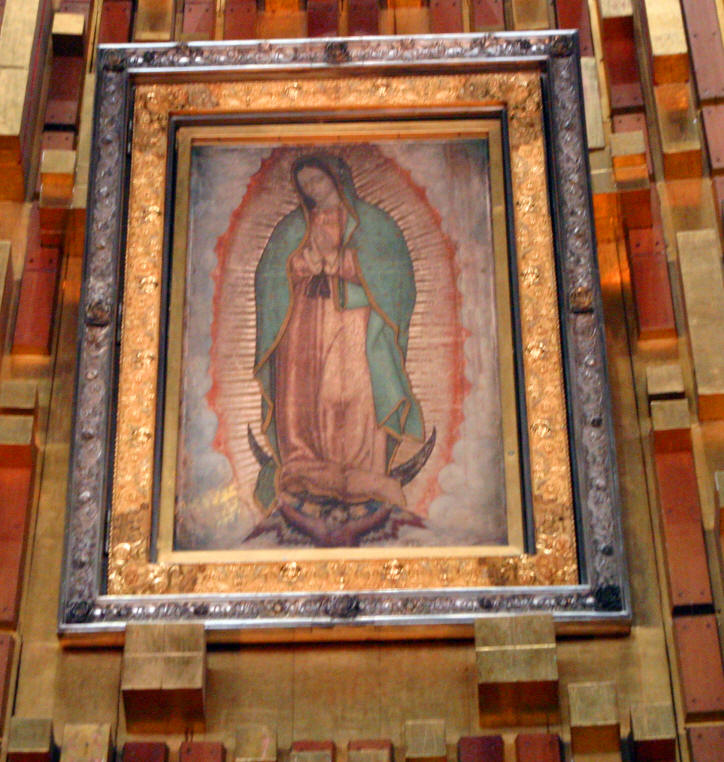
Our Lady of Guadalupe (homily)

 
There are so many things to say about this feast.

First, let’s talk about what happened on this day in AD 1531, 481 years ago.
Mary appeared to an ordinary person, 
who was, in turn, sent to the powerful, who didn’t believe the message. 

How often that is how it works! 
Think of Joan of Arc, or Bernadette at Lourdes, 
the three children at Fatima, or Gideon in the Bible, 
or Mary and Joseph themselves.

How about you? Have you ever had someone come to you,
Who maybe didn’t dress or speak well, who seemed…a little off?

Second, let’s talk about the image of our Lady of Guadelupe.

So much has been written on this, 
and I encourage you to read more about it. 

The image appeared on the cloak that Juan Diego was wearing; 
he had used it to gather up roses he found on the hill--
just as Mary said he would. 
When he came to the bishop--who asked for a sign!--
he unfolded his cloak, and there it was!

That image is on display in Mexico City. I’ve seen it.

She stands on a moon which seems to be made of snake-skin. 
That seems odd to us; however, in Juan Diego’s time, 
Mexico was under the influence of Aztec worship--of a serpent. 
That worship involved human sacrifice.

We in North America, almost 500 years later, 
see a fascinating image of our Lady. 
But the people of Mexico saw much more.

They saw God telling them they were valuable to Him.
They saw Mary, not as a European, but as someone of mixed-race.
They saw a message to reject paganism and embrace Christ.

I visited Mexico in 2008, and I was there on this feast.
It’s very hard to explain how important this event 
is to the people of Mexico.

Which leads to a final point. 
Why did our bishops make this a feast day? 
Neither Fatima or Lourdes are ranked as high as this day.

Our bishops are calling us to see ourselves 
in solidarity with the rest of the people of North and South America.

So often, those of us whose ancestors were European, or African, 
look at the people of Central and South America 
as very different people from us. Too often, we look down on them.

But we might remind ourselves that this key miracle 
didn’t happen in the United States.
God chose Mexico. Long before any settlements happened up here.

Sunday, December 09, 2012

Baruch says, get up! John says, go to confession! (Sunday homily)

We heard from the Prophet Baruch today.

Baruch was an associate of the Prophet Jeremiah.
Along with Jeremiah, he saw God’s People taken into captivity.
Everything was in ruins, including God’s Temple.

So when Baruch talks “mourning and misery,”
that’s what he’s talking about.
When he says to look up and rejoice, he knew that wasn’t easy to do.

This isn’t a joyful time for everyone.
If we’ve lost someone we love, or if our economic situation is bad,
it can be hard to be festive.

I often think of how, as a boy,
we always expected there would be presents under the tree;
and there always were.
Looking back, I marvel at the sacrifices my parents made
so we kids wouldn’t have a sad Christmas.

And then I think of parents who have to see their children not have what I had.
Out of work. Powerless. It breaks my heart.

So here’s a thought. If this is a tough time for you, know you’re not alone.

Second, if God has given you the means to help others,
Maybe help some of those families I described?
Knowing you helped lift someone else’s suffering
Is a pretty nice way to feel good, when you don’t feel good.

Something else occurred to me as I thought about Baruch.
I thought about it, this past week, after going to confession.

You do realize we priests need to go to confession too?

And I’ll confess something else, here: I was slow in getting there.
Yes—I make excuses too!

But the sacrament always works!
Having God remind me that his mercy is always greater
than the force of my sinful habits never fails to lift me up with hope.

There are folks running around to get “highs” from all kinds of stuff,
and this is free! No bad side effects!

I’ll tell you what I heard another priest told his parishioners.
If you want to give a present to a priest, go to confession!
I can’t tell you what a joy it is, especially—especially!—
when someone says, “It’s been a long time…”

To be a Christian is to have Christ be born in your heart.
And yet we know—we go back on the invitation.
We become like the inn-keeper who says, “no—no room.”
How sad and dispiriting is that guilt we feel.

Let it go! Rise up! Get up! Be filled with the glory of God!

Saturday, December 08, 2012

Little Christmas

Last night, after the Vigil Mass for the Immaculate Conception, I was reflecting on how this great feast fits in with the Advent and Christmas season. Of course, many get confused about just whose conception is being celebrated; and December 8 seems like a good time for many to put out lights or put up Christmas trees. Last night, I surprised our veteran altar server-cum-sacristan when I opted for a gold vestment, instead of a white one. But these are Marian vestments, he said; I said, nothing is too good for our Lady!

This feast is something like a "little Christmas"--even in the readings, and prayers for the day. Consider this quote from Saint Anselm, which is part of the liturgy of the hours for today:
"The universe rejoices with new and indefinable loveliness. Not only does it feel the unseen presence of God himself, its Creator, it sees him openly, working and making it holy. These great blessings spring from the blessed fruit of Mary’s womb."

So, even though we aren't directly celebrating the birth--or even the conception--of our Lord, yet this is a feast directly tied to it.

It got me thinking about something else we do this time of year. We anticipate Christmas for several weeks--we can't wait for it, and increasingly, we don't. As a result, Advent kind of gets swamped by ever-earlier celebrations of Christmas.

Not that I'm endorsing that; but in a sense, that's what happens when we celebrate this feast: and in a way, that's what we are celebrating. The glory of Christ is so great, that it shines out in all directions--even in time; so that the glory of the Incarnation shines backward in time, to the first instant of Mary's conception. The brilliant light of the Logos completely filled our Lady, so that no moment of her life was left in shadow.

Well, I'll have to continue these thoughts in the confessional! Merry (Little) Christmas!

Friday, December 07, 2012

'Our tainted nature's solitary boast' (Immaculate Conception homily)

Before going any further, I want to explain something very clearly,
because I know many people get mixed up about this.

Today, the “Immaculate Conception,” is not the conception of Jesus, our Lord.
Nine months before Christmas is March 25—the Annunciation.
That’s when we mark the conception of Jesus.

Today is Mary’s conception. Nine months before she was born.
Her birthday is September 8. Go back nine months brings us to December 8: today.

Now, the Gospel reading is confusing, because it talks about the conception of Jesus.
There’s a reason for the readings we have.
The first reading is “problem”; the Gospel is “solution.”
The first reading describes how the first Eve—with Adam, chose to reject God’s way.
The Gospel, shows the new Eve doing what the first Eve should have.
No becomes yes; sin yields to grace.

OK, but what is this “immaculate conception”?
God had long prepared for this moment.
The Old Testament is filled with foreshadowings, including the first reading:
The offspring of Eve would one day defeat the enemy.

Part of God’s plan was to prepare Mary to cooperate fully in his plan.
She still came into existence through the love of her parents, Joachim and Anne.
But what God did was to protect her, at that first instant,
from the flaw we all have, of being prone to sin.
Mary was without sin: hence, “immaculate.”

Now, several questions arise.

First, how do we know this is true?

We know it’s true because Christians have always believed it.
From the beginning, Mary was known as the “all holy” one.

We know it’s true because Scripture supports it.
Notice what the Gospel says: “full of grace.” Not mostly full, but FULL.
To be full of grace is to be exactly what Adam and Eve were, before they sinned.
To be full of grace is the antithesis of sin; it is to be full of God; full of Life.

And we believe it because it’s fitting.
Which brings us to another question we might ask:
Why would God do it this way?

Because it’s fitting that the Mother of God
should be truly free when she responds to God’s Plan.

It was fitting that she not be under the power of evil to even the slightest degree.

And it is fitting that her “yes” to God’s Plan should bring with it such a suitable gift from God.
What gift would God give her? What gift could be better?

Finally, we might ask, OK, so what does it mean to us?

Mary is the first, not the only. She is not over us; she’s ahead of us.
She is, as the poet said, “our tainted nature’s solitary boast!”
She shows us what God will do in us—if only we say “yes.”

Tuesday, December 04, 2012

Things that happen downtown on a short walk for lunch

At the Archdiocese, we either bring our lunch or go out for it. If there's an executive dining room, I haven't been invited yet. So I walked down to a place I'd passed many times, called "The Orient: Chinese-Vietnamese Food." I looked for "Pho," which is Vietnamese noodle soup; it was listed as "noodles." It's cooling now.

Walking back, I saw this old message painted on the side of a building:

THE Dennison Hotel (just that way--with the "the" all caps and italics--so there would be no confusion)...

And under that, this appealing information:

"105 rooms -- 60 baths."

A few moments later, I walked by a parking garage. The attendant was standing in front, and he asked me to stop. "Do you know a woman named Sue Jones (it was a very distinctive name, which is omitted for obvious reasons)?"

"I'm sorry, say that again please?"

"Sue Jones--do you know her?"

"Um...no; why would I?"

"Well, I've seen her around with one of you guys--a reverend."

"Well, I'm sorry, I don't know that name."

Time to eat my Pho; it's still pretty hot, though...

Sunday, December 02, 2012

The ox and the ass...


A few weeks ago, the media made a fuss over the Holy Father pointing out, in his latest book about our Lord, that there is no mention in the Gospel of animals being present for the birth of our Lord.

Oh! Crisis! We shouldn't have animals in our nativity scenes! So said the pope!

Nope.

He's just pointing out, accurately, that the Gospels aren't the source for this. So what is?

Here's the first reading for the first Office of Readings for Advent--that is, for today:

(From the beginning of the book of the prophet Isaiah...)

The vision which Isaiah, son of Amoz, 
had concerning Judah and Jerusalem 
in the days of Uzziah, Jotham, Ahaz and Hezekiah, kings of Judah. 
Hear, O heavens, and listen, O earth, for the Lord speaks: 
Sons have I raised and reared, but they have disowned me! 
An ox knows its owner, and an ass, its master’s manger
But Israel does not know, my people has not understood.

P.S. If you google "Nativity ox ass" you will see plenty of classic depictions of this from the treasury of Western art. However, you may get a prompt that I got: warning, this search may return adult content"! In my case, it did not, but fair warning!

Happy Anniversary to the new translation of the Mass!

Well, the new translation of the Mass is no longer quite so new. It's been one year since we started using it. When the Church in the U.S. was gearing up for it, many who opposed it were predicting dire consequences--none of which transpired. I particularly recall the predictions that the first Christmas, with the new translation, would be disastrous, because the return of "C&E Catholics" (who wouldn't have heard all the instructions the regulars had) would bring pandemonium.

None of that happened; the sky didn't fall, and folks are continuing to come to Mass. Some folks--such as me!--are still using helps for the Gloria and the Creed, but life goes on.

Now, let me acknowledge that the new translation isn't perfect. There are certainly some ways it could be worded better. If ever anyone in charge of such things calls (I'm not sitting by the phone), I'll be ready to offer some suggestions.

And, it is true that the prayers the priest prays are worded in a more complicated way. The reason is that the underlying Latin sentences are expressing complex thoughts. While there is a way to break up these Latin sentences into multiple English sentences--it's not hard--it also breaks up the thought. And this is an opportunity to reflect: is that really necessary? Is it wise?

After all, any priest who wishes can preach on a particular prayer, and explain the content of it. I've certainly made use of some of the Mass prayers in my homilies this past year. The prayers, being richer in content, lend themselves better to that now.

But let's acknowledge that the sentence structure is complicated. In fact, the bishops chose an expediency that I don't quite approve of; however, it was a concession in view of this complexity. Many of the prayers insert a period near the end, rendering a concluding sentence that frequently goes like this: "Through Christ our Lord" or "Who lives and reigns forever and ever."

Those are not proper English sentences; they are fragments.

But what I think is happening is that the period is functioning as a semi-colon; and it's being used, instead, so as to facilitate proclamation of the texts, for those priests who struggle with carrying through a very lengthy sentence the right emphases for subject and verb. Here's an example...

Grant your faithful, we pray, almighty God,
the resolve to run forth to meet your Christ with righteous deeds at his coming,
so that, gathered at his right hand, they may be worthy to possess the heavenly kingdom.
Through our Lord Jesus Christ, your Son,
who lives and reigns with you in the unity of the Holy Spirit, one God, forever and ever.

Now, without diagramming the sentence--which is too much work and this is a day of rest!--I will simply highlight the underlying structure of the sentence:


Grant your faithful, we pray, almighty God,
the resolve to run forth to meet your Christ with righteous deeds at his coming,
so that, gathered at his right hand, they may be worthy to possess the heavenly kingdom;
through our Lord Jesus Christ, your Son,
who lives and reigns with you in the unity of the Holy Spirit, one God, forever and ever.

OK, let's re-arrange it to simplify it:

God, grant your faithful the resolve to meet Christ at his coming,
so that they may possess the kingdom through Jesus your Son...etc.

Now, don't misunderstand: I'm not suggesting that the omitted words don't matter; I'm simply using a simpler way to show the basic structure of the sentence. But go back to it now, and try reading the prayer aloud, giving emphasis to the bolded terms; and notice I changed the period to a semi-colon.

Does that work better? It does for me at least.

Here's another example. This prayer is used at every Mass, so I've had lots of time to think about it.

Lord Jesus Christ, who said to your Apostles:
Peace I leave you, my peace I give you;
look not on our sins, but on the faith of your Church,
and graciously grant her peace and unity in accordance with your will.
Who live and reign for ever and ever.

Now, at first this prayer's wording bothered me, well before I got to the fragment at the end. But praying it day by day, I figured out what it's saying, and thus how to proclaim it. Let's see if some playing around with the word-order or the punctuation, I can show you what I saw.


Lord Jesus Christ, who said to your Apostles, "Peace I leave you, my peace I give you":
Look not on our sins, but on the faith of your Church,
and graciously grant her peace and unity in accordance with your will.
Who live and reign for ever and ever.

Let's re-word it for clarity:

Lord Jesus Christ (who said thus-and-so), don't look at our sins, but at our faith, and grant your Church peace and unity according to your will...

Whoops, what about that last part? How do you fit it in?

Well, in reality, if this idea were originating in English, I don't think we'd ever end up with this sort of sentence; we don't say things this way. But Latin-speakers did. What's happening is this: a statement about the Lord--who is mentioned right up front--is being saved all the way to the end. We just don't do that in English; it's too complicated a sentence. So how might we write it, if we composed this in English?

Maybe this way:

Lord Jesus Christ--you live and reign forever and ever!
You said to your Apostles, "Peace I leave you, my peace I give you";
Look not on our sins, but on the faith of your Church,
and graciously grant her peace and unity in accordance with your will.

Now, maybe that would have been better in one regard, but it makes the prayer awkward in another way; I suspect that by putting the flourish of "forever and ever" up front, the idea being expressed--the actual thing being asked for--is not highlighted. One advantage of concluding with, "who live and reign forever and ever" is to emphasize that all things originate in our Lord, all things happen in him, and are complete in him. He is the first and the last, the beginning and the end. The old translation would frequently say, "for you live and reign forever and ever"--and, while others who are more expert in this area may have some good arguments to add here and correct me, I think that was a reasonable way to handle this.

But it's not the end of the world. One advantage of the new prayers is that, while they are chock full of content, they are expressed with a certain economy of words. Some of the awkwardness could be fixed by starting new sentences that refer to ideas expressed in the prior sentence; and the prayers could conclude--as they often did in the old translation--with, "We ask this through our Lord Jesus Christ..." etc. Again, that "we ask this" wasn't itself a terrible feature of the old prayers, but in adding some clarity and flow, it flattens the grandeur of the statement somewhat.

I am finding that if I spend some time thinking about the prayers before proclaiming them--and in the case of those I use daily, I am thinking about them while I proclaim them--then the idea being expressed becomes clear. No question, some of the ideas are complex--but that's the nature of the Roman Mass.

Remember: these are the prayers that were produced by those directed by Pope Paul VI to carry out the reforms called for at the Second Vatican Council. This point cannot be stressed too much: translating these prayers accurately means accurately implementing the Council's plans. The "concilium" of experts who did all this work could, after all, have restructured the prayers more than they did; they chose not to. Shouldn't we respect their work?

Meanwhile, I think there is so much more meaning and clarity in the new translation that these adjustments are well worth it.